
News · Policy · US
Kevin Warsh, 148 Days In, Treats A.I. as a Shock Before It Is a Gain
In Bangkok, the Federal Reserve chairman told the I.M.F.'s Kristalina Georgieva where he thinks he has fallen short, why the A.I. boom pushes up demand before it adds supply, and why he won't say what the Fed does next.
For information only. Not investment advice. Disclaimer · Special coverage: IMF–World Bank Annual Meetings, Bangkok
AI-generated summary, reviewed by the editor.
- In Bangkok, Warsh told the IMF's Kristalina Georgieva that AI raises demand before supply, a shock a central banker must recognize, and that he does not prejudge meetings.
- He said he has spent too much of his 148 days on interest rates and not enough on the Fed's supervision and payments staff.
- The Fed raised its benchmark rate to 3.75% to 4% on Sept. 16, unanimously, and 16 of 18 officials expect at least one more increase this year.
It restates the article and adds no new facts. How we use AI
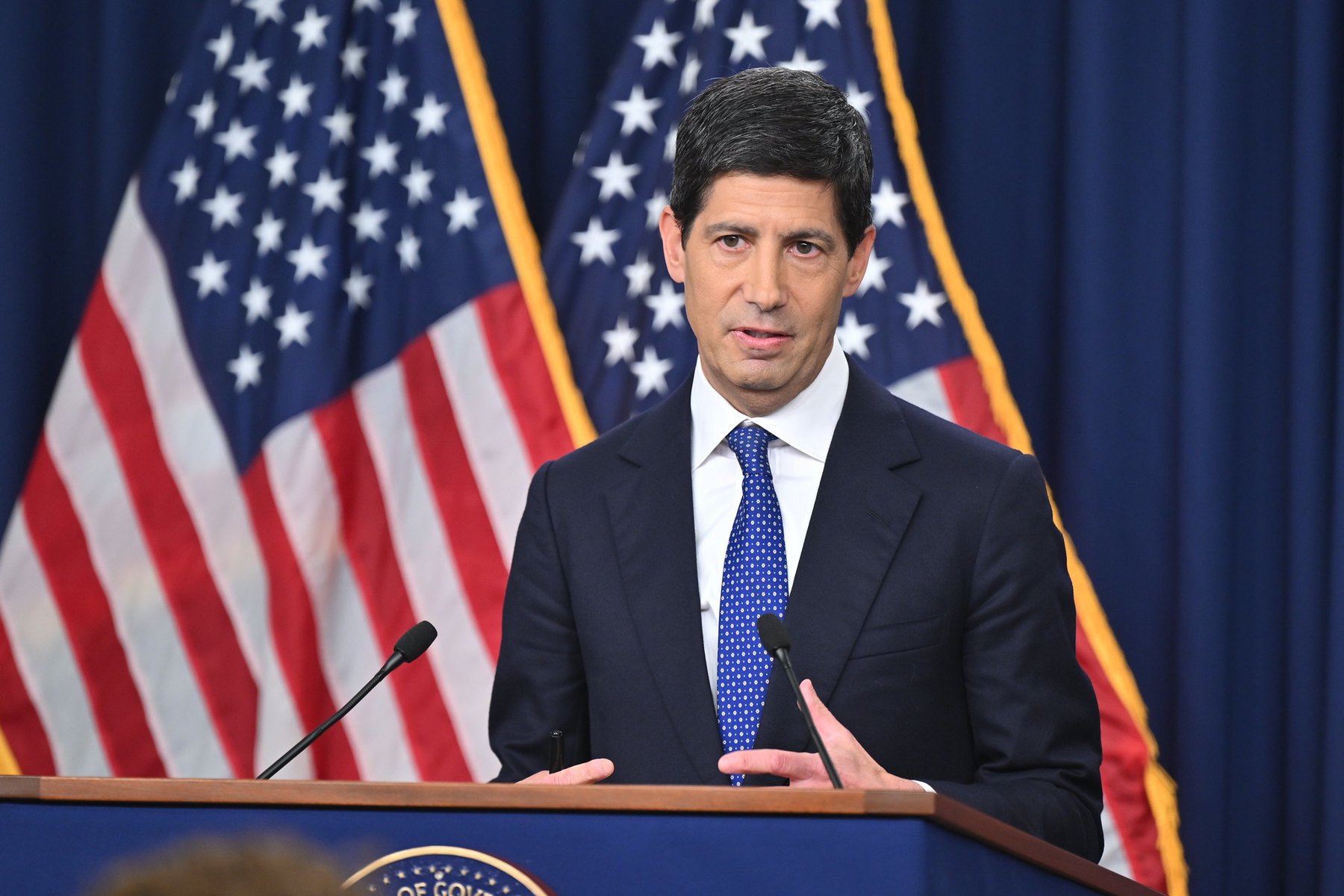
Bangkok · Kevin Warsh has been chairman of the Federal Reserve for 148 days. On Friday, in front of an audience here, he said where he thinks he has fallen short.
He has spent too much of that time on interest rates, Mr. Warsh said. Most of what the Fed does has nothing to do with them. The staff who run bank supervision, payment systems and consumer affairs have not heard enough from him that he cares about their work. He said the moment he took over had probably pulled him that way, along with the cameras, which follow monetary policy and little else.
"The head of the Fed needs to be the head of all parts of the Fed," he said.
He made the admission in a public conversation with Kristalina Georgieva, the managing director of the International Monetary Fund, at the fund's annual meetings, which run Oct. 12 to 18 in Bangkok [1]. He opened with a "full disclosure": the two are old friends. Later he said her questions were more cordial than the ones he gets at his own press conferences, and joked that he might invite her to the next one.
The conversation ranged widely, but centered around a key theme.
Mr. Warsh sees an American economy carried by an investment surge, much of it in artificial intelligence, and expects the technology to make countries richer. He also says it is raising demand now, long before it raises supply, and that a central banker has to treat that as a shock. Ms. Georgieva described the same moment from the other side: economies lifted by A.I. enthusiasm, economies dragged down by war, and prices that will not settle in either.
Mr. Warsh offered no hint of what the Fed will do at its next two meetings, on Oct. 27-28 and Dec. 8-9 [4]. "I don't prejudge meetings," he said.
Mr. Warsh, 56, took the job after a confirmation fight over the Fed's independence [3]. The Senate voted 54-45 on May 13, mostly along party lines, with Senator John Fetterman of Pennsylvania the only Democrat in favor [2][3]. He was sworn in on May 22 [3]. His predecessor, Jerome Powell, who had led the Fed since 2018, broke with tradition by staying on the board and keeping his vote, and said he would keep a low profile [2].
The fight was about independence.
The Trump administration's pressure on the Fed included a Justice Department criminal investigation of the central bank. Senator Thom Tillis blocked a committee vote in protest and relented only after a U.S. attorney agreed to drop the inquiry [2]. Senator Elizabeth Warren called Mr. Warsh the president's "sock puppet." He denied it and promised to use his own judgment [2][3]. In December 2025, Mr. Trump had said he would appoint only someone who agreed with him on cutting rates, and media reported that Mr. Warsh, who opposed cuts under President Biden, changed his position after Mr. Trump took office [3].
Then he raised them.
On Sept. 16, the Fed's rate-setting committee voted unanimously to lift its benchmark rate by a quarter point, to a range of 3.75% to 4%, the first increase since July 2023 [4][5]. "The plain fact is that inflation is too high," Mr. Warsh told reporters that day [4][5]. The committee's statement said inflation "remains elevated" and that the increase would support a "timelier return" to its 2% target [5]. In projections released with the decision, 16 of 18 officials expected at least one more increase this year [5]. KPMG's summary of the meeting says Mr. Warsh did not take part in the projections exercise. "Those aren't my forecasts," he said [5].
On Friday he described the move in five words. The Fed, he said, had "removed a dose of accommodation."
Key dates in Kevin Warsh’s first months as Federal Reserve chairman
- Last previous increase in the Fed’s benchmark rate
- Senate confirms Warsh as chairman, 54-45
- Warsh is sworn in
- Fed’s rate-setting committee votes unanimously to raise its benchmark rate a quarter point, to 3.75% to 4%. In projections, 16 of 18 officials expect at least one more increase this year
- In Bangkok, Warsh says the Fed “removed a dose of accommodation” and declines to prejudge the next meetings
- Next Fed meeting
- Following Fed meeting
He came to the job knowing the institution.
Mr. Warsh served on the Fed's board from 2006 to 2011 and worked as a liaison between the central bank and Wall Street during the financial crisis [2]. Ms. Georgieva noted he was the youngest governor ever, at 35, and said he saw the crisis from the inside. "I do not wish to repeat this experience," she said. Mr. Warsh said he still carries "a little bit of scar tissue from the deepest, darkest days of the global financial crisis."
Ms. Georgieva asked how monetary policy should think about A.I., now and later. Mr. Warsh called it probably the most consequential change to the U.S. and global economy in his lifetime, and said he takes it "seriously, but as a central banker, also soberly, responsibly."
His answer had three parts. The first is timing.
The technology is "hitting the demand side of the economy before it's going to hit the supply side," he said. In the medium term he calls it a positive supply shock. "But on the path to net positive supply shock we're seeing increases in aggregate demand," he said. "That just is what it is." For a central bank charged with stable prices and full employment, he said, "you've got to recognize this as a shock."
He separated it from the shocks that war brings. This one, he said, carries "a huge benefit" to the global and U.S. economies over the horizon.
The second part is understanding the known unknowns.
He cannot say what A.I. will do to employment in the next 12 to 18 months. He cannot say who will own the profits. "Who's going to get to make the money?" he asked, and what happens to the companies that bet they would, if the market structure does not allow it? The route from here to the gains, he said, is likely to be "a very bumpy one." It is not the Fed's job to pick winners. "That's what financial markets are for doing."
The third is where the Fed draws its line.
Central banks, he said, should not be in the business of stopping every deviation from the most likely outcome. They should ask whether there are negative tail risks they can do something about, and be "pretty humble" about the answer. He said he has asked a task force to examine the upsides and the downsides.
Mr. Warsh contrasted all of this with the mood of two decades ago.
At meetings like this one, he said, officials talked about secular stagnation, the idea that slow growth was close to inevitable. Now, he said, the United States has an investment surge, and it is broadening beyond A.I. "Policy matters," he said. He credited a combination of macroeconomic policy and strong microeconomic foundations, and pointed to what audiences had heard in recent weeks from new Nobel Prize winners.
The exchange also touched on what to call the technology.
Ms. Georgieva, wary of what she called a linguistic controversy over how to pronounce the letters, proposed N.H.I., for non-human intellect.
The fund Ms. Georgieva runs supplied the backdrop that week. Its October forecast puts global growth in 2026 at 3.1%, a touch above its July estimate, and global headline inflation at 4.7% [6][7].
The same summaries describe an economy pulled in two directions.
One says accelerating investment in A.I. infrastructure has been a decisive factor in holding up growth, and that the war between Israel and Iran has weighed on it [6]. Another reports oil prices above $100 a barrel, a baseline that assumes an average of $96 this year and a reopening of the Strait of Hormuz in March 2027, and a gap between winners and everyone else: 32 countries account for 95% of global growth, down from 54 in the April forecasts [7]. That source also reports an I.M.F. downside case in which expected A.I. productivity gains fail to arrive, leaving global output 1.1% lower by 2028 [7].
In her opening speech to the meetings, Ms. Georgieva named three challenges: the rapid expansion of A.I., persistently high energy prices, and record public debt [1]. On stage with Mr. Warsh she began with what she called the fragility of the world economy's resilience, and the divergence between countries.
He said the resilience surprised him.
If she had asked him five or six months ago to forecast how members of the Group of 20 would be doing, given the hot spots in geopolitics, he would not have predicted that so many were holding up, he said. He would have said it of the United States, but not of so many others.
A.I., Mr. Warsh said, will change the Fed's own work. Central bankers try to separate real inflation trends from noise and lagged statistics, and he described how: "We torture data with old fashioned models to try to find out what's underlying inflation trends." He expects that to change. "Not so long from now, it won't be torture," he said, because central banks will have analytical tools to sort the data and more confidence in what it says about whether a number is real or mismeasured.
He has also tried to build thinking the committee does not already have.
About four or five months ago, he said, he started a set of outside task forces, five in all, including one on productivity and jobs and one on collecting inflation data. The productivity group will hold its first field hearing on Nov. 16 in the San Francisco Bay Area. He said he checks in on each one periodically, but mostly lets them work, so that they hand the Federal Open Market Committee new ideas and the committee and its peers are not left pushing the same ones around.
"I'm pretty sure I've got the right questions," he said. "I'm not sure I have the right answers."
He called the work "global public goods" and said he hopes the I.M.F. and other Group of 20 central banks will adopt some of it.
Asked what he has learned in 148 days, Mr. Warsh began with the staff. He had worried, after 15 years away, that the talent might have left. It had not. He described a workforce he put at roughly 23,000 people, proud of the institution, and challenging one another beneath what looks from outside like a single script.
The second lesson was the one about his own focus.
The Fed's power, he said, comes from its institutional credibility, which he credited to the chairman before him, and less from the printing press, a "powerful tool" he teased his fellow central bankers for loving. A stumble in supervision or payments reflects on that credibility as much as a rate decision does. He said he will give those areas equal attention over his next 100 days.
Asked what the 17th chairman might be remembered for, he declined. "I'm not in the legacy business," he said. He recalled being sent, as a 35-year-old nominee, to meet Paul Volcker by a senator on the Banking Committee who thought he looked young. He said he has known or worked with his five immediate predecessors, and credited Mr. Volcker, Alan Greenspan and Ben Bernanke with changing the Fed to fit their moments. "They met the moment of their times," he said. None of them, he added, had a perfect record.
Then he looked forward.
"There's no status quo ante to return to," Mr. Warsh said, and the world "is changing faster than at any point in my adult life." He hopes, he said, that his remaining three years and eight months or so are "nothing but benign." He described his method as looking out the window: the Fed does it eight times a year, he said, and in his Jackson Hole speech he called the first job "to interrogate reality." The meeting in September had reached a judgment. In the month since, he said, "the world has broadly conformed to our expectations."
The other thing he heard at the meetings was that inflation is not an American problem alone.
Each central bank acted under its own mandate, he said, and the result was a tightening of policy in most places at about the same time. "There's no free riders," he said. Ms. Georgieva said a shared commitment to price stability gives businesses and households the confidence growth needs, and called it one of the big messages of the week.
Mr. Warsh closed by thanking his colleagues and the staff for what he called a remarkable openness to new ideas. He said he prefers frameworks to regression models, and that the phrase he does not want to hear at the Fed is that this is how things have always been done. [His exact words on models are garbled in the transcript; this is a paraphrase.]
He ended on a forecast he allowed might sound naive.
"I believe optimistically, you might think naively, at least in the US, we're going to come out of this stronger," he said. "So it's not zero sum."
Sources
Quotes and remarks from the Oct. 16, 2026 conversation come from the supplied transcript. Background came from the pages below, which I opened. None was checked against a primary document.
- IMF and World Bank Annual Meetings Open in Bangkok Amid Global Economic Risks, Morocco World News
- Senate confirms Kevin Warsh as next chair of the Federal Reserve, NPR
- Kevin Warsh sworn in as new US Fed chair, Al Jazeera
- September FOMC: Federal Reserve hikes interest rates for first time since 2023, Fox Business
- Warsh asserts Fed's independence, KPMG
- IMF Raises 2026 Global Growth Forecast to 3.1%, Mumbrella Asia
- IMF Forecasts 3.1% Global Growth in 2026
Comments
Sign in with LinkedIn to join the discussion. Your LinkedIn name and photo appear publicly beside your comment. Please keep it civil and on topic.