
News · Rates & FX · US
The Fed Hasn’t Said It Is Done.
The Federal Reserve held rates steady six days before the midterm elections despite two dissenters. Its December move depends on oil, artificial intelligence, and on a data release due this morning.
For information only. Not investment advice. Disclaimer
AI-generated summary, reviewed by the editor.
- The Fed held its rate at 3.75% to 4% on a 10 to 2 vote, two dissenters wanting a quarter-point increase, as September consumer prices rose 3.7%.
- Icarus Asia's model puts 75% odds on a quarter-point increase at the December meeting and 10% on a half-point or more; the firm calls them model outputs.
- Warsh said financial conditions are tighter but not tight; a Boston Fed paper finds oil shocks hit jobs far less than in the 1970s.
It restates the article and adds no new facts. How we use AI
Figures as reported
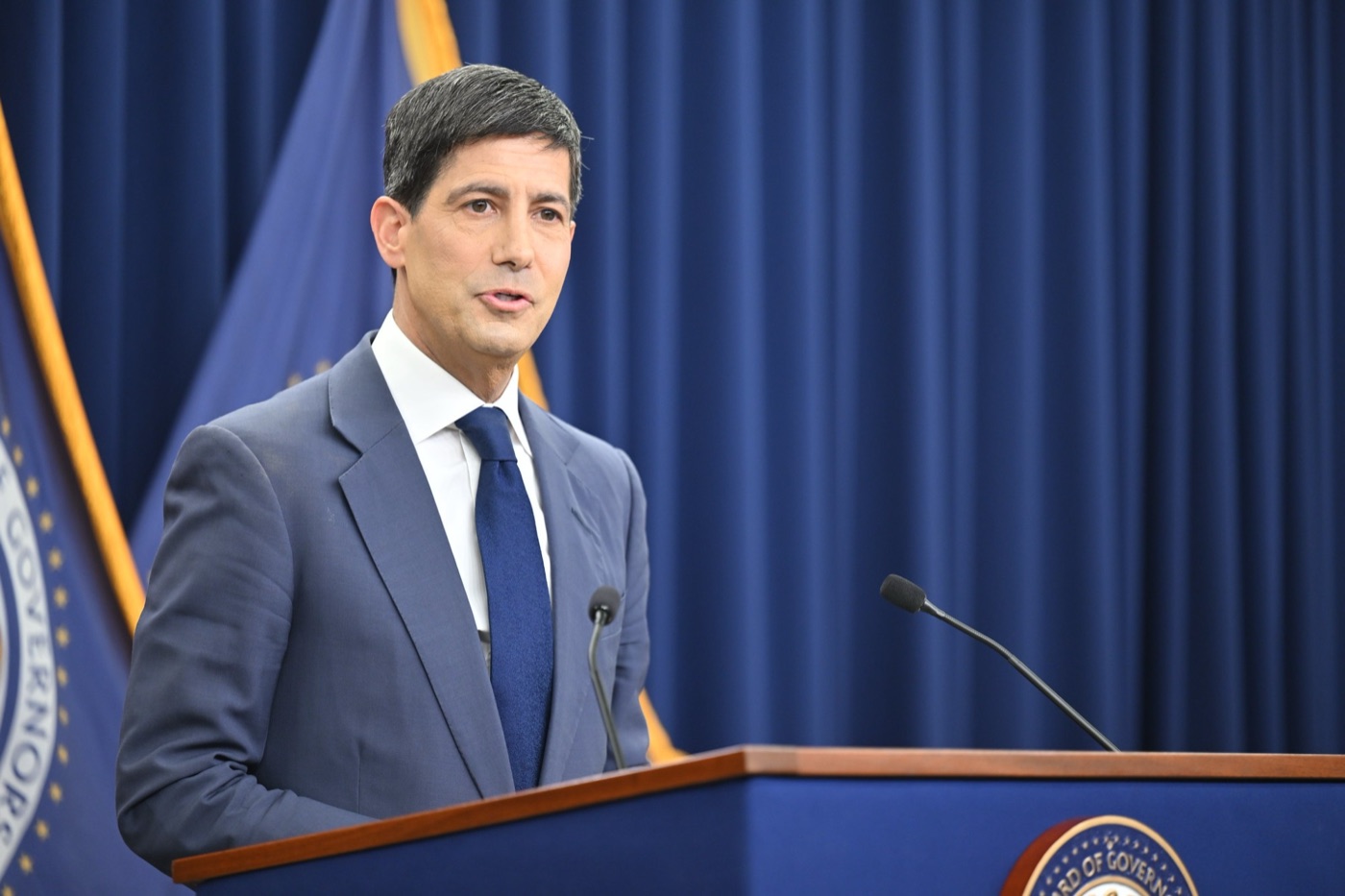
Kevin Warsh took the podium at 2:30 p.m. Wednesday to explain a decision almost no one had doubted, and ended up describing a fight. The Federal Reserve had held its benchmark rate at 3.75% to 4%, a result markets had priced at better than 90%. But the vote was 10 to 2, and the chairman told reporters the committee had “just come out of a family fight, a serious, sober discussion.”
The two dissenters wanted a quarter-point increase. Beth Hammack, president of the Cleveland Fed, had dissented in April and July as well. Lisa Cook, a governor, was breaking with the majority for the first time in more than four years.
The pause followed the Fed’s first rate increase since July 2023, a unanimous 25-basis-point move on Sept. 16, the first under Warsh, who was sworn in as chair on May 22.
This week’s statement did not read like the statement of a central bank that had finished. It raised its description of growth from “solid” to “strong.” It said inflation remained elevated. Its stated reason for waiting was that the committee wanted “the accumulation of more information.”
The prices are not waiting.
Consumer prices rose 3.7% in September from a year earlier, up from 3.4% in August. Wholesale prices jumped 6.3%. Brent crude traded near $110.80 a barrel on Tuesday, against $72 before the Iran war began in late February. The 10-year Treasury yield was just above 5%. The average 30-year mortgage rate was 7.32% last week, compared with just under 6.2% a year earlier.
September’s PCE inflation report, the Fed’s preferred gauge, is due at 8:30 this morning in Washington. Forecasters expected the headline figure to rise 0.5% for the month and 3.7% over twelve months, from 3.4% previously.
Icarus Asia’s proprietary model puts a 75% probability on a quarter-point increase at the Dec. 8–9 meeting, and another 10% on a half-point or more. It gives a one-in-four chance that the Fed delivers at least 100 basis points of cumulative increases by the end of June 2027.
So the pause bought the Fed one thing, which was time to look at more numbers. The first one in the batch comes out in a few hours.
A Hold in a Hawk’s Vocabulary
Read without the vote count, the statement sounds like a committee that is about to raise rates.
It found no weakening in activity or employment that needed protecting. It kept its language on “robust” investment and strong productivity. The one word that changed in the decision was the verb, from “raise” to “maintain.”
Warsh’s case for waiting is interesting reading.
A quarter-point increase takes months to work through spending, hiring and pricing, he argued, and some of the work was already visible: financial and credit conditions had tightened for some businesses and households.
“While overall financial conditions are tighter, I’m unwilling and unable to call them tight.”
Kevin Warsh, Fed chair
“Monetary medicine is starting to work,” he said, describing the committee’s “overwhelming judgement.” Then came the qualifier that matters most. “While overall financial conditions are tighter, I’m unwilling and unable to call them tight.”
Tighter is not tight.
That distinction is a test the committee is running on itself: whether September’s increase, plus a market-driven rise in borrowing costs, will cool demand enough without another vote. The logic is defensible but not yet evidence that policy has become restrictive.
The logic is defensible but not yet evidence that policy has become restrictive.
There is a second argument, about productivity, and it is the one economists on both sides of the table keep returning to.
If an economy’s capacity is expanding quickly, strong growth does not mean the same thing it meant in 2022. The statement paired “strong” activity with strong productivity on purpose. Whether the pairing holds is the question the next several months will answer.
The weak point in the majority’s case is the inflation data, which has not cooperated.
Michael Feroli of JPMorgan made the point about consistency. The committee raised in September after an August core PCE reading of 0.2%, then held with September core PCE expected at 0.3%. One month should not decide policy, Icarus Asia’s research note says. But the contrast leaves the Fed with a harder explanation to give.
The pause was telegraphed.
There was “no need for urgency,” said John Williams, president of the New York Fed, after September’s increase. Vice Chair Philip Jefferson said he and his colleagues “will need to come to our own judgment, which may take more time.” Goldman Sachs read this as an every-other-meeting rhythm of tightening.
Hammack and Logan, the Dallas Fed president, had said publicly that rates were not yet high enough, and before the meeting as many as three officials looked like possible dissenters. Two dissented.
The committee had “just come out of a family fight, a serious, sober discussion.”
Kevin Warsh, Fed chair
The labor numbers are murkier.
Employers added 29,000 jobs in September and unemployment rose to 4.2%, according to official data, a softer picture than the committee’s own statement, which said unemployment had changed little.
Warsh used the same afternoon to change how the Fed schedules itself.
Starting in 2027, the Fed will set aside one of its eight annual meetings for strategy, with no rate vote and no policy statement, and by 2028 two will be. “Eight meetings per year is the right number,” he said. Asked what the Fed would say after a strategy session, he said it was “not obvious yet.”
Inflation is reaccelerating, with persistence risk, the research note says. It is not yet “runaway.”
Six Days Before the Vote
The meeting ended Wednesday. The midterms are Nov. 3. Warsh rejected the suggestion that the timing mattered.
“Politics played no role in the decision,” he said.
He added that he had heard no discussion of politics or elections in the committee’s deliberations. That is the chairman’s account, not independent verification of what motivated each of the twelve voters.
The public record leans his way on two counts.
First, the Fed had already raised rates in September, over objections that were not subtle. In the ten days before that meeting, according to an account carried by SimianX (a single source), Trump, the vice president, the Treasury secretary and senior economic advisers all said publicly that the Fed should not hike.
Trump posted that “high interest rates put the U.S.A. at a very unfair disadvantage.”
Asked about the president at his press conference, Warsh said, “I’ve got nothing for you on a discussion with the president,” and that “Independence is a two-way street.” The vote was 12 to 0. Trump later said that he had told Warsh he “might as well” vote for a hike.
Second, the pause was signaled in advance. Williams and Jefferson had both said as much in the weeks before.
The counterargument is not that anyone saw a ballot with a thumb on it. It is that a hold this close to an election, with inflation at 3.7% and growth described as strong, invites a particular suspicion.
The counterargument is not that anyone saw a ballot with a thumb on it. It is that a hold this close to an election, with inflation at 3.7% and growth described as strong, invites a particular suspicion.
The Fed “doesn’t want to poke the White House in the eye,” economist Joseph LaVorgna said before the meeting. Feroli went further on the communication risk, warning that a hold left inadequately explained less than a week before voting would encourage suspicion that something other than employment and inflation was steering policy.
A sensitivity to elections is plausible as a marginal influence. The information-gathering explanation remains the primary narrative supported by the official statement and the chair’s account.
A December increase would not prove October was political, either, because it would come after another month of inflation, jobs and financial-condition data. To find that October was political, someone would need evidence of what the committee would have done with identical data and no election. The public record does not contain it.
There is a stranger part of the story, and it involves one of the two dissenters.
On Oct. 9, Trump announced a three-person committee to investigate mortgage fraud allegations against Cook. Trump alleges she listed a Georgia condo and a Michigan house as her primary residence on 2021 mortgage applications. Cook disputes the claim, and other financial records appear to contradict the administration’s account, according to SCOTUSblog’s summary. The committee is Kevin Hassett, Andrea Lucas and Keith Sonderling. The White House has scheduled a closed hearing for Nov. 5, two days after the election. The Supreme Court blocked Trump’s first attempt to fire Cook on June 29, ruling 5 to 4 that she could stay in office while her challenge continues. The chief justice wrote that the president “failed to afford Cook the procedural protections to which she was entitled by statute.”
So the governor the White House is trying to remove voted this week to raise interest rates. No document in the public record says whether one fact has anything to do with the other. The research note says only that the official record establishes the dissenters’ policy preference and not their motives.
What the Fed can control is the part it chose not to.
Warsh does not believe in forward guidance when the economy is this strong, and he has said he will not prejudge meetings. There is a difference between declining to promise a rate path and declining to explain the conditions under which that path would change.
An unchanged rate, a stronger growth assessment and worse inflation look inconsistent unless someone explains why waiting improves the expected outcome. Clear conditional language could reduce election speculation without tying the committee’s hands.
The Problem Is Not at the Pump
Brent crude was about $72 a barrel before the Iran war began in late February. On Monday, according to market data, it fell more than 6% from about $117.40, its highest close since March 19, as diplomacy appeared to gather pace. By Tuesday it was near $110.80. Gasoline has been above $4 a gallon for three months and accounted for more than half of September’s rise in consumer prices, according to the Labor Department. Diesel hit a record $6.53 a gallon in late September.
Those are the numbers a driver sees. The Fed’s concern is with what happens after the driver adjusts.
A Boston Fed paper published June 4 estimated that the Iran conflict produced a real oil price shock of about 33%, roughly half the size of the 1973–74 embargo or the 1978–80 Iranian revolution. Before the mid-1980s, a shock that size would have added about 2.2 percentage points to PCE inflation over the following year. Today the estimate is about 1.5 points, though the authors called it highly uncertain. The link to core inflation, which strips out food and energy, is much weaker.
The paper’s most consequential finding was about jobs.
In the 1970s, a shock this size was associated with a drop of about 1.8 points in employment growth. That effect has largely disappeared, and effectively vanished around 2010, when domestic oil production expanded sharply. Texas, the paper estimated, would have employment growth about 1.7 points higher than the average state twelve months after a 33% shock. Massachusetts would be about 0.4 points lower.
The authors drew the policy conclusion in plain terms. If oil shocks no longer cause much of a slowdown, there is less disinflation to wait for, and monetary policy should focus on the inflation effects rather than the employment effects. They called their results statistical associations, not causal estimates.
A Kansas City Fed bulletin published July 8 reached a related conclusion by a different route.
Andrew Glover, a research and policy adviser at the bank, found that since 2010 oil shocks have raised inflation more persistently than unemployment. After a shock like the recent one, with WTI up more than 50% following the start of the conflict, unemployment rises about 1 percentage point and normalizes within three months. PCE inflation takes more than two years. Household inflation expectations rose and returned to normal only after the Fed tightened. Glover wrote that anchored expectations “may be the outcome of monetary policy’s response to oil shocks” and not something that can be assumed.
He was careful, though. His estimates do not show what would have happened without tightening. And he noted that the persistence of the current oil price rise was uncertain, since WTI had fallen after a U.S.-Iran memorandum of understanding in late June. Four months later, Brent is above $110.
Figures as reported in the Boston Fed and Kansas City Fed papers
Vigilance is supported. The claim that every oil shock requires an immediate hike is not. Nor is the claim that tightening alone caused expectations to settle. What the evidence does support is that repeated energy increases change how firms and households set prices and wages, and that the point of rate increases in such a case is to limit that behavior.
The Boston Fed adds a warning of its own.
Higher oil prices can raise inflation and weaken demand at once, because they erode what households can buy, and the paper notes that such erosion has often preceded downturns. The Fed’s answer depends on which effect wins.
A Boom That Pays Its Bills Before It Delivers
Earlier this month, at the International Monetary Fund’s meetings, Warsh was asked about artificial intelligence. “If you’re a central banker … you’ve got to recognize this as a shock,” he said. On Wednesday he said capital spending was “not just strong, but it is broadening” across sectors.
Read furtherKevin Warsh, 148 Days In, Treats A.I. as a Shock Before It Is a Gain
“If you’re a central banker … you’ve got to recognize this as a shock.”
Kevin Warsh, on artificial intelligence
The Fed’s statement had already described investment as “robust” and productivity as strong. Those two phrases pull in opposite directions, and the whole AI argument lies between them.
The investment shows up first.
A data center needs concrete, transformers, skilled electricians and a connection to a grid that was not built for it. All of those are bought now, from suppliers who cannot expand overnight. The productivity gains, if they arrive, come later and unevenly. In between, the spending competes with everyone else for scarce capacity.
Alphabet, Amazon, Meta, Microsoft and Oracle were on track to spend $741 billion in 2026, up nearly 75% from the year before, according to FactSet, as reported by the Wall Street Journal. Wage growth for electrical contractors was 6.5% in April, nearly double the rate for all private-sector workers. Wholesale electronic components jumped about 27%. Goldman Sachs projected that data centers would account for nearly half of U.S. power demand growth through 2030, and that consumer electricity prices would rise about 6% a year in 2026 and 2027.
Eighty-one percent of business economists surveyed by the National Association for Business Economics expected the buildout to add to inflation over the next year.
Gregory Daco, chief economist at EY-Parthenon, argued that the early phase of a technological revolution tends to strain limited resources and push up prices. UBS economists said the gap between the building boom and any price relief from AI would take at least a couple of years to close.
Figures as reported
None of that makes AI inflationary in itself. The issue is sequencing, and the Fed’s own emphasis on strong productivity is a reminder that the supply response may already be meaningful. The question is whether it is large enough and fast enough.
Should the largest projects be assumed immune to higher rates?
Warsh himself said that interest rates had affected investment choices, with more discrimination among projects and wider credit spreads for certain assets. He argued that capital spending strength was broadening beyond a small group of sectors.
A well-funded hyperscaler building a flagship campus is less sensitive to a quarter-point increase than a homebuyer or a small business. If that is right, then each additional hike may restrain the rest of the economy before it touches the part that is overheating. This is a transmission risk, not evidence that policy cannot reach AI spending.
Mortgage rates at 7.32% are already doing their work on housing. The data centers are not waiting on a mortgage.
Mortgage rates at 7.32% are already doing their work on housing. The data centers are not waiting on a mortgage.
Then there is the question of how oil and AI interact. The two shocks transmit differently through the economy.
Energy raises costs and threatens second-round effects on wages and expectations. AI construction brings forward demand before capacity and productivity arrive. Either one alone would not make the accelerated scenario, the note says. The danger is a chain: repeated energy increases prolong cost pressure, resilient investment sustains demand, infrastructure bottlenecks limit the supply response, productivity falls short of what is needed, and price-setting and expectations begin to adjust.
In that chain, strong demand makes it easier for firms to pass costs along. That reduces the chance that an energy shock destroys enough demand to cure itself. It is the scenario in which the Fed’s October patience would turn out to have been expensive.
Who Pays if the Pause Was a Mistake
In the United States, the borrowers will be the first to pay for a misstep.
The average 30-year mortgage rate hit 7.4% in early October, a three-year high, and was 7.32% last week. A year ago it was just under 6.2%. Gasoline has been over $4 for three months. The 10-year Treasury yield, which prices everything from mortgages to corporate bonds, was 5.02% before the decision and rose about 2 basis points to roughly 5.04% after Warsh spoke, according to market data. Stocks rose slightly. The dollar slipped against the euro. Oil climbed. One trading-desk summary called the reaction muted.
That combination is awkward to read.
A hawkish shock would normally lift the dollar. The October moves do not confirm a conventional hawkish surprise, and they do not prove a credibility event either.
A rising long-term yield can reflect expected short rates, inflation compensation, real rates or a term premium, and nominal yields alone cannot say which. Readers should look at the front end of the curve, real yields, inflation compensation and the dollar together, rather than treat a long-end selloff as one signal.
The path the note describes has three versions, and they hurt differently.
A higher eventual peak for the policy rate means higher expected short rates over a longer period, support for the dollar if U.S. yield advantages widen, and more persistent refinancing costs in Asia. A faster tightening path means sharper repricing at the front end and stress on anyone with short-duration liabilities or unhedged dollar borrowing. A credibility or term-premium shock means long yields rise past what near-term policy expectations explain, with an ambiguous dollar effect and losses on long-duration assets. Or in other words, higher yields need not strengthen the dollar.
Asia has been through part of this already.
By June the yen had weakened past 160 per dollar, its weakest since July 2024, and the Indonesian rupiah was at an all-time low, below its levels in the 1997–98 crisis, according to Asia Times. The Indian rupee was near 95. “The dollar is king while this conflict lasts,” Carol Kong of Commonwealth Bank of Australia said then.
The country-level picture, as MUFG described it in a Sept. 11 note, runs along a fault line.
Currencies backed by strong external balances, including the Korean won, Taiwan dollar, Singapore dollar and Malaysian ringgit, were seen holding up better. The Thai baht and Indian rupee were described as vulnerable. With Brent above $100, net energy importers such as Thailand, the Philippines and India faced a negative shift in their terms of trade, while Malaysia and, to a lesser degree, Indonesia as net commodity exporters might get some offset.
Dollar funding matters more than a regional label.
Borrowers with near-term refinancing, floating-rate debt, unhedged currency exposure or thin dollar revenue are the most exposed to a faster Fed, and a peak reached gradually creates a different liquidity problem than the same peak reached quickly.
An oil shock and a rates shock can reinforce each other in energy-importing economies, because if higher energy costs coincide with a falling currency, policymakers may face weaker demand alongside imported inflation, with less room to offset either. And exposure to AI-linked growth is not protection from tighter money. Suppliers can benefit from investment demand and still be exposed to higher discount rates, concentrated customers or delayed projects.
MUFG made a related point about liquidity.
A possible 25-basis-point rate rise by the Bank of Japan, combined with elevated U.S. yields, implies tighter global liquidity and would remove one of the world’s cheapest sources of funding, raising the risk that yen carry trades unwind. The Bank of Japan had raised its rate to 1% in June, a 31-year high, according to Pesek.
The direction and size of any currency or asset move will depend on local policy credibility, external balances, hedging, and the reason U.S. yields are rising.
That last variable is something no one can call.
Two Ways to Be Wrong
The Fed’s next decision is Dec. 8–9, and every serious estimate says the direction is up. The argument is about how fast, and how far.
For December, there is a 15% chance of another hold, 75% for a quarter-point increase, and 10% for a half-point or more, according to Icarus Asia’s proprietary model. That makes 85% for some increase.
Chance of any December increase in the model: 85%.
View data
| Outcome | Probability, % |
|---|---|
| Hold | 15 |
| Quarter-point hike | 75 |
| Half-point or more | 10 |
For the path through the end of June 2027, there is a 55% chance towards gradual tightening of 50 to 75 basis points in total, which would take the target range to 4.25%–4.50% or 4.50%–4.75%. Icarus Asia’s modeling gives a 25% to an accelerated path of at least 100 basis points, with the range at 4.75%–5.00% or higher. Fifteen percent goes to a limited further tightening of 0 to 25 basis points, and 5% to a downturn or reversal.
Scenario weight, % of probability
View data
| Outcome | Probability, % |
|---|---|
| Gradual (50–75 bp) | 55 |
| Accelerated (100+ bp) | 25 |
| Limited (0–25 bp) | 15 |
| Downturn / reversal | 5 |
The weights are mutually exclusive and not statistically estimated, Icarus Asia says. “Their precision is a device for disciplined risk assessment,” it adds, “not a claim of forecasting certainty.”
The accelerated case does not require a single big move.
A concentrated run of quarter-point increases would get there too, and a single larger increase would not, by itself, imply a much higher peak. The reported market path, per Yahoo Finance, rose from about 3.9% to nearly 4.7% by September 2027. That is a description of derivatives pricing and not a forecast of the eventual peak.
What would move the odds is on the note’s list of eight things to watch, the first of which is due in a couple of hours.
Repeated firm monthly readings of core PCE across categories would raise the accelerated risk, and sustained moderation over several releases would lower it. Icarus Asia notes that conclusions should not rest on a single observation.
Broad measures like the median and trimmed-mean should rise or fall together with the headline figure. Energy price increases that spread into transport, goods and services would count against the Fed. So would longer-horizon inflation expectations rising in both surveys and markets, or investment spending staying strong while hiring and wages stay firm.
The strongest case for acceleration, in the note’s reading, combines persistent core inflation, broader price pressure, and an economy that keeps absorbing higher borrowing costs with no meaningful cooling. The strongest case for patience is oil that stabilizes, underlying inflation that improves, and productivity-led expansion that does the Fed’s work for it. Strong growth alone is not enough to prove overheating, the note says. “The relationship between demand and capacity is decisive.”
On the patient side, the arguments are not foolish.
Productivity estimates are volatile and revised. A single sector’s stress need not mean the economy is slowing. The Fed did tighten in September, and credit has noticeably gotten more selective. On the other, the available evidence does not make the patient case easy: inflation is reaccelerating, activity is strong, two voters wanted to move now, and the committee’s own statement leaves the burden of proof, in Icarus Asia’s phrasing, “on the case for continued inaction.”
There are two ways to be wrong here.
If the Fed hikes into a slowdown, it has overreacted to a supply shock that would have faded. If it waits while oil pass-through and an investment boom broaden into wages and expectations, it will have paid for one month of information with a harder path later.
Icarus Asia’s last line says the cost of October’s patience “could be a faster—and potentially higher—subsequent rate path.” Nothing in the public record can show yet which mistake is being made.
The committee meets again in six weeks. Hammack and Cook have already told it what they think should happen.
Probabilities attributed to Icarus Asia are model outputs, not forecasts of certainty.
Sources
- Yahoo Finance live blog on the Oct. 28 FOMC decision: vote, September CPI, pre-decision yields
- Federal Reserve FOMC statement and Chairman Warsh’s press conference, Oct. 28, 2026: statement wording, Warsh quotes
- Admiral Markets, Warsh press conference: market reaction
- Traders Agency, citing CNBC: meeting calendar change, capex remark, Goldman comment
- InvestingLive recap: Cook and Hammack dissents
- InvestmentNews on the Sept. 16 decision: first hike since July 2023, 12-0 vote
- SimianX on Warsh and Trump in September: pressure before the September meeting, Warsh’s remarks (single source)
- SCOTUSblog on the Cook committee: Oct. 9 announcement, Nov. 5 hearing, June 29 ruling
- Boston Fed, Reassessing the U.S. Economy’s Vulnerability to Oil Shocks (June 4, 2026)
- Kansas City Fed Economic Bulletin, Andrew Glover (July 8, 2026)
- Wall Street Journal report on data centers and inflation: hyperscaler spending, NABE survey, Goldman Sachs projections
- MUFG Research, Asia FX Weekly, Sept. 11, 2026
- “Fed’s Hawkish Pause: Election Optics, Oil–AI Inflation Risks, and the Path to Higher Rates,” Icarus Asia, Oct. 29, 2026
- Official sources: U.S. Labor Department data (September jobs and unemployment, gasoline and diesel prices) and public remarks by Federal Reserve officials, as reported Oct. 27–29, 2026
- Asia Times, William Pesek, June 23, 2026
Comments
Sign in with LinkedIn to join the discussion. Your LinkedIn name and photo appear publicly beside your comment. Please keep it civil and on topic.