
News · Rates & FX · US
The Bond Market's Brief Return to 2007
For about four minutes on Monday morning, the bond market did something it had not done since the summer of 2007. The yield on the 10-year Treasury note, the benchmark that sets the price of everything from a 30-year…
For a few minutes on Monday, Treasury yields touched a level unseen since before the financial crisis. What happens next may depend less on that number than on what's underneath it.
For about four minutes on Monday morning, the bond market did something it had not done since the summer of 2007. The yield on the 10-year Treasury note, the benchmark that sets the price of everything from a 30-year mortgage to a corporate bond sale, ticked up to 5.014 percent, according to Tradeweb data published by CNBC.
Somewhere on a trading floor, someone probably said the number out loud, the way people do when a threshold that has loomed for months finally arrives. Then the moment passed.
By the close, the yield had drifted back down to 4.96 percent, according to TradingEconomics, the kind of retreat that, on its own, told traders less than it seemed to. Yields touch round numbers and back away from them constantly. What made Monday different was not the number. It was how it got there, and what economists and bond analysts say has changed underneath it since the last time this happened.
"The 10-year Treasury yield over 5 percent? Some thoughts," wrote Wolf Richter, the founder of the financial blog Wolf Street, in a piece published earlier this month anticipating exactly this moment.
Richter, who has tracked Treasury markets for years, was recalling the last time the 10-year brushed against 5 percent, in October 2023, when the yield hit 5.02 percent intraday before collapsing to 4.83 percent within hours. "At 5 percent, the nibblers started taking out huge bites, and the sellers stopped selling," he wrote of that earlier episode. By the end of 2023, according to a retrospective note published by the Federal Reserve's research staff, the 10-year yield had fallen by more than 100 basis points from its October peak, closing the year at 3.92 percent.
At 5 percent, the nibblers started taking out huge bites, and the sellers stopped selling - Wolf Richter
In a note published by Icarus Asia, a Hong Kong-based markets research firm, analysts argue that the 2026 version of this test is built on shakier ground.
The 2023 spike, they write, came near the end of the Federal Reserve's rate-hiking cycle, when disinflation was already underway and a policy pivot was in sight. Monday's move came from the opposite direction. A fresh inflation shock, a Fed that looks likely to raise rates again this week, and a bond market that has spent the past several months demanding more compensation to hold long-term government debt in the first place.
The Perfect Storm
The immediate trigger was oil.
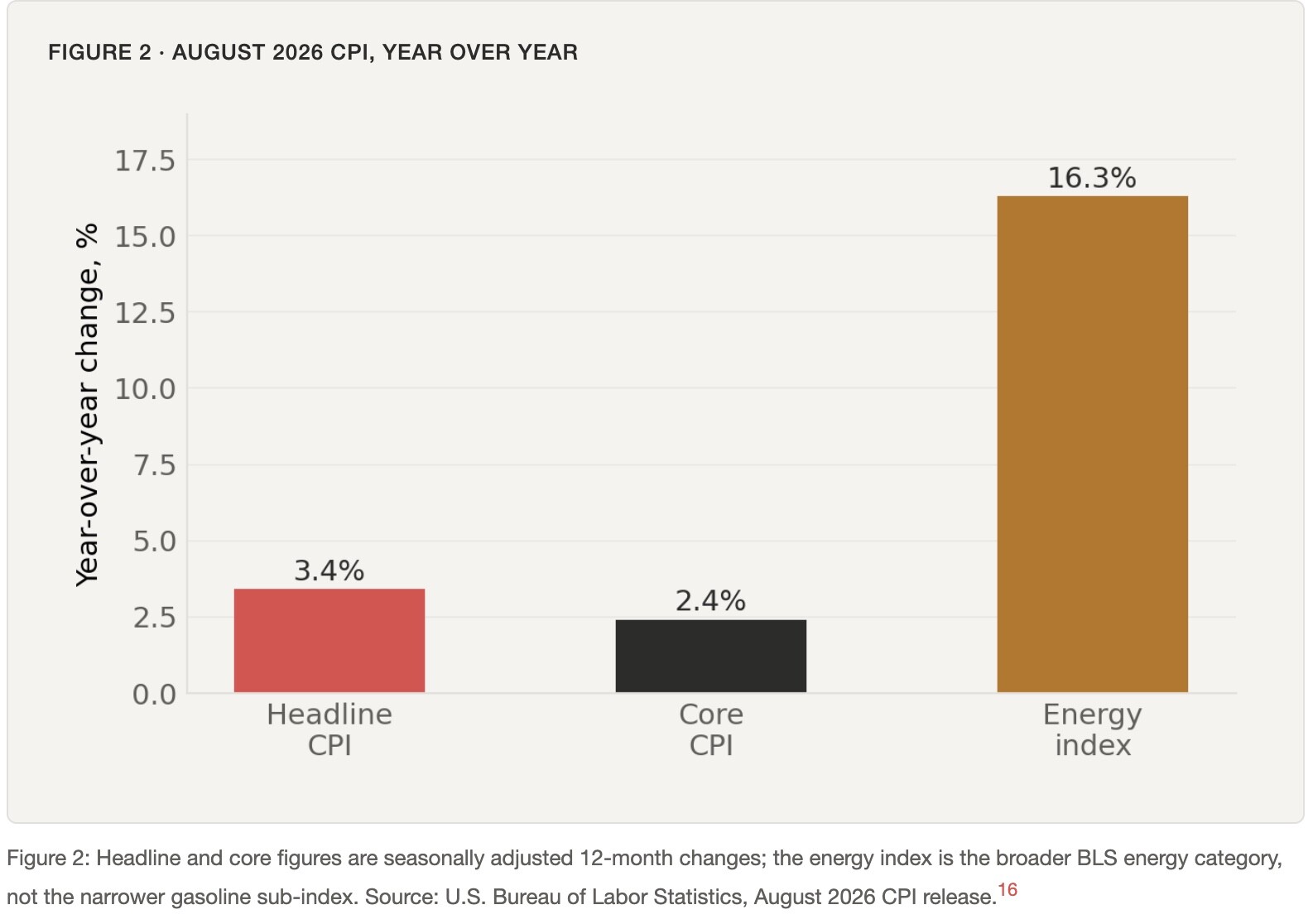
Crude prices climbed past $100 a barrel in the United States this month, feeding directly into the government's most closely watched inflation gauge. The Bureau of Labor Statistics reported that consumer prices rose 3.4 percent in August from a year earlier, up from July, with the agency noting in its release that "the index for gasoline rose 3.9 percent in August, accounting for over one third of the monthly all items increase." Core inflation, which strips out food and energy, came in cooler at 2.4 percent. But it was the headline number that mattered to traders positioning ahead of this week's Federal Reserve meeting.
By Monday, a Reuters poll found that 85 percent of economists expected the Fed to raise its benchmark rate by a quarter point on Wednesday, with futures markets pricing in roughly a 90 percent chance of a hike and the possibility of several more by the middle of next year. That alone might explain higher short-term rates. It does less to explain why a 10-year bond, whose yield reflects expectations for the next decade rather than the next quarter, would move so far in sympathy.
For that, bond strategists point to something more structural. The term premium, the extra yield investors demand for the risk of holding long-dated debt rather than continually rolling over short-term bills.
Data from the Federal Reserve Bank of St. Louis put that premium at 0.89 percentage points as of September 4, up from an estimate of roughly 0.60 percentage points that the Federal Reserve Bank of Dallas had calculated in June, though the two institutions use different models, making the comparison more suggestive than precise. Either way, the direction is consistent with a market that has grown warier of a decade-long commitment to the United States government's finances.
That wariness has an obvious source.
When the Bill comes Due
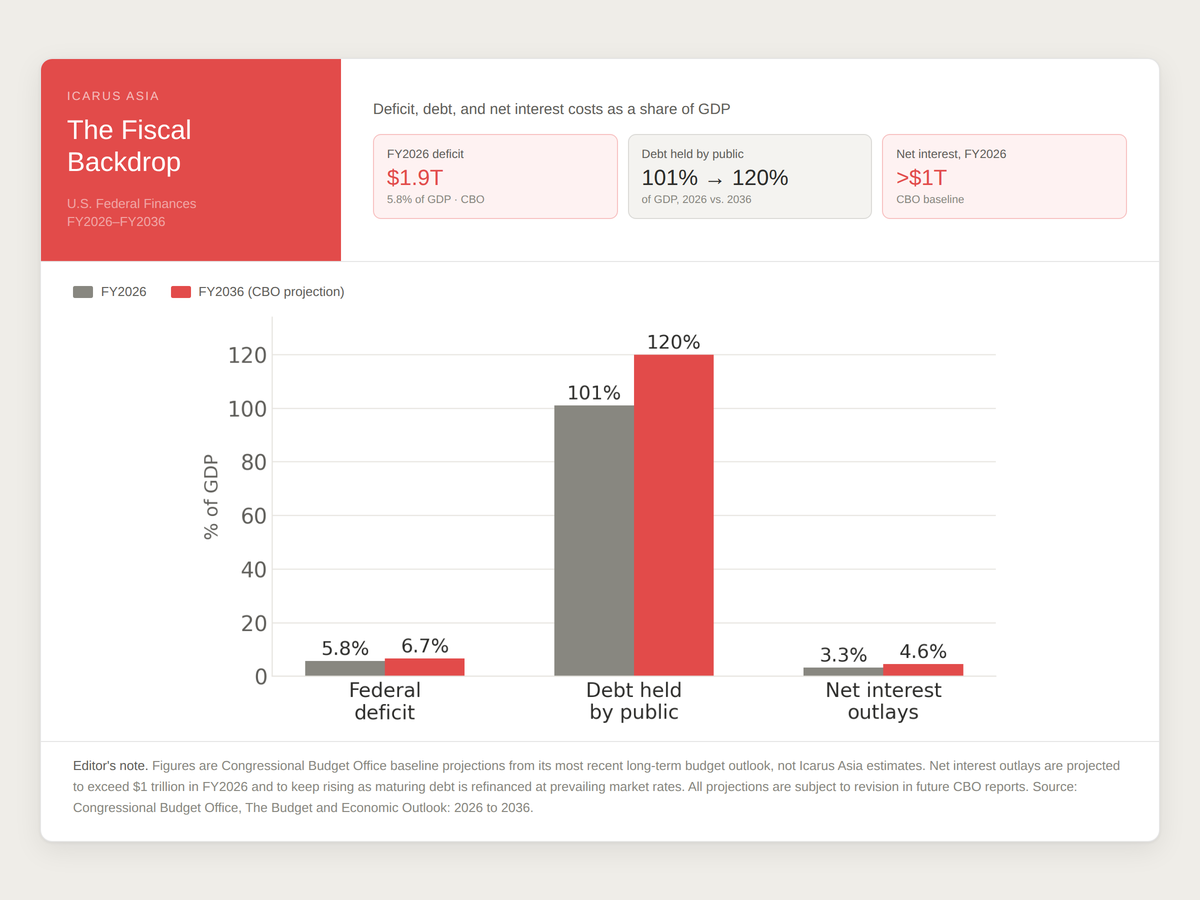
The Congressional Budget Office projected in its most recent long-term outlook that the federal deficit will reach $1.9 trillion this fiscal year, equal to 5.8 percent of gross domestic product, with debt held by the public climbing from 101 percent of GDP today to 120 percent by 2036. Interest payments on that debt are on track to exceed $1 trillion this year alone, a figure that rises as older, lower-rate debt matures and gets refinanced at whatever the market is charging that week--which, this month, has been close to a 19-year high.
The Treasury Department has not been a passive observer.
In August, it doubled the size of its long-end buyback operations, the mechanism by which it repurchases older, harder-to-trade bonds to keep the market functioning smoothly, from a maximum of $2 billion per operation to at least $4 billion. (You can read more about this here - https://icarusasia.com/research/treasury-long-end-buybacks)
Speaking to CNBC on Aug. 20, Treasury Secretary Scott Bessent signaled there was more room to move.
"We're going to increase the size of the buyback," he said, adding that it could be "more than the $4 billion per issue." Nine days later, the department followed through, announcing a $6 billion operation for Sept. 10, triple the size Treasury had been running before the crunch began, according to CNBC's reporting on the announcement.
Investors mostly shrugged.
"Treasury buyback fails to shock and awe the bond market," Axios wrote of the operation, a headline that captured what several bond investors had been saying privately for days. That a buyback, however large, is not the same tool as the kind of large-scale bond purchases the Federal Reserve deployed after the 2008 financial crisis.
A buyback swaps one government security for another. It does not reduce the total amount of debt the market ultimately has to absorb, and economists who study Treasury market plumbing say that distinction is exactly why the operation moved yields so little.
A buyback swaps one government security for another
None of this means 5 percent is destined to become the floor rather than the ceiling.
Bond markets have been wrong about worse things, and the same forces pushing yields up this month (an oil shock, a jumpy inflation print, an unusually online Treasury secretary) have a way of fading as quickly as they arrived. But the comparison to 2023 that traders keep reaching for may be doing them a disservice. That episode ended in a rally because the underlying economic story was already turning. Inflation was cooling, and the Fed was done hiking. This time, the Fed has not finished, oil has not retreated, and the government's own math is harder to ignore than it was three years ago.
Whether Monday's four minutes above 5 percent turn out to be a curiosity or the first sighting of a new normal may have less to do with Wednesday's Fed decision than with something far less dramatic.
How smoothly the Treasury Department's next 30-year bond auction goes.
It is the kind of unglamorous, technical detail that used to interest almost no one outside the bond market's own back offices. This year, it is difficult to look away from.
The author is an Executive Director and Head of Research and Analysis at Icarus Asia an independent financial research and market analysis firm that specializes in macroeconomic insights, structural fixed-income analysis, and liquidity trends across Asian and global capital markets.
DISCLAIMER: Not investment advice. Please do your own research and consult with a registered investment advisor.
Sources
Axios. "Treasury Buyback Fails to Shock and Awe the Bond Market." Axios, Sept. 10, 2026. https://www.axios.com/2026/09/10/bessent-bonds-buyback-treasury
Board of Governors of the Federal Reserve System. "The Treasury Tantrum of 2023." FEDS Notes, Sept. 3, 2024. https://www.federalreserve.gov/econres/notes/feds-notes/the-treasury-tantrum-of-2023-20240903.html
Brettell, Karen. "US 10-Year Yields Reach 5%, Highest Since 2023." Reuters, Sept. 14, 2026. https://www.reuters.com/business/us-10-year-yields-reach-5-highest-since-2023-2026-09-14/
Bureau of Labor Statistics, U.S. Department of Labor. "Consumer Price Index Summary — August 2026." U.S. Bureau of Labor Statistics, Sept. 2026. https://www.bls.gov/news.release/cpi.nr0.htm
CNBC. "Treasury Department to Buy Back $6 Billion in Longer-Term Debt, Triple the Normal Level." CNBC, Sept. 9, 2026. https://www.cnbc.com/2026/09/09/treasury-department-to-buy-back-6-billion-in-longer-term-debt-triple-the-normal-level.html
CNBC. "US10Y: U.S. 10 Year Treasury." CNBC / Tradeweb, Sept. 14, 2026. https://www.cnbc.com/quotes/US10Y
Congressional Budget Office. "The Budget and Economic Outlook: 2026 to 2036." Congressional Budget Office, Feb. 2026. https://www.cbo.gov/publication/61882
Federal Reserve Bank of St. Louis. "Term Premium on a 10-Year Zero Coupon Bond (THREEFYTP10)." FRED, accessed Sept. 2026. https://fred.stlouisfed.org/series/THREEFYTP10
Icarus Asia Research. "Above Five, Then Back Below." Icarus Asia, Sept. 14, 2026.
Reuters. "Fed Rate Hike on Wednesday Now Likely, Say Economists, and at Least One More to Follow." Reuters, Sept. 14, 2026. https://www.investing.com/news/economy-news/fed-rate-hike-on-wednesday-now-likely-say-economists-and-at-least-one-more-to-follow-4899032
Reuters. "Treasury's Bessent Says Upsized Bond Buybacks Could Increase Further." Reuters, Aug. 20, 2026. https://www.investing.com/news/economy-news/treasurys-bessent-says-upsized-bond-buybacks-could-increase-further-4870175
Richter, Wolf. "The 10-Year Treasury Yield Over 5%? My Thoughts." Wolf Street, Sept. 5, 2026. https://wolfstreet.com/2026/09/05/the-10-year-treasury-yield-over-5-my-thoughts/
TradingEconomics. "US 10 Year Treasury Note Yield." TradingEconomics, Sept. 14, 2026. https://tradingeconomics.com/united-states/government-bond-yield
U.S. Department of the Treasury. "Treasury Announces Increased Sizes of Nominal Long-End Liquidity Support Buybacks Beginning September 9." U.S. Department of the Treasury, Aug. 2026. https://home.treasury.gov/news/press-releases/sb0607