
News · Policy · US
A Ceasefire Won't Quickly Refill the World's Oil
A deal to reopen the Strait of Hormuz may stop the bleeding. Recovering from a billion barrels of lost supply is another matter.
The United States and Iran reached a ceasefire extension Monday that sets the stage for reopening the Strait of Hormuz to tanker traffic -- a development oil markets had been waiting on for months. Whether it translates into a meaningful recovery in global oil supplies before 2027 is a separate question, and most forecasters say the answer is probably not.
The June 14 agreement, due to be formally signed on Thursday, extends an existing truce by 60 days, aims at a permanent end to hostilities, and calls explicitly for lifting mutual blockades in the Gulf. Hormuz previously accounted for roughly 20 to 25 percent of global oil trade. Getting even a large fraction of those flows moving again is the most direct route to relieving what the International Energy Agency and the U.S. Energy Information Administration have characterized as the largest oil supply shock on record.
The IEA's May oil market report made the distinction clearly: a resumption of Hormuz flows is a necessary condition for inventories to stabilize, but not sufficient on its own — logistics, security conditions, and upstream infrastructure damage all have to fall into place as well.
The Scale of the Loss
The problem is the scale of what has already happened.
Middle Eastern output is running an estimated 11 to 14.4 million barrels per day below pre-war levels. By May, cumulative supply losses had surpassed one billion barrels. In March and April alone, global oil stocks fell by roughly 246 million barrels. The EIA's June short-term energy outlook projects average drawdowns of around 2.6 million barrels per day through 2026, which would push OECD stockpiles below 2.3 billion barrels by December -- their lowest level since records began in 2003.
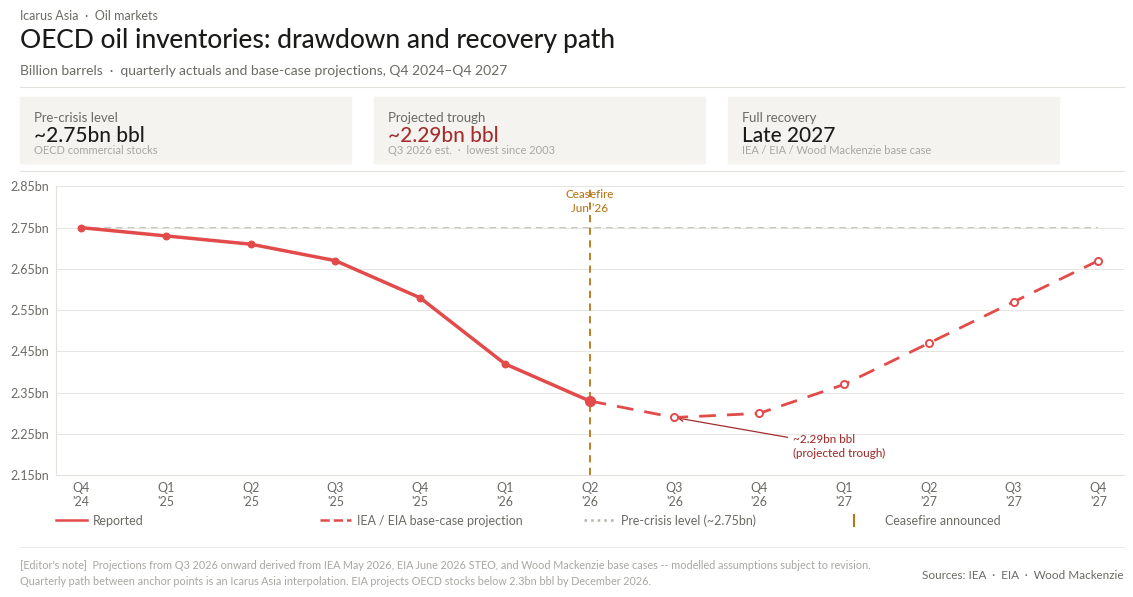
Before the conflict, those same inventories stood at approximately 2.7 to 2.8 billion barrels. IEA member countries have already committed more than 400 million barrels from strategic reserves in an attempt to keep refiners supplied, a backstop designed for short disruptions, not sustained ones.
Still Waiting for Ships
The obstacle to a faster recovery is not the agreement on paper but the physical reality in the Gulf.
As of mid-June, AIS-based traffic data from CSIS and trade monitoring services show tanker transits through Hormuz still well below pre-conflict levels. Many vessels remain diverted or idle.
Shipping insurers and classification societies continue to classify the strait as extremely high risk, pointing to residual mines, unexploded ordnance, and continued uncertainty over security conditions on the water. BIMCO and the International Maritime Organization are advising vessels to proceed with extreme caution. Until mine-clearance operations establish verified corridors and protection-and-indemnity clubs are willing to price routine voyages at something close to normal rates, the reopening is for now more a declaration than a working shipping lane.
Until mine-clearance operations establish verified corridors and protection-and-indemnity clubs are willing to price routine voyages at something close to normal rates, the reopening is for now more a declaration than a working shipping lane.
When Does the Market Turn?
The IEA's May report, written with a conflict resolution around early June in mind, still projects the market staying severely undersupplied through the third quarter. A modest surplus only begins to emerge in the fourth quarter, as some Hormuz flows resume.
The EIA's position is similar but slightly more conservative: it does not expect most shut-in Middle Eastern production to be fully restored until around January 2027, and sees global inventories starting to build only sometime in the new year. In that context, the next two or three months are mainly about slowing the rate of draws, not reversing them.
In that context, the next two or three months are mainly about slowing the rate of draws, not reversing them.
Energy consultant Wood Mackenzie's "Quick Peace" scenario -- built around a workable deal and a physical reopening roughly in line with the current timeline -- has Brent easing to around $80 a barrel by end-2026 as the market moves from deficit to mild oversupply. That would mark the start of a stock-building phase, though from a starting point that will by then be exceptionally low.
The Road Back
Getting inventories back to pre-closure levels requires more than just resumed flows.
The cumulative supply shortfall from the Middle East already exceeds one billion barrels, and agency projections suggest total 2026 drawdowns could add several hundred million barrels more before production and exports normalize. Closing a gap of that size takes sustained surpluses over many quarters.
The EIA sees Brent around $79 a barrel in 2027 as stocks slowly rebuild but does not project a full return to pre-conflict inventory levels within that year. Taken together, the IEA, EIA, and Wood Mackenzie outlooks converge on a working assumption that global commercial inventories are unlikely to recover to pre-closure levels before late 2027, with 2028 a realistic outer bound if shipping normalization or upstream restart runs slower than modeled.
The EIA sees Brent around $79 a barrel in 2027 as stocks slowly rebuild but does not project a full return to pre-conflict inventory levels within that year.
There is also the question of what pre-war production capacity actually looks like now. Gulf exporters and Qatar's LNG infrastructure have sustained damage that analysts say could take well over a year to repair in some cases. Saudi Arabia, the UAE, and Iraq face the practical work of restarting fields, pipelines, and loading facilities that were curtailed or damaged — a process that proceeds at its own pace regardless of what any agreement says.
Demand Has Already Shifted
The factor working in the market's favor is demand.
Sustained high prices have suppressed consumption enough that both the IEA and EIA now project global oil demand in 2026 falling below 2025 levels — an unusual outcome that shrinks the supply gap Hormuz volumes need to cover and makes it somewhat easier for returning Gulf flows to tip the balance toward a modest surplus in the fourth quarter.
The 400 million barrels already released from IEA member strategic reserves is perhaps the starkest indicator of where things stand — those stockpiles were built for emergencies measured in weeks, and they have been running for months. The ceasefire gives the market a path out. It does not change the fact that OECD commercial inventories, on current projections, will reach their lowest level since 2003 before any meaningful recovery begins. The agencies have their 2027 timelines.
But first, someone has to clear the mines.
The author is the Head of Research and Analysis at Icarus Asia, a risk and advisory business based in Hong Kong.
Disclaimer: Data in this article draws on published forecasts from the International Energy Agency, the U.S. Energy Information Administration, and Wood Mackenzie. Agency projections reflect assumptions as of their most recent public releases and are subject to revision.
This is not investment advice. Please do your own research or consult with a registered investment advisor.