
News · Policy · US
Fed Chair Kevin Warsh Didn't Want to Comment on Rate Hikes. Almost.
Over 33 minutes in Bangkok, the Federal Reserve's new chairman declined, more than once, to say what he will do at the next two meetings. He was less shy about the world he will be doing it in.
For information only. Not investment advice. Disclaimer · Special coverage: IMF–World Bank Annual Meetings, Bangkok
AI-generated summary, reviewed by the editor.
- In a 33-minute Bangkok session, Fed Chair Kevin Warsh declined to say what he will do at the Oct. 28 and Dec. 9 meetings, saying he does not prejudge.
- The Fed raised its rate a quarter point on Sept. 16, to 3.75 percent to 4 percent; September consumer prices rose 3.7 percent from a year earlier.
- Warsh said AI hits demand before supply and expects a positive supply shock later; CME FedWatch put an October hold at about 72 percent.
It restates the article and adds no new facts. How we use AI
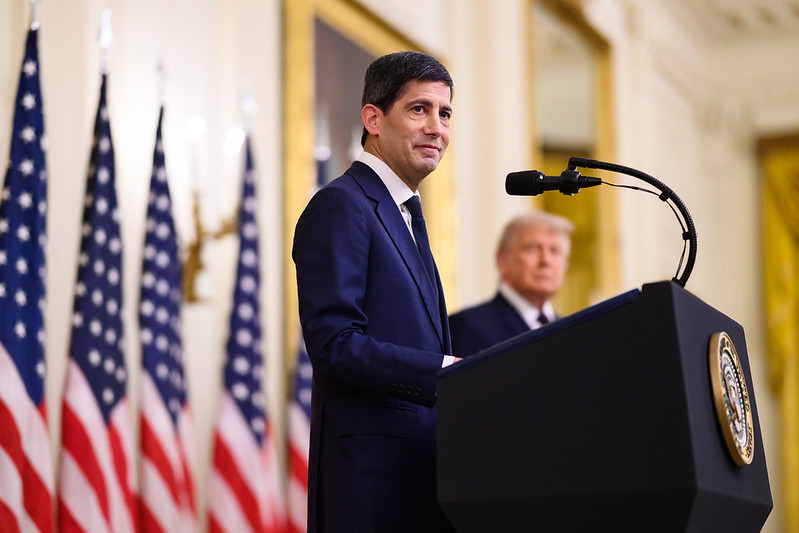
Kevin Warsh, the chairman of the Federal Reserve, was about nine minutes into a public conversation in Bangkok on Friday when he came to the edge of talking about interest rates.
"At the Federal Reserve, we made very clear that we would deliver price stability, and we removed a dose of accommodation about a month ago," he said. "I don't prejudge meetings. I don't believe in saying now what I might do at the meetings that we have in the balance of this year, but that was the situation."
Kristalina Georgieva, the managing director of the International Monetary Fund, who was asking the questions, told him he had just disappointed half the audience or more.
"I know," Warsh said. "They can all turn it off. It's a new chapter at the Fed, and we're not in that business anymore."
Read: Why Kevin Warsh Keeps Wall Street Guessing
He held to that for the next 24 minutes or so. Warsh never said whether the Fed will raise rates again on Oct. 28, six days before the midterm elections, or on Dec. 9, five weeks after them. About 18 minutes in, discussing the Fed's outside task forces, he used the verb again: "The same way, I'm not gonna prejudge FOMC meetings."
What he did say was that prices are climbing in country after country, that other central banks have been tightening, and that he counts this as "a positive development." None of it is a forecast.
By a count of the caption transcript, Warsh did not say "rate," "rates," "interest," "hike" or "raise" in 4,096 words. Neither did Georgieva in hers. He said "accommodation" once and "tightening" once.
Times each word appears in Warsh's side of the Bangkok session (4,096 words)
View data
| Word | Times said |
|---|---|
| "rate" or "rates" | 0 |
| "hike" or "raise" | 0 |
| "interest" | 0 |
| "accommodation" | 1 |
| "tightening" | 1 |
| "price stability" | 2 |
| "prejudge" | 3 |
| "prices" | 3 |
| "inflation" | 4 |
| "credibility" | 4 |
The Fed raised its benchmark rate by a quarter point on Sept. 16, to a range of 3.75 percent to 4 percent, in a 12-to-0 vote. It was the first increase since July 2023, and the committee's median projection pointed to one more this year. At his press conference that day, Warsh said, that "this summer's inflation readings do not tell me that underlying trends have meaningfully improved."
In Bangkok, asked about the state of the world economy, he described how he decides things.
He tries "to look out the window as clearly as I can," he said, at the Fed's policy meetings, about eight times a year. Data that looks current, he said, is not: "it's really lag data." At the September meeting the committee "came to a judgment" about what the global economy means for the United States, and in the month since, "the world has broadly conformed to our expectations."
He did not say what those expectations were. He did say two more windows remain.
"We'll be meeting a couple more times this year, and that will be the crystallizing moment," Warsh said, adding: "I'll make some judgments at the October meeting and the December meeting."
Warsh opened by calling Georgieva an old friend and joked that "there's some softballs coming." Near the end he said he might invite her to his next press conference, because her questions were "a little bit more cordial than some of the things I get." In between, he listed what he does not want to hear around the Fed: "this is how we've always done it, or this is what the model says."
After two days of meetings at the IMF gathering, he said, "it's hard to be in a discussion with central bankers and not compare notes and hear the same thing about the surge in prices." Georgieva had framed the problem in her question as "price pressures that are coming from everywhere," driven in part by the energy shock from the war in the Middle East and in part by "investment enthusiasm about AI."
Warsh then said what he heard from colleagues. "I heard, I would say, resolve from my colleagues around the world to deliver price stability," he said. "I've certainly delivered that resolve." A moment later: "While we each did the right thing by our own judgment, by our own remit, it was a synchronous tightening in monetary policy in most places around the world. And that means there's no free riders."
The consumer price index rose 3.7 percent in September from a year earlier, up from 3.4 percent in August, the Labor Department reported on Oct. 14. Gasoline rose 9.1 percent in the month and 34.2 percent over the year. Core prices, which exclude food and energy, rose 2.6 percent from a year earlier, more than economists had expected, The Associated Press reported, and 0.3 percent in the month. "The report was worse than expected," Bill Adams, chief U.S. economist at Fifth Third Bank, wrote in a note to clients. "Price increases were widespread."
Consumer price index, change from a year earlier
View data
| Measure | August (%) | September (%) |
|---|---|---|
| Headline CPI | 3.4 | 3.7 |
| Core CPI (ex food, energy) | 2.4 | 2.6 |
The war with Iran, which began in late February, has pushed up gas prices, AP reported. AP also reported that the data-center and AI buildout has also pushed up prices for computer chips and the electronics that use them. Computer prices were up 9.7 percent over the year. Average weekly paychecks, adjusted for inflation, shrank from a year earlier for the first time since May.
Change in consumer prices in September (monthly, seasonally adjusted; 12-month, unadjusted)
Change in September (monthly, seasonally adjusted)
Change over 12 months (unadjusted)
View data
| Item | September (monthly, %) | 12 months (%) |
|---|---|---|
| Gasoline | 9.1 | 34.2 |
| Computers | 1.4 | 9.7 |
| Airline fares | 1.2 | 22.4 |
| Used cars and trucks | 0.7 | -1.5 |
| All items | 0.6 | 3.7 |
| Housing | 0.4 | 3.2 |
| Electricity | 0.2 | 4.4 |
| Restaurants | 0.2 | 3.5 |
| Auto insurance | 0.1 | -5.0 |
| Groceries | -0.1 | 1.8 |
| Beef steaks | -1.0 | 2.7 |
A day later, the Labor Department's producer price index showed wholesale prices up 1.3 percent in September and 6.3 percent over the year, the biggest 12-month gain since December 2022.
John Williams, the president of the New York Fed, told an audience at the University at Buffalo on Sept. 29 that "with the policy action we took at our September meeting, there is no need for urgency." One more increase, he said, "may be appropriate late this year," if the economy evolves as he expects. On Oct. 13 he told Bloomberg News that "I haven't changed my view that it may be appropriate to have one more rate hike." He said he still believes energy prices will not add to inflation next year, and pointed to investment tied to the technology sector as one factor pushing prices up.
Philip Jefferson, the Fed's vice chairman, said at the University of Virginia's Darden School of Business on Oct. 1 that "my colleagues and I will need to come to our own judgment, which may take more time."
Austan Goolsbee, who runs the Chicago Fed, sounded the most troubled.
"I found it discouraging, and to pile on, last month was also discouraging," he said of the September report, and pointed to services inflation above 5 percent that he said cannot be blamed on tariffs or oil. Asked whether current rates are high enough to bring inflation back to 2 percent, he said: "I don't think we yet know the answer to that." Two weeks earlier he had been calling five and a half years above the target "playing with fire."
Alberto Musalem, the St. Louis Fed's president, who does not vote on rates this year, said on Oct. 8 that if returning to 2 percent in a timely manner means something like 18 months, "that kind of suggests that rates ought to be going up further in an appropriate period of time in the next six to nine months."
AI Adding to Aggregate Demand
Warsh's comments on artificial intelligence sit alongside surging chip prices which are key to everything from data centers to cars to fitness devices. Asked about the technology, he called it "probably the most consequential change to the US and the global economy in my lifetime." For central bankers, he said, it arrives in a particular order: "It's obviously hitting the demand side of the economy before it's gonna hit the supply side of the economy." In the medium term he expects "a positive supply shock." On the way there, he said, "we're seeing increases in aggregate demand. That just is what it is." He did not connect it to the October meeting. He said the path would likely be "a very bumpy one."
On jobs, he said: "We don't know in the next 12 or 18 months its effect on employment." Employers added 29,000 jobs in September, and the unemployment rate rose to 4.2 percent, the Labor Department reported on Oct. 2.
Traders were already leaning toward a pause.
CME's FedWatch tool put the odds of a hold on Oct. 28 at about 72 percent, Briefs Finance reported Friday, and most traders expect a quarter-point increase in December. Goldman Sachs, according to the same report, read Warsh's tone alongside other Fed commentary as pointing to an October pause, with one more hike in December. Warsh himself offered nothing to settle it.
Market-implied chance of a quarter-point increase on Oct. 28, CME FedWatch (snapshots, not daily data)
View data
| Date | Chance of hike |
|---|---|
| Sept. 29 | 69% |
| Sept. 29, later | ~47% |
| Oct. 7 | 17% |
| Oct. 13 | 22% |
| Oct. 14 | 47% |
| Oct. 16 | 27.7% |
UBS analyst Simon Penn, argued on Sept. 29 that the political logic of the midterms favored holding in October and moving in December. President Trump criticized the committee after the September increase, InvestmentNews reported, but has continued to back Warsh.
History is mixed.
A CME Group study by Mark Shore, which covered the 13 midterm elections between 1972 and 2024, found that the Fed left rates unchanged between Sept. 1 and Election Day in 54 percent of them, seven of 13. It named 1978 and 2022 as the years the Fed acted just before the vote, both years of rising inflation. On Nov. 2, 2022, six days before that year's election, the Fed raised rates by three-quarters of a point, to the same 3.75 percent to 4 percent range where it sits today. Thirteen elections are too few to build a forecast on.
Robert Kuttner, a co-founder and co-editor of The American Prospect, wrote Friday that "nearly all of the resurgent inflation" is the result of the Iran war and "Trump's chaotic tariffs." He cited gasoline up 34 percent over the year, heating oil up 74 percent, long-term Treasury yields at their highest since 2002 and mortgages "well above 7 percent."
In the same column he wrote that Warsh "made upbeat comments at an IMF meeting in Bangkok," suggesting the Fed might hold off on raising rates. The transcript supports the first part. Warsh was upbeat about the economy, saying a widening wave of investment has given it "plenty of tailwinds." It contains nothing about holding off. Warsh may have said something different in a closed meeting or an interview elsewhere in Bangkok; this account covers only the 33 minutes on tape. In those minutes, he committed to no rate decision.
He did say what he expects of himself. Asked what the 17th chairman might be remembered for, Warsh said, "I'm not in the legacy business. I'm in the business trying to get policy right." Georgieva had counted it as his 148th day in the job, after taking over in May. He praised Paul Volcker, Alan Greenspan and Ben Bernanke, who he said "met the moment of their times," and said the 17th chairman is not going to act like the 13th, 14th or 15th. "There's no status quo ante to return to," he said. He pointed to a Jackson Hole speech, one of whose themes, he said, was that "our first job is to interrogate reality."
The first test comes in 11 days. The September reading of the personal consumption expenditures price index, the inflation gauge the Fed targets, is due Oct. 29, one day after the committee announces its decision.
Georgieva ended the session by presenting him to the audience as "the defender of price stability." Under the Fed's blackout rule, officials stop commenting on policy from the second Saturday before a meeting until the day after it. This one began the next day, Oct. 17, and runs through Oct. 29.
Sources
- Associated Press (Rugaber, Christopher). "Inflation Worsened Last Month to 3.7% in Sign That Prices Remain Elevated as Midterm Elections Near." AP News, Oct. 14, 2026.
- Briefs Finance (Talwar, Kalbir). "Fed Chair Kevin Warsh Stays Mum on Next Move, Notes Global Tightening." Oct. 16, 2026.
- CME Group (Shore, Mark). "Could Fed Adjust Rates Ahead of Midterm Elections? A Historical Guide." Sept. 9, 2026.
- First Trust Portfolios. "The Consumer Price Index (CPI) Rose 0.6% in September." Oct. 14, 2026.
- First Trust Portfolios. "Nonfarm Payrolls Increased 29,000 in September." Oct. 2, 2026.
- Georgieva, Kristalina, and Kevin Warsh. "Fed Chairman Warsh on the Global Economy, AI (Full Interview From IMF)." Bloomberg Television (YouTube), Oct. 16, 2026. (English caption transcript; five passages compared against audio of the IMF's own upload).
- InvestingLive. "Fed Dot Plot Backs Hawks as Warsh Tone Rattles Markets More Than the Hike." Sept. 2026.
- InvestingLive. "Goolsbee: 5-1/2 Years Above Target Is 'Playing With Fire.'" Sept. 29, 2026.
- InvestmentNews (Almazora, Leo). "Warsh Touts US Economic Resilience, Keeps Coy on Next Rate Move." Oct. 16, 2026.
- Kuttner, Robert. "A Perfect Economic Storm." The American Prospect, Oct. 16, 2026.
- Quartz (Tolomia, Cris). "Fed Chair Kevin Warsh Gives No Rate Signal at IMF Bangkok Meeting." Oct. 16, 2026.
- Reuters (Derby, Michael S.). "Fed's Musalem Says Lowering Inflation Will Require More Rate Hikes." Oct. 8, 2026.
- Reuters. "Fed's Williams Sees No Urgency for Next Rate Hike." Sept. 30, 2026.
- Reuters. "Fed May Take Time to Make Next Interest Rate Move, Jefferson Says." Oct. 1, 2026.
- Reuters. "Fed's Williams Sees No Need for Rate Hike in 2027" (Bloomberg News interview, Oct. 13, 2026).
- Yahoo Finance. "Chicago Fed's Goolsbee Calls September Inflation 'Discouraging' but Favors Waiting on More Data." Oct. 14, 2026.
- "UBS: The Fed Has Never Raised Rates in the Month Before a Midterm Election" (Deep News, reporting Simon Penn). Sept. 29, 2026.
Comments
Sign in with LinkedIn to join the discussion. Your LinkedIn name and photo appear publicly beside your comment. Please keep it civil and on topic.