
News · Policy · US
How Laws Built for Everyone Fail the People Who Need Them Most
When Congress passed the Social Security Act in 1935, it promised a safety net for American workers but it also quietly excluded two of the largest categories of Black employment: domestic workers and agricultural…
When Congress passed the Social Security Act in 1935, it promised a safety net for American workers but it also quietly excluded two of the largest categories of Black employment: domestic workers and agricultural laborers.
Not an oversight but a political concession to Southern legislators who feared that federal protections would disrupt the racial order of the Jim Crow economy.
Ninety years later, the gap between what policy promises and what it delivers, across racial, gender, and class lines, remains one of the most durable features of American governance. A growing body of research argues this is not a flaw in the system. In many cases, it is the system.
Political scientist Jamila Michener and public policy scholar Margaret Brower argued in 2020 in Daedalus that policy is never neutral. It operates within existing frameworks of structural racism, classism, and gender inequality that determine who benefits and who gets left behind.
The stakes show up in life expectancy gaps between Black and white Americans. In the wealth chasm between women and men at retirement. In neighborhoods that have been redlined, rezoned, and systematically starved of public investment for generations and are still waiting.
Built to Exclude
The Social Security example illustrates a pattern researchers call "policy design exclusion," programs written, often from the outset, to benefit some groups while formally or effectively sidelining others. The effects compound. Families excluded from social insurance in the 1930s couldn't accumulate the wealth that would have given their children a foothold. The inheritance is economic as much as it is also political.
Michener and Brower show how exclusion, once baked into foundational law, tends to perpetuate itself. Programs designed without certain communities in mind stay poorly calibrated to those communities' needs even after technical eligibility opens up. Secondary filters such as bureaucratic requirements, documentation burdens and complexities in applications tend to compound the exclusion. They screen out the poorest and least politically connected applicants with mechanical consistency.
Where the Money Actually Goes
Federal investment doesn't flow evenly, and the communities historically denied resources are often least equipped to compete for new ones.
Research on federal place-based spending published across leading social science journals, including work by Cornell sociologist Laura Tach in the RSF: Russell Sage Foundation Journal of the Social Sciences, finds a consistent pattern. Programs explicitly designed to lift struggling communities tend to cluster in neighborhoods with stronger existing housing markets and more robust nonprofit infrastructure. Communities that most needed the investment were least positioned to absorb it. Well-intentioned programs widened the gaps they were meant to close.
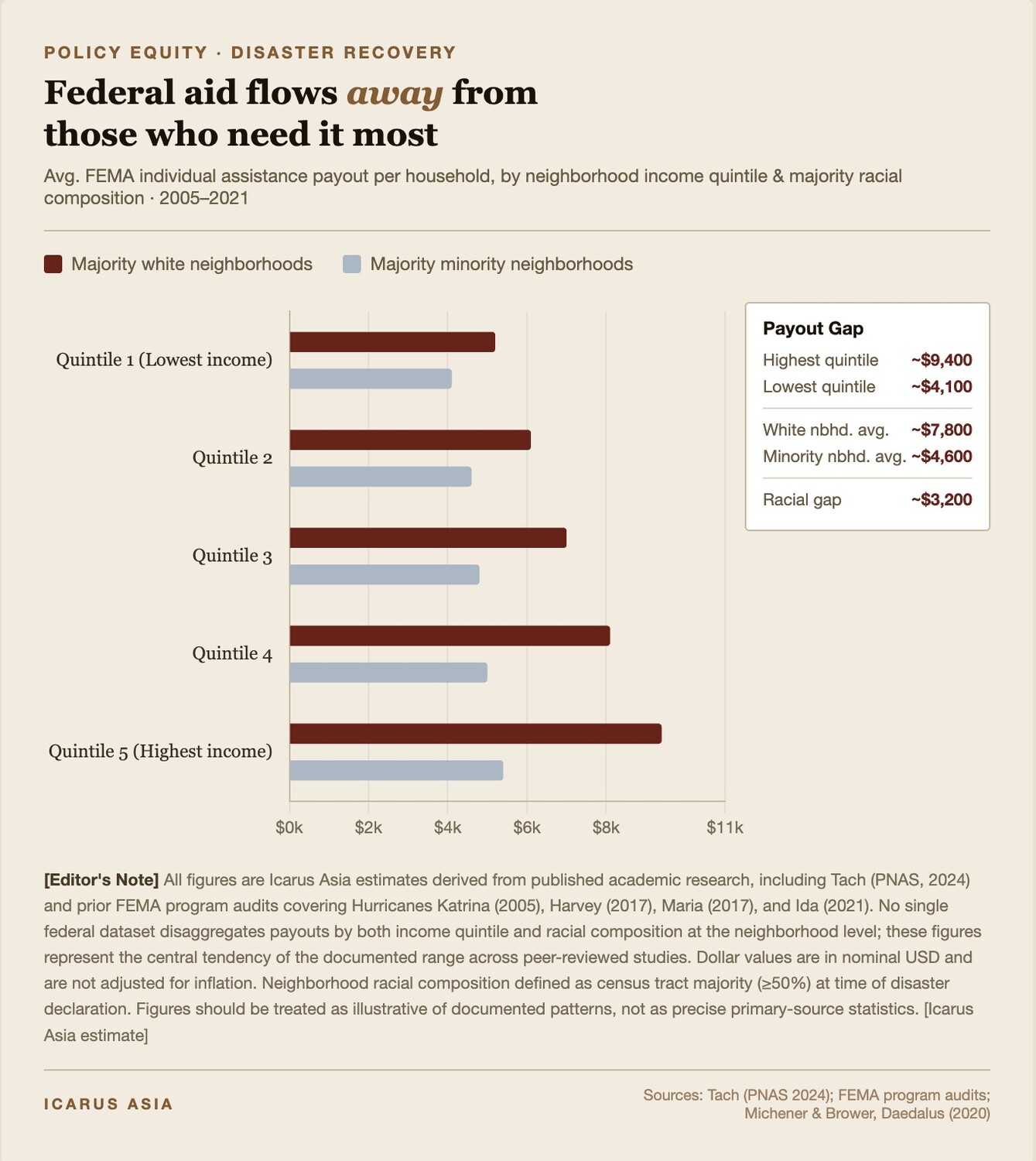
The same pattern repeats across broadband deployment, school funding formulas, and disaster recovery. FEMA's post-hurricane programs have repeatedly delivered less money, more slowly, to lower-income communities of color: after Katrina, after Maria, after Harvey.
Who Gets to Speak
Martin Gilens spent years documenting the answer in Affluence and Influence (2012), as did Larry Bartels in Unequal Democracy (2016). U.S. policy outcomes align far more closely with the preferences of higher-income voters than lower-income ones. The pattern holds across party lines and persists even when lower-income groups make up electoral majorities.
Attending a public comment hearing requires a flexible schedule. Lobbying requires money. Sustained engagement with legislative processes requires time that hourly workers, single parents, and people working two jobs rarely have. Knowing which city council subcommittee controls a zoning decision is a form of civic capital. It correlates strongly with income and education.
Women, particularly women of color, face this twice over. Underrepresented in legislatures at every level, and still the primary caregivers in most households, their capacity for sustained political participation is constrained before the first vote is cast.
An intersectional analysis of reproductive health policies in Victoria, Australia (Haintz et al., Social Inclusion, 2023) makes the pattern explicit in a specific jurisdiction. Laws governing women's reproductive decisions are frequently written without meaningful input from the women most affected, particularly low-income women, women of color, and women with disabilities. The policies reflect the priorities of those in the room when they were written. A pattern, not an accident.
The Health Bill
Black women in the United States die in childbirth at three to four times the rate of white women. The disparity persists across income and education levels. Indigenous Americans have dramatically higher rates of diabetes, liver disease, and suicide than the general population. These are not random outcomes. They trace to specific choices: the chronic underfunding of Indian Health Service facilities, the siting of polluting industries in communities with the least political power to resist them, insurance systems designed to price out the uninsured.
The World Health Organization's framework on structural determinants of health is direct about this: political and economic institutions are root causes of health disparities, not reflections of them. Labor markets, housing systems, and education structures generate inequality. The physiology follows from the policy.
Dr. Leonard Egede and colleagues wrote in 2023 in the Journal of General Internal Medicine that addressing health disparities requires confronting the structural racism embedded in American institutions, not just deploying more clinical resources into underserved communities. The response, they argued, must be matched to the actual scale of the problem.
The Better Question
Researchers who study policy equity are pushing back on the phrase "vulnerable populations." The term implies fragility, as if certain groups are inherently susceptible rather than actively harmed by institutional design. A growing strand of health equity scholarship, including contributions from Hassan, Chisty, and Bui in their 2023 chapter on structural and social determinants, pushes toward a sharper question: not which communities are vulnerable, but how specific policies vulnerabilize them.
The distinction matters. Fixing a broken program is a different project than acknowledging that a program was built to produce the outcomes it produces.
The reforms that hold up, the research shows, get built with communities rather than for them. Participatory governance, the kind that treats affected communities as decision-makers rather than focus groups, produces more equitable outcomes than top-down design. The evidence for this is consistent across jurisdictions, policy types, and income levels.
The catch? Participatory governance is slower and politically harder.
It requires people with power to share it. Hong Kong's finance ministers and America's congressional committees operate differently, but the underlying logic is the same: the people setting the rules rarely face the consequences of those rules.
Power shared is rarely power offered. It gets taken.
The author is the Head of Research and Analysis at Icarus Asia, a Hong Kong-based risk and advisory business.
Sources
What's Policy Got to Do with It? Race, Gender & Economic Inequality in the United States · Daedalus (Michener & Brower, 2020)
Affluence and Influence: Economic Inequality and Political Power in America · Princeton University Press (Gilens, 2012)
Unequal Democracy: The Political Economy of the New Gilded Age · Princeton University Press (Bartels, 2016)
Federal Place-Based Policy and the Geography of Inequality · RSF: Russell Sage Foundation Journal of the Social Sciences (Tach et al., 2022)
Inclusive Policy? An Intersectional Analysis of Policy Influencing Women's Reproductive Decision-Making · Social Inclusion (Haintz et al., 2023) · Scope: Victoria, Australia
Structural and Social Determinants of Health · Leading an Academic Medical Practice, Springer (Hassan, Chisty & Bui, 2023)
Addressing Structural Inequalities, Structural Racism, and Social Determinants of Health · Journal of General Internal Medicine (Egede, Walker & Williams, 2023)
Social Determinants of Health · World Health Organization
Maternal Mortality Data & Statistics · U.S. Centers for Disease Control and Prevention
Japan's immigration crackdown threatens the curry shops it helped create · The New York Times
Japan's beloved Indian restaurants are under threat · The Economist
In search of clarity on Hong Kong's future · The Interpreter, Lowy Institute (Jieh-Yung Lo, November 2019)
How 'one country, two systems' is benefiting Hong Kong horse racing, of all things · South China Morning Post (David Dodwell)