
News · Policy · Global
Georgieva warns AI is a 'slow-moving tsunami' for jobs and tax bases
The IMF chief's first appearance of the week focused on young workers and shrinking government revenue.
For information only. Not investment advice. Disclaimer · Special coverage: IMF–World Bank Annual Meetings, Bangkok
AI-generated summary, reviewed by the editor.
- IMF chief Kristalina Georgieva described AI's spread through jobs as a wave arriving slowly, saying it is already cutting demand for routine-task workers and young entrants are most at risk.
- Her bigger worry is fiscal: AI shifts income from labor to capital, and labor is where most governments raise their taxes, Bloomberg reported.
- A January 2024 IMF staff note put almost 40% of global jobs as exposed to AI, about 60% in advanced economies; exposed does not mean lost.
It restates the article and adds no new facts. How we use AI
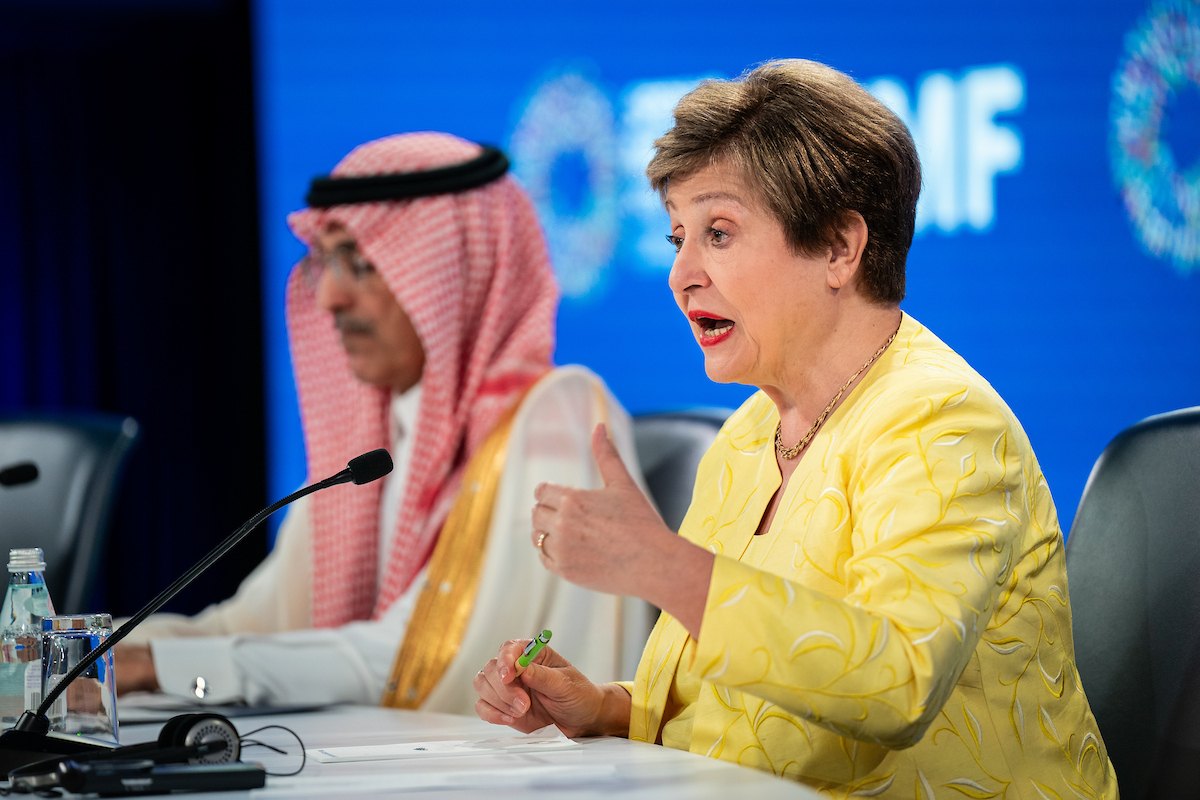
Bangkok · Kristalina Georgieva described the spread of artificial intelligence through the job market on Monday as a wave that is arriving slowly, at a jobs session on the opening day of the IMF and World Bank meetings.
"It is a slow-moving tsunami, but [a] tsunami nonetheless," the International Monetary Fund's managing director said, according to Bloomberg. Artificial intelligence is already cutting demand for workers who do routine tasks, she argued, and governments should act on the evidence now. She called the growth in low-paying construction jobs "not a story to celebrate." TRT World reported she also cited low-paying work at data centers.
"We cannot today imagine what exactly the world of work will be five years from now," she said. Bloomberg reported that young workers in AI-exposed fields have already seen slower hiring, leaving new entry-level applicants more vulnerable.
Her bigger worry is fiscal. AI shifts income from labor to capital, and labor is where most governments raise their taxes, Bloomberg reported. The fund's Fiscal Monitor, due Wednesday, carries the title "Taxing Better to Boost Growth."
From Davos to Bangkok
She had used the word before. At the World Economic Forum in Davos in January, Georgieva said AI was "like a tsunami hitting the labor market," Fortune reported, with the heaviest impact on people just entering the workforce. The tasks AI removes, she said, are usually the ones entry-level jobs consist of. She asked "Where are the guardrails?" and said of AI: "We don't know how to make it safe. We don't know how to make it inclusive."
At Davos she also said the middle class "inevitably, is going to be affected," as pay rises at the top and workers whose roles get no AI boost are squeezed. Unregulated, market-driven deployment, she said, was her "biggest worry."
In Bangkok, concern is growing that AI will widen inequality, Bloomberg reported, because its gains have so far gone to a narrow set of workers and economies despite a "global investment supercycle."
What the fund has counted
The numbers behind the warning come from a January 2024 IMF staff note by Cazzaniga and seven co-authors. It found that almost 40% of global employment is exposed to AI. In advanced economies the share is about 60%. The note put emerging markets at 40% and low-income countries at 26%. About half of the exposed jobs in advanced economies may be negatively affected, the authors wrote, while the rest could gain from higher productivity.
Share of jobs exposed to AI, IMF estimate, %
Poorer countries should not take comfort from the lower figure. CNBC reported that Georgieva said they are not better off, only because "AI is further away." The first wave of impact, she said, is already visible.
What the IMF staff expect for exposed jobs in advanced economies
The fund's staff said younger workers are better placed to adapt, that inequality may rise, and that displacement risks reach higher-wage earners as well as routine workers. The policy advice in the note splits by income level: regulation and help for workers to move jobs in advanced economies, digital infrastructure and skills in emerging and developing ones, and safety nets and retraining for all.
The first rung
Singapore President Tharman Shanmugaratnam, who co-chairs the World Bank's Jobs Council, said entry-level hiring was weakening. "The first rung in employment, your first job upon graduation, is now seeing less demand," he said, according to CNBC. In the United States, he said, demand for graduates has fallen for the first time in a century, and the wage premium for a college degree is shrinking. Without action, he warned, a graduate cohort loses more than a year of skills, which erodes trust in the future.
Outside the fund, the data point the same way. Challenger, Gray & Christmas counted nearly 55,000 U.S. job cuts in 2025 that cited AI, Fortune reported. The Brookings Institution found that automation was at least two to three times as likely to affect starting roles as managerial ones.
Tharman argued that support measures used during the pandemic and the global financial crisis "now has to be thought of not as a crisis measure, but as part of the structural, the menu of structural policies." Governments, he said, should work with the private sector and give firms incentives to hire fresh graduates. China, India and developing Southeast Asia are growing well, he said, but job creation is weak. "AI is going to widen the divergence if we are too passive about it," he warned, TRT reported.
Tharman also said AI displacement will arrive gradually, task by task, he said, which gives time to adapt, provided workers learn on the job and universities shift toward applied training.
Figures cited in Bangkok and in recent reporting
Asia's arithmetic
The IMF estimates AI could add 0.5 to 1 percentage point to growth in advanced Asia and 0.2 to 0.8 point in emerging Asia, CNBC reported. Georgieva called it "a very big deal" that would "more than offset" the drag from aging in rich Asian economies, per Bloomberg.
IMF estimate of added GDP growth from AI adoption, percentage points
Krishna Srinivasan, head of the IMF's Asia and Pacific department, told the session that "what matters is whether AI augments workers or automates jobs," TRT reported. The gains are already visible in trade data. The World Bank said in its East Asia and Pacific update on Oct. 6 that AI-related goods made up more than 70% of export growth in Malaysia, the Philippines, Thailand and Vietnam, ICIS reported.
On Sept. 22 in New York, Georgieva said the fund does not yet see AI investment demand crowding out government borrowing, but that it could become a problem and needs monitoring.
Banga's bet on small AI
The World Bank held its own session on the subject. At a Monday session titled "Small AI: More and Better Jobs," President Ajay Banga said simple tools on basic phones can raise productivity in poorer countries without large language models. His example: nurses at Indonesian primary-care centers using phone apps to assess symptoms and reach remote doctors, according to the News Agency of Nigeria.
About 1.2 billion young people will turn 18 over the next 15 years, Banga said, and "the private sector generates between 75 and 85 per cent of jobs in any country." Governments should build infrastructure, set policy and "de-risk" private capital, he said. He named five job-creating sectors: infrastructure, agriculture, primary health care, tourism and value-added manufacturing.
Georgieva returned to the same group of workers. "People to worry about, first and foremost, [are] young people that are coming into the labor market," she said.
Sources
- Bloomberg via The Irish Times, Oct. 12, 2026: Georgieva remarks at the jobs session.
- CNBC via CNBC Africa, Oct. 12, 2026: IMF estimates; Shanmugaratnam and Banga remarks.
- TRT World, Oct. 12, 2026: session coverage, including Srinivasan and Shanmugaratnam remarks.
- Fortune, Jan. 23, 2026: report on Georgieva's Davos panel, including Challenger, Gray & Christmas and Brookings figures.
- IMF Staff Discussion Note SDN/2024/001, January 2024, on AI and the future of work (Cazzaniga, Jaumotte, Li, Melina, Panton, Pizzinelli, Rockall, Tavares).
- News Agency of Nigeria via PM News, Oct. 12, 2026: Banga on small AI.
- ICIS, Oct. 7, 2026: World Bank East Asia and Pacific update.
- Semafor, Sept. 22, 2026: Georgieva in New York.
Comments
Sign in with LinkedIn to join the discussion. Your LinkedIn name and photo appear publicly beside your comment. Please keep it civil and on topic.