
News · Policy · Global
In the AI gold rush, it's Goldman versus Goldman
In 1849, a merchant named Sam Brannan ran through the streets of San Francisco clutching a vial of gold dust and shouting that fortunes were waiting in the hills to the northeast.
The bank is funding the boom, warning about the crash, and has already started selling the hedge.
In 1849, a merchant named Sam Brannan ran through the streets of San Francisco clutching a vial of gold dust and shouting that fortunes were waiting in the hills to the northeast.
He was right about the gold.
What he neglected to mention was that he had quietly bought up the region's entire supply of picks, pans, and shovels before making the announcement. While ten thousand men scrambled toward Sutter's Mill, Brannan sat behind a counter in San Francisco and charged them for the tools to get there. He made $36,000 in nine weeks. Most of the prospectors went broke.
Goldman Sachs has more moving parts than Sam Brannan did, and it is operating on a scale that makes the California gold rush look like a local fundraiser. But the structural logic -- become the indispensable intermediary between speculative capital and an uncertain opportunity, and collect a fee regardless of who finds gold -- is the same.
The AI Gold Rush
In 2026, the five largest cloud computing companies are on pace to spend roughly $757 billion on AI infrastructure. Data centers are being bolted together across rural Virginia and the West Texas desert, power contracts are being signed with utilities that didn't exist five years ago, and cooling systems are being designed to prevent billions of dollars of semiconductors from overheating.
Goldman's Global Investment Research team put that figure in a note circulated to institutional clients this spring, noting it represents an 80 percent jump from the prior year.
Goldman Sachs is helping finance that spending.
It is also among the most prominent voices warning that the spending might not pay off. And as of early this year, it has quietly started building a financial product designed to let clients profit from the deterioration of the loans backing the companies the spending is supposed to displace.
That three-part position -- fund the boom, voice doubt about the boom, sell the hedge against the bust -- is not an accident, and it is not a conflict of interest. It is, by any reasonable reading, the whole business model.
The Till Rings Three Times
Goldman's revenues from the AI economy flow through three distinct channels, each largely independent of whether artificial intelligence actually delivers the productivity gains that justify the spending.
The most visible is underwriting.
Every time a major technology company needs to tap public markets to fund its capital program, Goldman is typically in the room. Oracle's $25 billion debt package, one of the largest in that company's history, was priced in February 2026. Alphabet recently completed a major capital raise at comparable scale. The pattern holds across the AI supply chain: semiconductor manufacturers building fabrication plants, utilities racing to add generation capacity, real estate investment trusts acquiring land for hyperscale campuses.
Goldman's investment banking division collects a fee at each transaction. The second channel is less visible and growing faster.
Hyperscalers cannot fund what Goldman's Digital Infrastructure Technology Banking group has estimated at $5.3 trillion in combined capital spending through 2030 from public debt markets alone.
A substantial share of AI infrastructure financing has migrated off corporate balance sheets entirely.
A substantial share of AI infrastructure financing has migrated off corporate balance sheets entirely.
Analysis by Quinn Emanuel Urquhart & Sullivan, LLP, drawing on deal documentation and regulatory filings, found that more than $120 billion in data center spending was moved off the balance sheets of major technology companies in roughly 18 months, financed through special-purpose vehicles and direct loan arrangements provided by private credit funds. Outstanding private credit loans to AI-related firms exceed $200 billion by that same analysis. Morgan Stanley projects that private credit could supply an additional $800 billion in data center financing over the next two years, and that it will account for more than half of the $1.5 trillion in data center expansion financing needed through 2028.
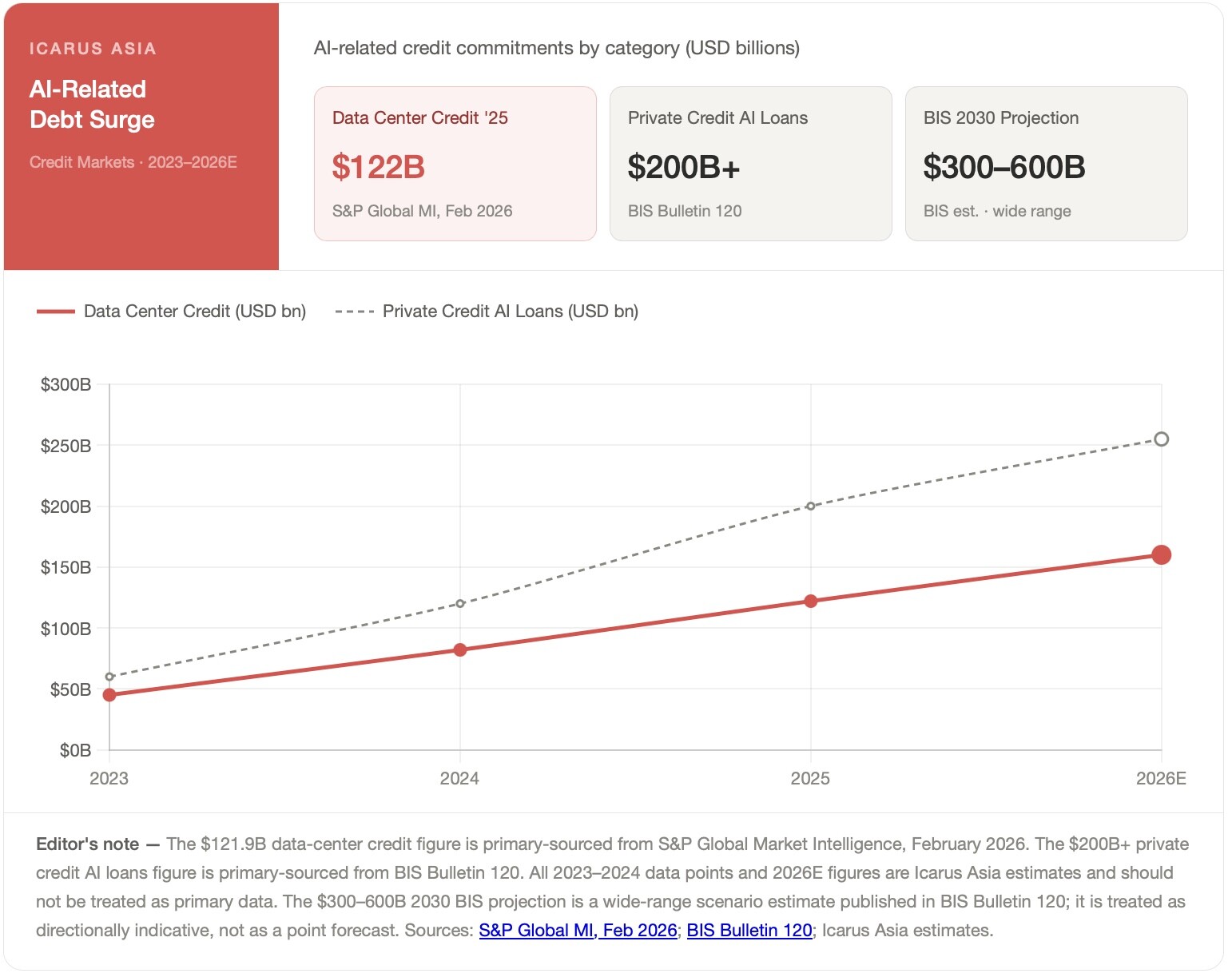
Goldman has been building aggressively to capture a piece of this.
Its asset management arm has been expanding infrastructure funds designed to finance the physical backbone of AI -- land, buildings, cooling infrastructure, dedicated power substations. These assets generate long-lived fee and interest income backed by contracts with counterparties who are, for the most part, among the world's most creditworthy borrowers. The returns flow whether or not the AI models running inside the facilities ever produce measurable economic gains for the companies licensing them.
The third channel is advisory.
When a legacy enterprise software company needs to acquire an AI-native firm to shore up a product line facing competitive pressure from AI agents, Goldman charges for the introduction. When a private equity firm that assembled a software portfolio in 2021 needs to restructure those businesses because AI is eroding their revenue, Goldman charges for the advice. The deal flow runs in both directions, and Goldman has structured itself to sit on both sides of the capital table.
"As a market-maker, we obviously engage constantly with clients on facilitating the trading strategies they want to execute," a Goldman spokesperson said in a statement to Reuters earlier this year. "This happens every day, across many asset classes, in every market environment."
What the spokesperson did not say, and what the numbers make plain: those trading strategies now include strategies to short the same credit market Goldman is helping build.
The Skeptic on the Payroll
Jim Covello is the head of global equity research at Goldman Sachs. His functional role in 2025 and 2026, judged by the attention his notes have attracted across institutional finance, is something closer to designated skeptic: the person on Goldman's letterhead arguing, repeatedly and on the record, that the business case for artificial intelligence may not hold up.
Covello's core concern is not that the technology is fraudulent or that the models fail to work. It is that the cost of building and deploying AI systems has far outrun the value those systems demonstrably generate. In research notes published and circulated publicly in 2024 and 2025, Covello and his team argued that AI spending is "unlikely to generate returns" sufficient to justify current investment levels -- a position that put Goldman's research arm in direct tension with the technology industry's public projections.
The independent data offers partial support.
U.S. nonfarm business labor productivity grew at roughly 2.3 percent in 2024, according to the Bureau of Labor Statistics -- above the post-2010 average but not the step-change that would typically justify a capital investment cycle of this magnitude. Daron Acemoglu , an economist at Massachusetts Institute of Technology, estimated in a 2024 paper that AI would meaningfully affect only about 5 percent of tasks over the next decade and contribute roughly 0.5 percent to aggregate productivity growth over that period -- a figure far below the claims being used to justify current capital spending.
The International Monetary Fund, more optimistic in its forecasts, nonetheless acknowledged in its April 2024 World Economic Outlook that realizing AI's productivity potential depends on adoption rates and complementary investments that have not yet materialized at scale. The productivity gains are real in narrow applications -- coding assistance, customer service automation, document summarization. At the macroeconomic level, they remain genuinely hard to find in the data. And the longer the gap between spending and output persists, the more difficult it becomes to justify the next round of capital commitment.
The productivity gains are real in narrow applications -- coding assistance, customer service automation, document summarization.
This is a reasonable argument, and there is no cause to doubt Covello holds it sincerely.
But the combination of that argument with Goldman's institutional positioning produces an outcome worth naming clearly: Goldman simultaneously amplifies the investment case for AI (through its research on the capex supercycle, its reports on semiconductor market dynamics, its bullish framing of power and infrastructure stocks) and provides intellectual cover for clients who are nervous about being overexposed to it.
An institutional investor reading Goldman research in mid-2026 encounters both things within a short window.
The bank's economists argue that AI-driven capital spending represents a structural shift in economic organization, that companies tied to physical infrastructure will generate durable earnings, and that the rational move is to rotate away from capital-light software and toward semiconductors, power, and real assets. Covello's team argues, with equal firmness, that the return on AI investment hasn't materialized and that current valuations assume a productivity dividend that has not arrived.
Both views serve Goldman's business.
A client persuaded by the first hires Goldman to invest in the buildout. A client persuaded by the second hires Goldman to hedge its AI exposure or restructure its software portfolio. The most sophisticated institutional investors, taking both views seriously at the same time, hire Goldman for both purposes simultaneously. The credibility that Covello generates by publishing heterodox research on a bank's most lucrative growth sector is itself a product Goldman sells to nervous institutional clients.
It is how you earn the restructuring mandate when the cycle turns.
The Short
The newest instrument in Goldman's AI toolkit is also the hardest to categorize, and it is worth understanding precisely because it clarifies something important about how the bank actually views the credit cycle it is financing.
In early 2026, Goldman began pitching a select group of hedge fund clients on a financial product called a total return swap, or TRS, structured to create synthetic short exposure to corporate loans of companies facing disruption from AI. The Financial Times reported on the pitches; Reuters confirmed the existence of the product through a source familiar with the matter. Goldman acknowledged it in a public statement. No trades have been executed, according to Bloomberg's reporting from March 31, 2026. The bank told clients the product was "not ready yet."
But the demand that prompted its development is real, and understanding the instrument's structure tells you something about where Goldman thinks the credit cycle is heading.
A total return swap transfers the full economic performance of a reference asset at every periodic settlement date. In this case, the reference assets are loans made to software companies, enterprise SaaS businesses, and other firms whose business models are under pressure from AI agents and large language models. A fund taking short-side TRS exposure profits when those loan prices fall, when credit spreads widen, or when borrowers' financial positions deteriorate — without waiting for a formal default event. This is the structural distinction that matters to anyone trying to read the trade: a credit default swap, the instrument most familiar to investors who remember 2008, pays out only on a defined credit event, meaning a bankruptcy filing, a missed payment, or a formal restructuring. A TRS pays on price movement. The borrower does not have to default. The loan just has to trade lower.
Goldman, when it warehouses the long side of these trades, takes on simultaneous exposure to credit risk, spread risk, and mark-to-market changes at every reset. That is a demanding position to manage, particularly in a private credit market where loan prices are often set by the managers who hold them rather than by independent secondary market clearing.
Goldman, when it warehouses the long side of these trades, takes on simultaneous exposure to credit risk, spread risk, and mark-to-market changes at every reset.
There is an unresolved question at the center of the product's design -- whether settlement prices will be determined by secondary market trades, manager marks, or an independent pricing model. That is not a technical footnote. It determines when losses are recognized, which determines when the short side of the trade collects, which determines the trade's entire economic logic. The reference basket composition, meaning the specific loans in the pool, has also not been publicly disclosed.
Apollo Global Management successfully bet against several large software company loans last year, generating returns that drew sustained attention from hedge fund allocators. The CDS market for private credit names is thin. Shorting the equity of software companies that still generate cash is operationally cumbersome and does not isolate the credit view. Goldman's TRS fills a structural gap in the market for investors who want to express a bearish credit view on AI-disrupted software without waiting for a formal default event.
What does this means in practice?
Goldman has now built positions on both sides of the private credit market for AI-related names. The bank is helping arrange debt financing for the AI infrastructure buildout. It is simultaneously developing the instrument that lets hedge fund clients profit from the deterioration of loans to companies the buildout is disrupting. Both positions are rational. Both are disclosed at the institutional level. Both reflect a clear-eyed read of the credit cycle. Goldman's internal compliance protocols separate its banking and trading operations, as they do at every major Wall Street institution.
Goldman has now built positions on both sides of the private credit market for AI-related names.
What those protocols do not change is the informational position Goldman holds by virtue of sitting inside all of these markets at once.
Goldman Is Not Alone
Before going further, here is a caveat that matters. Goldman's positioning is the most visible, but it is not unique.
JPMorgan, according to Bloomberg, has been exploring parallel TRS structures of its own, suggesting that demand for AI credit-short products is broad enough to support multiple providers. Morgan Stanley, which has published some of the most detailed projections of private credit's role in AI financing, is itself a participant in the market it describes, with its own infrastructure and credit funds active in the same sector. Apollo Global Management successfully bet against several large software company loans last year, demonstrating that institutional appetite for AI credit shorts predates Goldman's product.
Bank of America, Citigroup, and Barclays have all participated as bookrunners on major AI-linked debt issuances. The same three-channel logic that governs Goldman's AI revenue streams -- underwrite the debt, advise on the consolidation, position for the restructuring -- applies, with varying degrees of execution, at every major financial institution with an AI exposure.
What distinguishes Goldman is scale, strategic coherence, and the explicit development of the TRS product. It is the clearest case study. But the phenomenon it represents is a Wall Street phenomenon, not a Goldman one.
Fool's Gold?
The full picture of AI financing is considerably more opaque than the public markets narrative suggests, and this opacity is worth understanding because Goldman is one of the few institutions with a complete enough view to see through it.
Most coverage of AI capital spending focuses on investment-grade bond deals and equity issuances that appear in Bloomberg's league tables. Those are an incomplete picture of where the money is actually coming from.
A substantial share of AI infrastructure financing does not appear on corporate balance sheets. It lives in special-purpose vehicles, in private credit facilities arranged directly between asset managers and hyperscalers, in real estate structures where the data center is a leased asset rather than an owned one, and in power purchase agreements with utilities whose own construction is financed by infrastructure debt funds. These structures are not secret, but they are not consolidated in any single public disclosure, and their aggregate scale is not easily visible to individual institutional investors.
These structures are not secret, but they are not consolidated in any single public disclosure, and their aggregate scale is not easily visible to individual institutional investors.
The Quinn Emanuel analysis documents the scale of this migration.
More than $120 billion in data center spending was moved off major technology company balance sheets in roughly 18 months through off-balance-sheet structures backed by private credit. The institutional providers include funds operated by Blackstone, Blue Owl, Apollo, PIMCO, and BlackRock, acting through SPVs and direct loan arrangements on top of large syndicated facilities arranged by banks. Goldman is positioned across this ecosystem through its asset management arm and its role as arranger and adviser on many of the underlying transactions.
This architecture creates structural risks that are not fully priced into current market assessments.
Private credit loans to AI-related firms are not traded on public exchanges, so their valuations are set periodically by the managers holding them, not by independent market clearing. This creates the mark-timing gap at the center of Goldman's TRS product: secondary loan prices, where a secondary market exists, tend to move before manager marks are updated, creating a window in which a fund holding short TRS exposure can profit from credit deterioration that has not yet appeared in official portfolio valuations.
Private credit loans to AI-related firms are not traded on public exchanges, so their valuations are set periodically by the managers holding them, not by independent market clearing.
The off-balance-sheet financing structures also distribute credit exposure across a wide range of institutional investors, including pension funds, insurance companies, and sovereign wealth vehicles, whose AI infrastructure risk is real but indirect and often incompletely disclosed in their own reporting. A stress event in private credit markets for AI names would affect not only the hedge funds positioned for it but the retirement savings of investors who have no idea they hold data center debt through a private credit sleeve in their pension allocation.
A stress event in private credit markets for AI names would affect not only the hedge funds positioned for it but the retirement savings of investors who have no idea they hold data center debt through a private credit sleeve in their pension allocation.
Morgan Stanley's projection that private credit will account for more than half of all data center financing through 2028 implies that a capital-intensive sector historically funded through liquid public bond markets is becoming significantly dependent on an illiquid, intermediated funding source. If AI spending slows, or if the creditworthiness of major hyperscaler tenants deteriorates, the repricing of private credit for AI names could be rapid, correlated, and difficult to exit.
Goldman, by virtue of its multiple positions in this system, has the most complete picture of those risks. It is arranging the financing, so it knows the deal structures. It is advising the companies, so it knows the business fundamentals. It is developing the TRS product, so it is actively mapping the short-side demand.
Goldman, by virtue of its multiple positions in this system, has the most complete picture of those risks.
Whether or not that constitutes an unfair informational advantage over the rest of the market, it is at minimum an unusual one.
What the Shovels Are Actually Made Of
There is a telling passage in a note Goldman's equity strategy team circulated to institutional clients in June 2026.
The bank's economists argue that the post-pandemic investment cycle is rotating away from capital-light growth stocks and toward what they call "capex beneficiaries": semiconductors, power, defense, industrials, and real assets. S&P 500 companies posted 38 percent year-over-year growth in capital expenditure in the first quarter of 2026, according to Goldman's equity research team, while stock buybacks rose just 1 percent. Cash is moving from financial engineering toward physical construction.
Goldman's equity strategy desk reported that its universe of capex beneficiary stocks was up roughly 25 percent year-to-date through mid-year. The market broadly agrees with the call, or at least is acting as though it does.
But the specific companies Goldman identifies as the next winners are the same categories of company Goldman is underwriting, financing, and advising: data center REITs, power utilities, semiconductor equipment firms, infrastructure funds. Goldman's research arm is recommending a rotation into the exact assets its investment banking and private markets arms are being paid to help create.
This circularity is not unique to Goldman, and it does not automatically make the call wrong.
This circularity is not unique to Goldman, and it does not automatically make the call wrong.
Research analysts at investment banks are supposed to be insulated from their firm's banking relationships, and there is no reason to conclude that Goldman's capex thesis is incorrect simply because Goldman profits from it being right.
What is worth naming is the degree to which Goldman has constructed a financial position that pays in genuinely opposite scenarios.
If AI delivers on its productivity promise, the infrastructure Goldman has helped finance will generate durable returns, the M&A mandates Goldman has executed will prove value-creating, and the capex beneficiary thesis will validate. If AI's economic case fails to materialize at the pace the capital cycle assumes, the loans Goldman has helped arrange will come under pressure, the companies Goldman has advised on software acquisitions will face restructuring needs, and the TRS product will be positioned to help hedge funds profit from the deterioration.
Goldman is not indifferent to the outcome.
Its own balance sheet has exposure to AI-related credit through its private markets operations, and a sharp credit event in AI names would not be consequence-free for the bank. But the architecture of Goldman's AI positioning, read in its entirety, covers every scenario except one: a world in which nothing changes and Goldman is not needed.
That world has never materialized for Goldman Sachs, and the bank is not building for it.
The Prospectors
Sam Brannan made his fortune and then spent it.
He died in 1889, broke, having lost his money to a divorce settlement and a failed property venture in Mexico. The gold rush he announced created a city and destroyed most of the men who answered his call, and it made the merchants who sold the tools considerably richer than the miners who used them.
The metaphor has its limits.
Goldman is not merely selling shovels and walking away. It is a party to the credit structures it helps build.
Goldman is not merely selling shovels and walking away. It is a party to the credit structures it helps build.
Its private credit funds need their AI loans to perform. Its advisory fees depend on continued deal activity. Its own research will influence whether the capital cycle it is financing extends or contracts. Goldman has skin in the game, even if the skin is arranged across multiple positions that offset each other in ways that are not easy to see from the outside.
But the historical parallel holds at the level that matters. The merchants in 1849 who did best were not the ones who were most confident the gold was there. They were the ones who had chosen a position that didn't require being right about where the gold was. The fee came before the digging started. The shovels got paid for either way.
The merchants in 1849 who did best were not the ones who were most confident the gold was there. They were the ones who had chosen a position that didn't require being right about where the gold was.
Goldman has the shovels. It also just started building the contract that pays out when the mine comes up empty.
The prospectors in 1849 knew they were taking a risk on an uncertain bet. What most of them didn't know was that the most certain business in the gold fields was not finding gold.
It was being the one who got paid to help everyone else try.
The author is the Head of Risk and Analysis for Icarus Asia, an independent risk and advisory business based in Hong Kong.
Disclaimer
This article is produced for informational and journalistic purposes only. It does not constitute investment advice, financial advice, legal advice, or any other form of professional advice. Nothing in this article should be construed as a recommendation to buy, sell, hold, or otherwise transact in any security, financial instrument, or asset class referenced herein.
Forward-Looking Statements. This article contains forward-looking statements, projections, and estimates drawn from third-party research, including Goldman Sachs institutional publications, Morgan Stanley analyst notes, academic working papers, and independent research by Icarus Asia Research. These projections reflect the views of their original authors as of their respective publication dates and are subject to change. Actual outcomes may differ materially from any projection cited.
Data Accuracy. While every effort has been made to verify the figures cited, financial data, economic projections, and market estimates can be revised after initial publication. Readers are encouraged to verify key figures against primary sources before relying on them for any purpose. Of particular note: the capital raise figure attributed to Alphabet in this article derives from background research prepared for this piece and has not been independently verified against a public disclosure document. It should be confirmed before this article is published or distributed.
Global versus U.S. Data. Several figures cited in this article -- including private credit loan totals and data center financing projections -- are global in scope, not U.S.-only. Data center transactions frequently involve cross-border capital structures. Much AI-related financing is structured through bonds and off-balance-sheet special-purpose vehicles that do not appear in standard U.S. leveraged loan indices or bank balance sheet disclosures. Readers should account for these structural limitations when interpreting the figures.
Goldman Sachs Institutional Research. Goldman Sachs Global Investment Research publications cited in this article are produced for and distributed to institutional clients. They are not publicly available in their original form. Figures derived from Goldman research in this article were sourced from financial press reporting that quoted or paraphrased Goldman publications. Readers who require the underlying research should obtain it directly from Goldman Sachs or through their institutional research subscription.
Independence. This article was produced independently. The author and Icarus Asia Research have no commercial relationship with Goldman Sachs, JPMorgan, Morgan Stanley, Apollo Global Management, or any other institution named herein. No compensation was received from any financial institution in connection with the production of this article.
No Endorsement. Reference to any institution, product, or financial instrument in this article does not constitute an endorsement of that institution, product, or instrument. The discussion of Goldman Sachs's total return swap product is based on public reporting and does not reflect any non-public information provided by Goldman Sachs.
Not Legal or Regulatory Advice. Discussion of regulatory frameworks, compliance protocols, and legal structures in this article is for informational context only and should not be relied upon as legal or regulatory guidance. Readers with questions about specific regulatory treatment of financial instruments should consult qualified legal counsel.
Sources
Goldman Sachs Global Investment Research "AI Capex: The Infrastructure Supercycle" (or equivalent institutional research note) Goldman Sachs Global Investment Research, circulated to institutional clients, Spring/June 2026.
Goldman Sachs Digital Infrastructure Technology Banking Group Internal research cited in publicly available Goldman Sachs Asset Management materials and reported by Goldman Sachs Research.
Goldman Sachs Equity Research Team (Jim Covello, Head of Global Equity Research) Published research notes on AI return on investment, 2024–2026.
Goldman Sachs Equity Strategy Desk "Market Outlook: Capex Beneficiaries and the Infrastructure Cycle" Goldman Sachs, June 2026.
Financial Times "Goldman Sachs pitches hedge funds on strategies to short tech debt" Financial Times, March 2026.
Bloomberg "Goldman Sachs AI Loan Short Product Status" Bloomberg, March 31, 2026.
Reuters Reporting on Goldman Sachs total return swap product; Morgan Stanley private credit projections. Reuters, March–May 2026.
The Street Reporting on Goldman Sachs equity research and capex cycle thesis, 2026.
Bloomberg Reporting on JPMorgan exploration of parallel TRS structures.
Acemoglu, Daron "The Simple Macroeconomics of AI" National Bureau of Economic Research (NBER) Working Paper No. 32487, May 2024.
International Monetary Fund "World Economic Outlook: Steady but Slow — Resilience amid Divergence Chapter on AI and Productivity," April 2024.
Quinn Emanuel Urquhart & Sullivan Analysis of private credit structures in AI data center financing, 2024–2025.
Bank for International Settlements BIS Quarterly Review, March 2026.
Icarus Asia Research "Goldman's AI Loan Short: Total Return Swaps, Private Credit Exposure, and the AI Disruption Trade," June 2026
Prepared by Icarus Asia Research in conjunction with the article "In the AI gold rush, it's Goldman versus Goldman." Subject to revision as new information becomes available.