
News · Policy · Global
Humanity Has Less Than a Decade to Regulate A.I., Anthropic Cofounder Says
Speaking to the world's finance officials in Bangkok, Jack Clark said A.I. is already doing original science. Two economists asked who will pay for it, and who will work beside it.
For information only. Not investment advice. Disclaimer · Special coverage: IMF–World Bank Annual Meetings, Bangkok
AI-generated summary, reviewed by the editor.
- Anthropic cofounder Jack Clark told the IMF meetings humanity has less than a decade to build serious rules for AI, which he said must reach his own industry.
- He said AI is speeding up science, citing 67.7 percent on Humanity's Last Exam and 94 percent on FrontierMath, figures as stated by Clark, not independently verified.
- Economist V. Anantha Nageswaran said finance ministries and households would pay the bill; Clark conceded his model cannot predict which jobs new industries might create.
It restates the article and adds no new facts. How we use AI
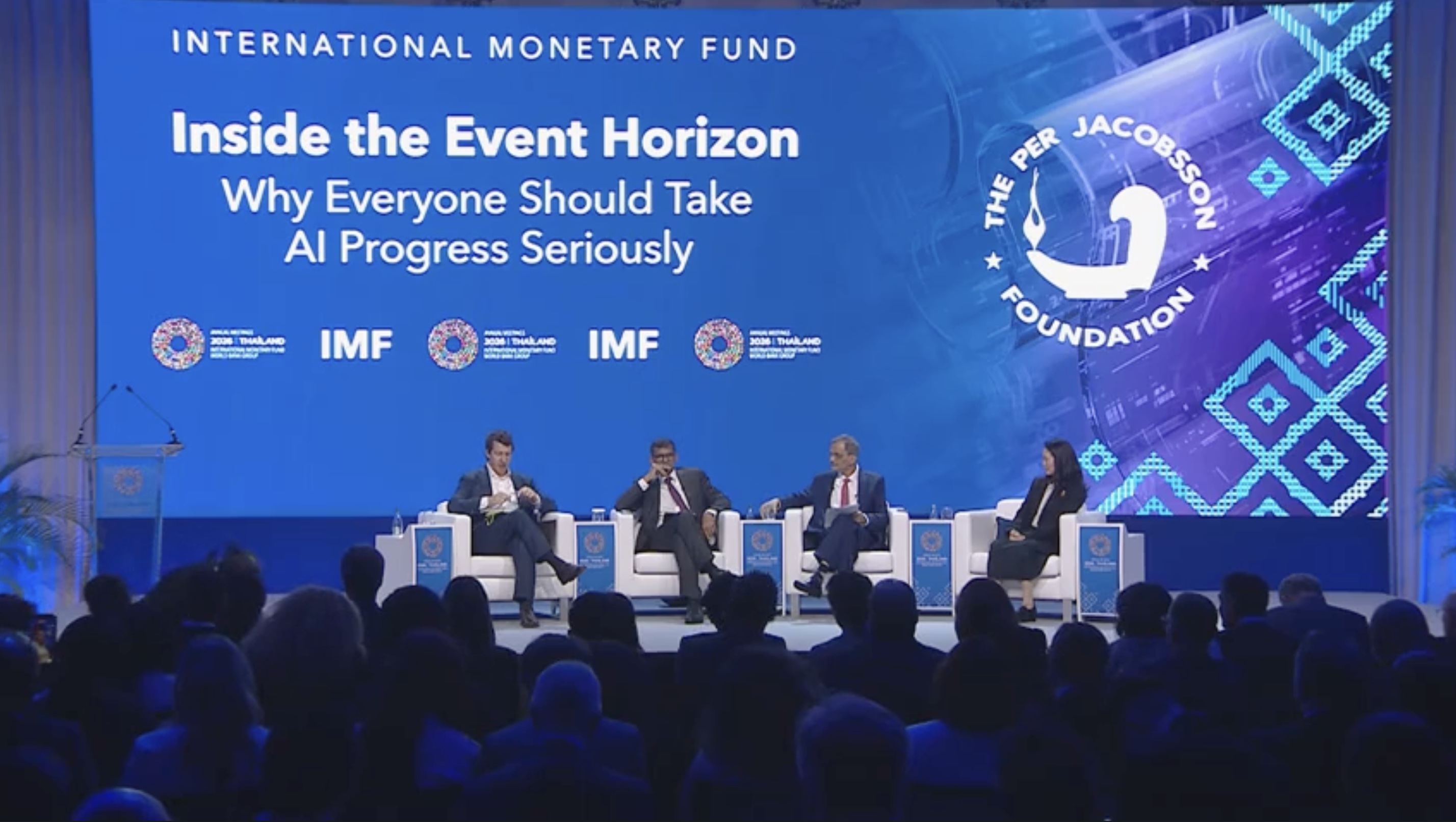
Bangkok · Humanity has "a handful of years, less than a decade easily," to build serious rules for artificial intelligence, Jack Clark, a cofounder of Anthropic, told the International Monetary Fund's annual meetings on Saturday.
The rules will have to reach his own industry, Mr. Clark said. The world will need "unusual and serious rules for this technology and the companies building it," he said, along with restraint, which he called the hardest and most noble human trait. Build the infrastructure, he said, but go slowly and deliberately on developing the technology itself.
"A handful of years, less than a decade easily."
Jack Clark, cofounder of Anthropic
The clock is short, he argued, because A.I. has begun to speed up science, and with it everything built on science. "The singularity is here," he said, using the word science fiction writers have long used for the point at which machines drive progress faster than people can follow.
The economists who answered him took up other questions: who is paying for the machines, who will be hired to work beside them and who will answer when they fail.
Mr. Clark had opened his lecture by listing his credentials. He is a human being, he said. There is one of him, and it took almost 40 years to build the experience to give the speech. Half an hour later he came back to the line and turned it into an argument. He asked the room to picture running hundreds or thousands of copies of himself at once, and creating new ones instantly instead of waiting four decades. That is what the next few years will look like for large parts of the economy, he said.
The lecture came on the second-to-last day of the I.M.F. and World Bank meetings, which ran from Oct. 12 to 18 at the Queen Sirikit National Convention Center in Bangkok, the first time Thailand has hosted them since 1991. Before the week began, the fund's managing director, Kristalina Georgieva, named three risks hanging over the global economy: the fast expansion of A.I., persistently high energy prices and record public debt. The program included sessions on A.I. and jobs, A.I. and cyber risks, and a World Bank discussion titled "Small AI: More and Better Jobs." Nigel Clarke, the fund's deputy managing director, said A.I. had come up in meetings, seminars, corridor talks and back at the hotels. "If it wasn't mentioned, it was the subtext," he said.
The occasion was the Per Jacobsson Foundation Lecture, a fixture of the annual meetings named for the Swedish economist who led the fund from 1956 until his death in 1963. Jacobsson had worked at the League of Nations and then at the Bank for International Settlements, which he joined in 1931. Raghuram Rajan, who chairs the foundation, described him as an internationalist who watched trade and cooperation collapse in the Great Depression and helped rebuild both after World War II, "at a time when, very much like today, international cooperation was at a great discount."
The roster of speakers over more than six decades, Mr. Clarke said, has been central bank governors, finance ministers, economists and presidents. It had never included the cofounder of a company not yet five years old. The foundation's board settled on A.I. as the topic in January and then asked itself, Mr. Clarke said, "how exactly is this going to work?" He had met Mr. Clark by chance in California a few weeks earlier, he said: "no podium, no title cards, just a knapsack and a pair of jeans."
Mr. Clark began his career as a journalist covering data centers. He left journalism in 2016 for OpenAI and helped found Anthropic a few years later. For the past decade, he told the officials, he had been visiting governments to say that A.I. would one day become powerful enough to alter national security, change the economy's trajectory and perhaps build itself. He now says that day has come.
Professor Rajan, a University of Chicago economist, moderated. In 2005, as the fund's chief economist, he had told a symposium at Jackson Hole, Wyoming, that financial innovation might be making the world riskier. He pressed Mr. Clark on the question many young people are asking: Will they find work, and keep it?
Mr. Clark conceded that his own economic model cannot predict which jobs new industries might create. It does predict, he said, potentially very disruptive effects on employment.
"The Singularity Is Here"
The word Mr. Clark used for what he sees coming is older than his industry. The science fiction writer Vernor Vinge forecast a singularity in 1993, Mr. Clark said, and described a point at which "greater than human intelligences drive progress," and "that progress will be much more rapid." Past it, in Mr. Vinge's phrase, "our models must be discarded and a new reality rules." Mr. Clark told the officials he believes that this year "we've gained convincing evidence that it has now begun."
The evidence came as a stack of claims, none easy to check from a podium. Software came first. A.I. systems, he said, are now more capable and efficient than the vast majority of the world's software engineers, and Anthropic's own researchers produce almost 10 times the code they did in the company's first four years. The same gains have made the systems better at cyberattacks and at cyberdefense, he said, and the two cannot be separated.
Then came science. He said A.I. systems had been used to propose solutions to the Navier-Stokes Millennium Prize problem, the Jacobian conjecture and several open Erdős problems, and that in many cases the systems supplied the core insight. Researchers have used A.I. to design viruses from scratch, he said, and some drugs now in clinical trials were designed in large part by A.I. In laboratories, models increasingly operate equipment on their own. He named no papers and no trials.
Mr. Clark's comments come as Palantir's chief technology officer, Shyam Sankar, who has criticized what he called a kind of "mass psychosis" or "social delusion" in Silicon Valley, in which some tech workers hold a near-religious faith in artificial intelligence, according to the SF Chronicle. Mr. Sankar pointed in part to his claim that some A.I. researchers have taken up smoking to show how firmly they believe the technology will one day cure cancer. Mr. Sankar did not provide any evidence for that claim.
What struck Mr. Clark as profound, he said, was that a single underlying model did most of this. "We have virtual polymaths."
The benchmarks he described pointed the same way. On Humanity's Last Exam, a test spanning chemistry, mathematics, classical literature and ecology, the best systems scored 8 percent when it launched in January 2025. This week, he said, the top score is 67.7 percent, held by Claude Opus 5.5, an Anthropic model. On FrontierMath, a set of problems curated by professional mathematicians, the best systems solved 2 percent at its November 2024 launch and now solve 94 percent. He keeps a file of 100 such graphs, he said, refreshed that morning, and they bend the same direction, upward, starting in the past two years and sometimes the past one.
Share of problems solved or score at launch, and the figure Clark gave this week
View data
| Benchmark | At launch (%) | This week, per Clark (%) |
|---|---|---|
| Humanity's Last Exam (launched Jan. 2025) | 8 | 67.7 |
| FrontierMath (launched Nov. 2024) | 2 | 94 |
He closed the evidence with a story. The week before, a paper had tested A.I. on 50 unpublished problems in theoretical physics, written by physicists from their own research so that no model could have read the answers. One of the authors, the Indian physicist Suvrat Raju, wrote a Facebook post that Mr. Clark read aloud. "I don't know of any individual who can solve any significant fraction of our final collection of problems without AI assistants," Mr. Raju wrote.
A model called Astra scored in the late 80s on the first pass. Then, as the authors examined its mistakes, it insisted that it was right and the experts' answers were wrong. The authors went back, and in several cases the experts found subtle errors buried in their own calculations. As they corrected them, Astra's score rose to 98 percent, 49 of 50.
"I don't know of any individual who can solve any significant fraction of our final collection of problems without A.I. assistants."
Suvrat Raju, physicist, in a post read aloud by Mr. Clark
Mr. Clark compared it to a scene near the end of many films, when the protégé proves to the mentor that they are ready to go out on their own. "That's what happened last week," he said.
His reason for telling it was creativity. Breaking new ground, he argued, tests one of the last frontiers of A.I. capability, and a system that can do it in physics might do it in A.I. research too, "which could have an explosive effect on innovation."
From 10 Million Scientists to a Billion
He then turned to economics, a pet peeve for many at the I.M.F. and World Bank meetings, where, according to Asian Value Investor, most of the audience were professional economists. For decades, ideas have been getting harder to find. A 2020 paper in The American Economic Review, by Nicholas Bloom, Charles I. Jones, John Van Reenen and Michael Webb, found that research productivity is falling steeply across industries even as research effort grows. Keeping Moore's Law going, for example, takes more than 18 times the researchers it took in the early 1970s. Mr. Clark did not cite the paper, but he described its problem: countries keep adding researchers and getting less from each one.
His proposal was to change the supply. Training a new cohort of scientists takes 10 to 15 years and millions of dollars, he said. An A.I. system can be created at once, in any number, as long as there is computing capacity to run it. Every human scientist, in his telling, becomes the supervisor of hundreds or thousands of virtual ones.
Anthropic's economists have modeled what follows. Under what Mr. Clark called singularity conditions, one model puts American gross domestic product at $44 trillion by 2030. "Which sounds very outlandish, I know," he said, but growth on that scale would require new industries, and autonomous scientific inquiry is how they would appear.
For 10 years, he said, he had urged governments to build electric capacity and data center space. "Not many policymakers listened," he said. "I think now we deal with the consequences of that." Data centers sit mostly in the United States, China and, increasingly, the Middle East, and supply chains are tight enough that prices are rising.
Now he wanted laboratories. The next phase, he said, moves A.I. into the physical world, running experiments and operating robots. UNESCO estimates the world has about 10 million scientists, which he called too few to oversee today's work, with too few labs for materials analysis, too few biology labs to test drugs and too little large equipment on the ground or in space. He pictured a billion virtual scientists directed by those 10 million human ones. He did not say who would pay for the extra laboratories.
Poorer countries, he said, have an opening: a developing country that supplies raw materials can build testing facilities, grow a scientific community and leapfrog. "That's a choice." The catch applies to everyone. "An avalanche of proposed new drugs is of little use," he said, "if only a handful can ever be tested." Moving discoveries out of the lab and into clinics, factories and fields, he said, was a job for the policymakers in front of him.
The Ledger
The first economist to answer Mr. Clark brought a different kind of evidence. Yan Shen, a Peking University professor who directs the university's Institute of Digital Finance, described what she called a paradox: China is investing heavily in A.I. and adopting it fast, and the profits have yet to follow.
She laid out a chain of links between investment and lasting growth. A.I. has to be widely adopted, adoption has to raise productivity, productivity has to produce real gains, the gains have to be spread and the spread has to create demand. In China, she said, the early links are strong and the later ones are weak. Generative A.I. users reached 700 million in the first half of this year, and about 30 percent of large enterprises above a size threshold have adopted it. Demand for computing power rose about 170 percent from a year earlier.
Yan Shen's five links between A.I. investment and lasting growth
- Wide adoption. Generative A.I. users reached 700 million in the first half of the year, about 30 percent of large enterprises have adopted it, and demand for computing power rose about 170 percent.
- Higher productivity. A Peking University study found heavier A.I. use raises productivity on average, with the biggest gains at firms already near the top.
- Real gains. Among China's listed companies, no sign yet that more A.I. use raises return on assets or return on equity.
- Gains spread. Workers in more A.I.-exposed occupations showed lower labor income for the head of household and a higher chance of carrying debt.
- Demand. Cheaper supply is meeting flat demand because incomes are not rising with the technology, which she said may worsen deflation pressure.
A study by the National School of Development at Peking University found that heavier A.I. use raises productivity on average, but that the firms already near the top gain the most. Among China's listed companies it found no sign yet that more A.I. use raises return on assets or return on equity. Her team's field study, she said, found three explanations. Companies often do not know which technology suits them. They adopt because competitors have, a "theater effect," as she put it, and cannot afford to lose the game. And the technology moves so fast that an investment can be obsolete before it earns anything. Households told a harsher story: workers in more A.I.-exposed occupations showed lower labor income for the head of household and a higher chance of carrying debt.
The field visits also produced bright spots. A milk tea chain less than three years old, she said, runs 15,000 branches and aims for 20,000 this year, standardizing fresh ingredients within two days in a way she said would be hard without an A.I. system. A social media post in which a young woman complained that her boyfriend never separated his socks from the rest of the laundry reached a washing machine maker, which built a machine that runs three separate washes in one load. An app aimed at China's shortage of physicians, which links patients, hospitals, doctors and the pharmaceutical side, widened coverage and cut costs.
On the national scale she saw a split. She put private A.I. investment in China in the first half of the year at about 250 billion yuan, against American spending she tallied, citing The Wall Street Journal, at $600 billion spent and $3 trillion committed. China-originated models overtook American ones in share of tokens consumed on OpenRouter, a model marketplace, after March. Worldwide downloads of Chinese A.I. apps spiked after the arrival of DeepSeek and have slowed since. Chinese apps lead in image and video, she said, and have lost ground in productivity tools. She added that China faces deflation pressure that A.I. may worsen, with cheaper supply meeting flat demand because incomes are not rising with the technology. Her bottom line: China is not at the frontier.
V. Anantha Nageswaran, chief economic adviser to the Indian government, reached back to Jackson Hole in August 2005, where Professor Rajan asked whether financial innovation had made the world riskier and a distinguished member of the audience called the premise slightly Luddite. Three years later, Dr. Nageswaran said, the answer arrived. He said he might earn the same label and would accept it on one condition. "I'm against technology that takes away human agency and against finance that hides its own risks."
Mr. Clark had given the builder's view, Dr. Nageswaran said. He would give the view from the receiving end. Finance ministries, central banks and households, he said, will pay the bill.
The bill, as he itemized it, begins with debt. The American data center build-out may need more than $10 trillion by 2032, he said, about 3.6 percent of gross domestic product a year. This year, for the first time, the big cloud companies will spend more on capital expenditure than they generate in cash.
Read: AI's Inflationary Footprint Arrives First
Borrowing covers the gap, increasingly off balance sheet: Meta's Hyperion data center is about 90 percent debt, raised through a joint venture whose bonds do not appear on Meta's balance sheet. The money also circles. Hyperscalers invest in A.I. labs, and the labs sign large computing contracts with the same hyperscalers; in the first quarter, he said, about a third of the big five's earnings came from marking up such stakes. On top of that sit leveraged exchange-traded funds concentrated in A.I. stocks and hedge fund borrowing from prime brokers, which he said has doubled since 2023.
Figures V. Anantha Nageswaran cited in his remarks
Read: Goldman's bet on the software short
The bill also reaches public budgets, and here he turned Anthropic's own modeling against its optimism. In an extreme scenario the company has run, he said, the American economy ends up a third larger by 2030, but labor's share of income falls from about 60 percent to 45 percent and the wages of knowledge workers end up more than 10 percent lower than they would have been. The outcome that best justifies today's valuations of hyperscalers and labs, he said, is the one that shrinks the income tax base. If A.I. disappoints instead, he said, the Bank of England has warned that fiscal forecasts built on higher productivity will suffer, and so will government debt. "Either way, governments are exposed."
"Either way, governments are exposed."
V. Anantha Nageswaran, chief economic adviser to the Indian government
Read: If you build it, will they come? Inside a $30 billion bet.
His advice to finance ministries ran against the grain of the afternoon. Keep A.I.'s productivity dividend out of your forecasts, he said, until it shows up in the data. Mr. Clark had spent his half hour describing an American economy of $44 trillion by 2030.
The First Rung
Dr. Nageswaran's first risk was the bottom of the career ladder, and he put numbers on it. In a 41-country study, he said, the junior share of the workforce fell in 23 of the 31 countries where it could be measured. In the United States, employment among 22- to 25-year-olds in the most A.I.-exposed jobs has fallen about 19 percent behind that of older workers in the same jobs.
The cause, he said, is an incentive problem. A firm used to earn back the cost of training a junior from the routine work she did. A.I. now does that work cheaply, so training is a pure cost, and each firm, acting rationally, hires fewer juniors. Together they dry up the pipeline of future experts. The people who will check A.I.'s work tomorrow, he said, are made on that first rung today.
"The people who will check A.I.'s work tomorrow are made on that first rung today."
V. Anantha Nageswaran
His second risk was to the habit of thinking itself. Researchers at the M.I.T. Media Lab tracked people writing essays over four months, with and without an A.I. model, and recorded their brain activity. Connectivity weakened as reliance grew, he said, and in the first session 83 percent of ChatGPT users could not quote a sentence from an essay they had written minutes earlier. The authors called it cognitive debt. The study is small, he said, but it matches what teachers report.
Professor Rajan took the question to Mr. Clark, who gave three answers. Early-career hiring needs support, he said, and Anthropic has funded an initiative he called Claude Core that aims to place 1,000 recent graduates in nonprofits and aid groups across America, with the company paying their salaries. Some occupations will lose work, he said, naming call centers and customer service, while others, including some scientific fields, look neutral or positive, and Anthropic shares data from its platform with governments so they can tell which is which. The third answer was the concession that his model cannot predict the jobs new industries might add.
"I don't say that blithely," Mr. Clark said. Changing how science and technology get done, he said, could change "pretty fundamental things" about how labor markets work.
He also picked up Dr. Nageswaran's suggestion that large firms disclose their entry-level hiring. Anthropic had published a post that day on its own hiring and training, including trends by seniority, he said, and firms should be required to share such numbers. "That's the telemetry that lets you make decisions."
Asked whether young Chinese worry as much as young people elsewhere, Professor Shen answered with an observation from the field. Engineers pushed out of information technology jobs, she said, have become cheaper for service companies to hire, as the milk tea chain's owner told her. China is graduating five million students in the STEM fields this year.
Dr. Nageswaran's answer for countries with a lot of labor ran the other way, toward work that machines handle poorly. Wages in occupations that need human presence, hands and judgment end up about a third higher, he said: nursing, elder care, teaching, counseling, cooking, the work of electricians, welders and plumbers, and of the technicians who keep data centers running. Aging societies will need them. India alone needs about 1.8 million more doctors, nurses and midwives to reach a minimum standard. What holds young people back is status. In a recent survey he cited, 71 percent of young Americans said trade school carries more stigma than a degree. He wants vocational qualifications given formal parity with degrees, as in Germany's Meister system, apprenticeships that begin while students are still in school, and a national mission on skills that he said India deserves and other emerging economies could copy.
Asked whether it hurts to be off the frontier, he called it a blessing in disguise. The frontier is capital-intensive, he said, and the leveraged models that fund it are beginning to unravel, so being a second or third mover may be fine. He pointed to Indian start-ups building cheaper "edge" A.I., to a pilot at the Aravind eye care system for detecting diabetes-related blindness early, and to remote classrooms that teachers will not travel to. India has to create about eight million livelihoods a year, he said. Staying off the frontier, in his words, "is probably concentrating minds on where we should be concentrating."
Who Holds the Reins
Mr. Clark had asked governments to build quickly. On the technology itself he asked for the opposite. That A.I. will be a capable scientist, he said, "does not mean we should use it for absolutely everything."
He framed two choices. The first is where to point it. Biology deserves the strictest human oversight and transparency, he said. A.I. research is harder, and it is his own industry's problem: labs like Anthropic must decide how much oversight to apply when A.I. does the work of improving A.I. That could speed progress and raise the risk of losing control of the technology. A student in the physics department of a Tokyo university, whom he met earlier in the week, had told him that A.I. could already do many of the experiments the student worked on, and wanted to know which to do personally and which to leave to the machine. "I don't have the answer," Mr. Clark said. Every field of science, he said, will have to find one quickly.
The second choice is how much humans need to understand. In mathematics this year, he said, the advances made by A.I. were creative enough that people are spending time decoding them. In a few years the systems may be inventing scientific equipment built around how A.I. works rather than how minds do. "Do we need to understand that equipment?" he asked. "Should we."
Then he turned personal. As a teenager he read about population growth, climate change and resource extraction, and expected a Malthusian collapse. Solar panels got cheap faster than anyone predicted. Medicine produced cures for illnesses that had killed people, including some in his own family. Companies learned to land rockets, and researchers began using A.I. to decode animal speech. He works on A.I., he said, because it can produce more of that, and because whether it does is a matter of choices. It is also, he said, a technology with "danger woven into it."
He closed with Carl Sagan, who imagined that the humans who reach the stars would resemble us, with more of our strengths and fewer of our weaknesses. Sagan assumed hundreds of thousands of years to get there. Mr. Clark said the world has "a handful of years, less than a decade easily."
Dr. Nageswaran had made the same point in a banker's idiom. OpenAI's chief scientist wrote last month, he said, that no lab has solved alignment well enough to keep scaling responsibly at maximum speed. A lab that slows down loses the race and its valuation. "Nobody pays the lab for restraint," he said, "and we have seen this structure before. It was called banking before 2008." He wanted supervisors to treat signed leases, residual value guarantees and joint venture debt as the debt they are, and the Financial Stability Board to map those exposures across borders. Safety testing, he said, cannot be left to the labs, and the developing world belongs in the room where the standards are set.
"Nobody pays the lab for restraint."
V. Anantha Nageswaran
Professor Rajan asked the question that hangs over such proposals. Anthropic has been at the forefront of talking about existential risk, he said, while countries decline to regulate for fear that rivals will pull ahead. Is humanity doomed because it fears other humans more than extinction?
"No," Mr. Clark said. "Humanity is not doomed." People, he said, try everything except the hard thing until a crisis arrives, and Anthropic would like to skip the crisis. He found it strange that regulating A.I. is discussed as if it required inventing general relativity. People work in regulated offices, drive regulated cars and eat regulated food. Basic safety testing, transparency and disclosure standards, and a way to price the risk would be a start.
Professor Shen suggested beginning with finance. A.I. agents in financial markets raise market risk and operational risk that no single country can manage, she said, and cooperation there is among the least political options. "Well, thankfully finance is non-political," Mr. Clark said, "so it should be easy."
Dr. Nageswaran was less hopeful. Nuclear technology stayed in few hands, so safeguards were possible, he said. "This particular horse may already have bolted." What he hopes for is an accident serious enough to wake everyone and short of catastrophe, one that would make governments consider disabling some features behind safeguards, or revisiting technologies that were mothballed because their costs exceeded their benefits. "If an accident that is not catastrophic but serious enough makes all of us think about having this conversation," he said, "that I would count as progress."
He had closed his own remarks with an image from the Upanishads, which compares a human being to a chariot, with the mind holding the reins and the intellect as the charioteer. A.I. adds a very powerful horse, he said, and horses without a charioteer do not take us where we want to go. "The real risk is not that machines will start to think," he said. "It is that we will stop."
Professor Rajan came back to the reins at the end. If the machines become much more capable than people, he asked, at what point do we say, take the reins?
Mr. Clark said the choice is real and approaching. Anthropic's chief executive, Dario Amodei, has said in a public post that it may make sense to limit the ceiling of intelligence allowed in these systems, a notion Mr. Clark called a little at the edge of the Overton window and exactly what the question implies. People control the technology now, he said, while it gets more capable faster than anyone's intuitions. The window to act is a small number of years. He recalled the philosopher David Chalmers saying that philosophy now has a deadline. "I think the policy conversation has a deadline now," Mr. Clark said.
Two questions came from the floor. Sandeep Mehta noted that Professor Rajan had warned of the 2008 crisis and cited a report putting global debt at $365 trillion, 311 percent of global output. Was another crisis coming? Mr. Clark said it was not his area. Dr. Nageswaran said, "I'm sure we will soon find out the answer."
The last came from Jenny Young, a chief economist at ICBC Standard Bank in London: If you had children, what would you want them to study? Mr. Clark said degrees built on rote knowledge will come under extreme pressure and that creativity holds its value. He said he might be talking his own book, but he expects the liberal arts, history, philosophy and ethics to matter more. His children are 3 and 1. Professor Shen said her daughter is already doing a doctorate, and that parents' main job is to protect curiosity and give children confidence about the future. Chinese education, she said, needs to move from the Confucian model, in which the teacher talks and the students memorize, toward questions and answers.
Dr. Nageswaran went last. Teach students how to ask the right questions, he said, and send them back to the basic skills of reading and writing with their hand.
Comments
Sign in with LinkedIn to join the discussion. Your LinkedIn name and photo appear publicly beside your comment. Please keep it civil and on topic.