
News · Macro · Global
IMF and World Bank open Bangkok meetings with war, oil and debt on the table
Finance chiefs gather outside Washington for the first time in three years as the Iran war enters its eighth month.
For information only. Not investment advice. Disclaimer · Special coverage: IMF–World Bank Annual Meetings, Bangkok
AI-generated summary, reviewed by the editor.
- The IMF and World Bank meetings opened in Bangkok with the Strait of Hormuz shut, oil above $100 a barrel and public debt at its highest since World War Two.
- IMF chief Kristalina Georgieva warned prices would keep rising; the fund still projects 3% global growth for 2026.
- Developing countries owe about $400 billion in external debt payments this year, with interest above 10% of revenue on average, Reuters reported; Treasury Secretary Scott Bessent is skipping the meetings.
It restates the article and adds no new facts. How we use AI
Bangkok · In October 1991, Bangkok declared two public holidays to clear its traffic for the finance ministers and central bankers heading to the Queen Sirikit National Convention Center, and launched a large security operation to protect them. More than 12,000 delegates were expected for the IMF and World Bank annual meetings, the Christian Science Monitor reported at the time.
Their worries then were a sluggish U.S. recovery and a shortage of capital, the Monitor reported. Mikhail Gorbachev had signed an agreement giving the Soviet Union special association status with the fund, and the IMF's managing director, Michel Camdessus, reportedly said full membership was premature while Moscow and the republics sorted out their relationship.
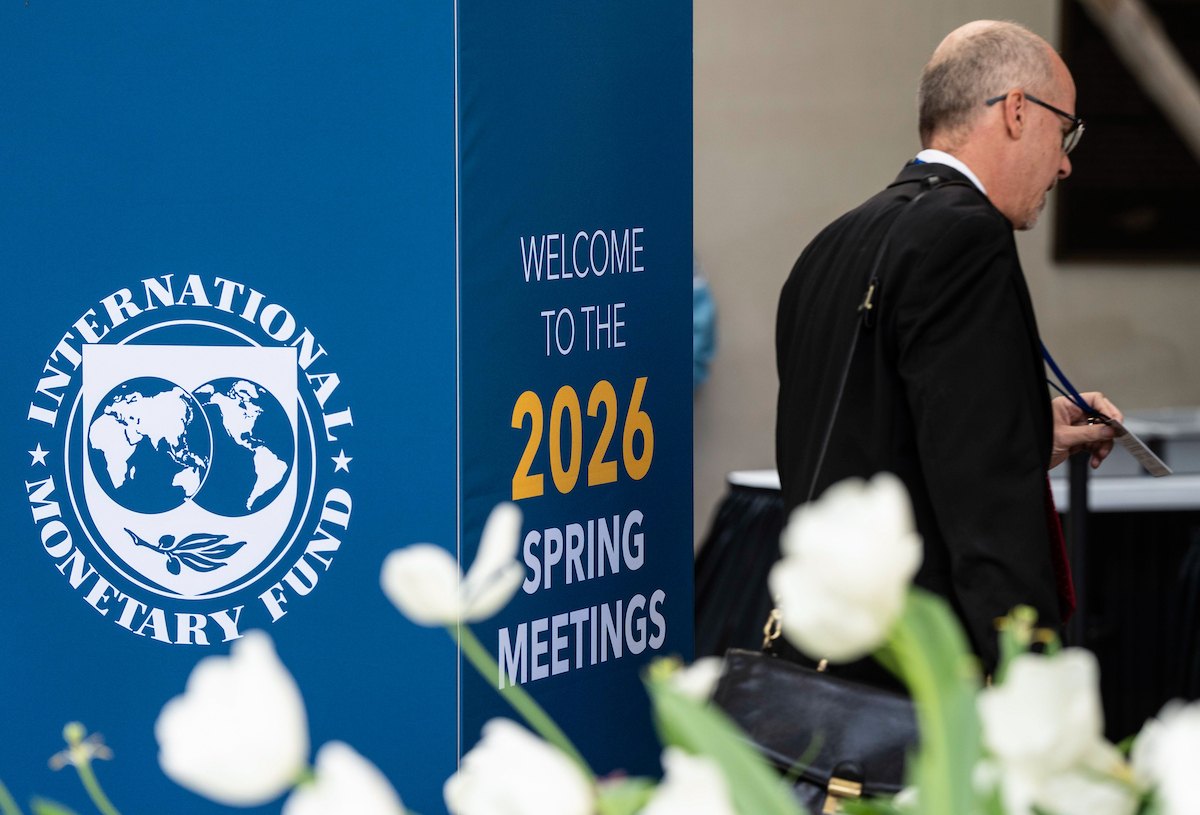
On Monday the same hall opened its doors again. Kristalina Georgieva, the International Monetary Fund's managing director, said 18,000 people had registered, 4,000 more than attended the last meetings held outside Washington, in Marrakech in October 2023, Reuters reported. Delegates from 191 countries are expected for the week, which runs Oct. 12–18 across a venue of about 300,000 square meters.
This year's worries are bigger. The meetings opened with the Strait of Hormuz shut, oil above $100 a barrel and public debt at its highest level since World War Two. The U.S. Treasury secretary stayed home. And Georgieva had warned three weeks earlier that prices would keep rising.
Delegates at IMF and World Bank annual meetings held in Bangkok and Marrakech
A war in its eighth month
The Middle East war sets the agenda. It began on Feb. 28, when the U.S.-Israeli-led campaign against Iran started, and Iran responded by closing the strait, which normally carries about a fifth of the world's oil. More than 1 billion barrels have been released from stocks since then, mostly from onshore commercial inventories, and industry executives say accessible storage is running low, Reuters reported. The Group of Seven (G7) countries agreed to release another 100 million barrels of diesel and crude from emergency reserves, after pressure from President Donald Trump, who wants lower gasoline prices before the November elections.
Trump also announced a Russian diesel deal and a temporary waiver of some U.S. sanctions on Moscow, which Ukrainian President Volodymyr Zelenskiy criticized. Reuters noted that attacks on Saudi airports have complicated flights to Bangkok.
Brent crude, US$ per barrel
"Winter is coming."Georgieva, in her curtain-raiser speech, as reported by Reuters
Georgieva used the same phrase in New York on Sept. 22, at a Semafor event, when she warned that prices would keep rising. Oil near $100 had so far been absorbed by the global economy, she said, but she did not expect that to last. Inflation had pushed central banks worldwide to raise interest rates, which lifted government borrowing costs and cut the room to cushion the fallout. Semafor noted that the United States will spend more on debt interest this year than on its military.
Governments "should prepare for people being more unhappy," she said, adding: "Maybe on the street." Rising rates were "washing away hard-earned gains in emerging markets." Artificial intelligence has offset part of the energy shock, she said, but not all of it.
Josh Lipsky of the Atlantic Council told Reuters the link between security and finance is now plain, pointing to the closure of Hormuz as a direct consequence of events three years ago.
For now the forecasts have held. The fund still projects 3% global growth for 2026, and Reuters reported it may nudge its 2027 forecast slightly higher, while Ukraine and Gulf economies face downgrades. CNBC reported that AI-related investment and trade have lifted output in a handful of economies, helping keep global expansion near 3%. The new World Economic Outlook, titled "Resilience under Strain, Urgent Choices," is due Tuesday morning.
World Bank President Ajay Banga said growth has held up better than feared and told Reuters the bank isn't cutting its global forecasts for now, though pressures are building again. He is watching diesel and fertilizer costs, heavy debt and the risk of a strong El Niño. "The real thing is not just El Niño by itself; it's the combination," Banga said, adding that it "will call upon all of us to be far more careful on what we prepare for in the coming months." Experts cited by Reuters warned a "super" El Niño could cause 450,000 heat-related deaths.
The debt bill
Public and external debt, IMF figures as reported by Reuters
Developing countries owe about $400 billion in external debt payments this year, and interest already takes more than 10% of their revenue on average, Reuters reported. IMF research has found that food and energy price spikes are an increasingly common cause of economic crises.
Diplomats from the Group of 20 (G20) major economies see little appetite for a COVID-style suspension of debt service payments, Reuters reported, citing high debt and political pressure. New IMF guidance favors fewer but deeper reforms as loan conditions, and many lower-income countries fear that means painful austerity.
Iolanda Fresnillo of Eurodad, the European Network on Debt and Development, said: "We fear that this review of conditionality policy is just going to make things worse." She told Reuters the fund is becoming "less and less relevant" if its governance does not change.
Kenya avoided a debt restructuring through spending cuts and tax rises. Both sparked youth protests.
Empty chairs, open streets
Treasury Secretary Scott Bessent is skipping both the meetings and this week's G20 finance gathering, which the United States leads this year. A U.S. official told Reuters he cited "domestic engagements." Thai Examiner reported that Deputy Secretary Francis Brooke and Under Secretary Erin Browne lead for Treasury. Reuters said the absence may frustrate counterparts amid tensions over Iran, Ukraine and U.S. sanctions on the International Criminal Court.
Several other finance ministers are staying home for domestic budget and election duties. Most central bankers are attending, and Federal Reserve Chairman Kevin Warsh sits down with Georgieva on Friday, Oct. 16, the day of the plenary. Swiss President Guy Parmelin is in town for what Thai Examiner described as the first Swiss presidential official visit to Thailand in 22 years.
Outside the hall, police are bracing. A Metropolitan Police memo dated Oct. 10 listed six roads that could be restricted if demonstrations break out, and a deputy commissioner called the measures "contingency measures." The convention center has 17 X-ray checkpoints and 19 walk-through gates, and about 500 Tourist Police are on duty, Thai Examiner reported. Police said they had identified no specific attack plot. The Assembly of the Poor, a Thai grassroots network, said it would mobilize during the meetings.
The weather was a bigger worry a week ago. Floods since mid-September had affected more than 3.5 million people nationwide by Oct. 5, with 31 deaths, according to AP figures cited by Thai Examiner. Anutin ordered a review of four flood scenarios that day, including cancellation. The Bank of Thailand later said the venue and participant locations within a 5-kilometer radius were not expected to be affected, provided upstream water is managed well and no heavy rain falls.
Dates reported by Reuters, Semafor, Thai Examiner and the IMF schedule
- Last meetings held outside Washington, in Marrakech. Days earlier, Hamas attacked Israel.
- The U.S.-Israeli-led war with Iran begins. Iran closes the Strait of Hormuz.
- Georgieva tells a Semafor audience in New York: “Winter is coming.”
- Thai Prime Minister Anutin Charnvirakul orders a review of four flood scenarios for the meetings, including cancellation.
- Meetings open at the Queen Sirikit National Convention Center. Bessent stays home.
- World Economic Outlook, “Resilience under Strain, Urgent Choices.”
- Plenary. Fed Chairman Kevin Warsh joins Georgieva at 10:30 a.m.
- Meetings close. A signing ceremony for the 2029 Annual Meetings is set for Sunday morning.
The test
Lipsky told Reuters the last off-site gathering took place days after the Hamas attack on Israel in October 2023, and that officials in Marrakech dismissed it as not an economic issue.
"They have to be proactive and they have to recognize that they don't live in the world they used to," Lipsky said.
Sources
- Reuters (Andrea Shalal), Oct. 11–12, 2026: curtain-raiser on the Bangkok meetings, via Al-Monitor and Cyprus Mail.
- Semafor, Sept. 22, 2026: Georgieva remarks in New York.
- Christian Science Monitor, Oct. 8, 1991: "IMF, World Bank Meet in Bangkok."
- Government of Thailand: hosting the 1991 Annual Meetings.
- Thai Examiner, Oct. 12, 2026: security, delegates, floods.
- The Nation: Bank of Thailand flood assessment.
- Fortune: price of oil, Oct. 9, 2026. Polity/Reuters: IMF July 2026 Update.
- CNBC, via CNBC Africa: AI and global growth.
- Common Dreams, Oct. 6, 2026: Assembly of the Poor.
- IMF: 2026 Annual Meetings schedule.
Comments
Sign in with LinkedIn to join the discussion. Your LinkedIn name and photo appear publicly beside your comment. Please keep it civil and on topic.