
News · Macro · Global
The Ghost in the Machine
How a Soviet humiliation in London became the operating manual for Beijing's economic strategy
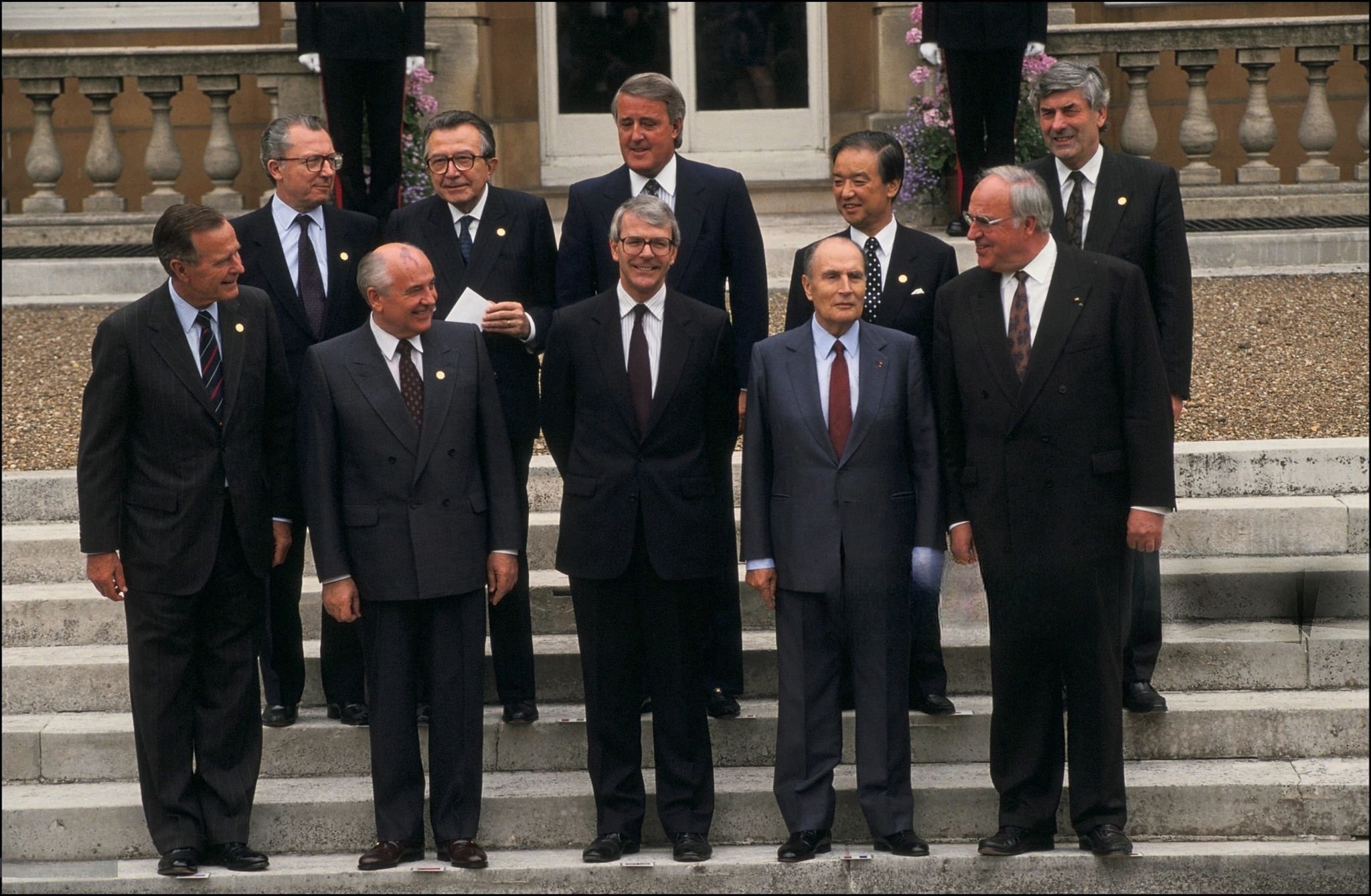
On the morning of July 17, 1991, Mikhail Gorbachev flew into London with a number in his head.
National income was down eleven percent. Industrial output had fallen nearly six percent. Shelves across the Soviet Union were going bare. His government had run out of money to service its foreign debt — which had swelled from about $25 billion when he took power to nearly $80 billion six years later — and his aides were telling him, privately, that the country had perhaps six months before the whole apparatus began to fall apart in ways that could no longer be managed.
What Gorbachev wanted, when he arrived at Lancaster House for the 17th G-7 Summit, was a financial rescue. Full membership in the global economy. Western capital flowing into Soviet privatization. Something to show the Soviet people that the gamble of perestroika — the bet that openness would regenerate the system rather than unravel it — had been worth making.
What he got was a meeting.
The G-7 leaders offered the USSR what their joint communiqué called "special association" with the IMF and World Bank — access to technical advice, expert assessments, consultations. No credits. No debt restructuring. No money.
John Major, the British prime minister who hosted the summit, called it "an historic day." It was not the kind of historic day Gorbachev had in mind. Thirty-three days later, Communist hardliners launched a coup against him. Five months after that, the Soviet Union ceased to exist.
Western scholars have analyzed the failure at Lancaster House at length: Was it a missed opportunity to stabilize a nuclear state in crisis? A deliberate strategic calculation? A failure of imagination? Less attention has gone to what the episode looked like from Beijing.
The Soviet collapse did not come as a shock to the Chinese Communist Party. It came as a lesson.
Within months of the dissolution in December 1991, the CCP had begun organizing the study of Soviet failure into something institutional — not a postmortem conducted at a respectful distance, but an active forensic project aimed at identifying every mistake, every inflection point, every structural vulnerability that had allowed the world's second superpower to simply disappear. The party school system — which trains hundreds of thousands of Chinese cadres at every level of government — established the Soviet experience as mandatory curriculum. Formal study delegations fanned out to Poland, Hungary, Romania, the Baltic states, visiting the organizational ruins of fallen communist parties and compiling internal reports on what had gone wrong and why.
The scholar who became the party's leading expert on this question was a woman named Zuo Fengrong, director of the International Politics Research Department at the CCP Central Committee Party School. Between 2010 and 2013, Zuo produced two major works on Soviet history: The Truth About the Soviet Union, a reference volume co-edited with three colleagues that addressed 101 discrete questions of Soviet historical interpretation, and The Perestroika Period, the eighth volume of a nine-volume party-commissioned history. These were not polemics. They were serious scholarship, grounded in archival sources, and they were about precisely the question that Lancaster House made vivid: What happens to a state that becomes financially dependent on systems it cannot control?
The Soviet answer was brutal in its clarity.
In 1980, the Soviet Union was earning hard currency the old-fashioned way — selling oil at roughly $35 a barrel, with energy exports providing about 60 percent of its hard-currency income. Then, in early 1986, global oil prices collapsed. By mid-year they were below $10 a barrel, a decline of more than 70 percent in less than six months. The Soviet government lost an estimated $20 to $21 billion in annual hard-currency earnings almost overnight.
Gorbachev's government responded by borrowing.
In the four years from mid-1985 through end-1988, the Soviet Union had managed to hold its net hard-currency borrowing to a cumulative $800 million. Then in 1989 alone it added $10 billion. By the time Gorbachev walked into Lancaster House, the Soviet Union owed foreigners roughly $80 billion and its commercial credit had been cut off entirely.
A RAND Corporation analysis documented that between late 1989 and mid-1990, the USSR had been transformed from "a preferred borrower in international credit markets" to "a potentially serious international credit risk, almost completely without access to international credit markets on normal commercial terms." When Gorbachev asked the G-7 for help, there was no leverage left. He had already spent it.
The Chinese party schools taught this episode not as tragedy but as anatomy.
In December 2012, weeks after becoming General Secretary, Xi Jinping spoke to party cadres in Guangdong province. The speech was not a public address; it was later leaked.
Xi's diagnosis of the Soviet collapse was straightforward: it came down to ideology. "Why did the Soviet Union disintegrate?" he asked. "Why did the Soviet Communist Party collapse? An important reason was that their ideals and beliefs had been shaken." Nobody, he said, had been "man enough to stand up and resist" the erosion of communist conviction. A year later he elaborated: "Historical nihilism rejected Soviet Union history, CPSU history, Lenin and Stalin. It messed up the thinking."
Nobody, Xi said, had been "man enough to stand up and resist" the erosion of communist conviction
The phrase "historical nihilism" — lishi xuwu zhuyi or 历史虚无主义 — became a term of art in Xi's China, a label for the crime of looking at the communist past with insufficient reverence. It was classified in a 2012 internal party document among seven dangerous Western values threatening official ideology, alongside constitutionalism and civil society. Senior party theorist Wang Huning is credited with developing the concept into a systematic ideological framework. The implication was clear: the party would not let its cadres suffer from the same crisis of faith that had rotted the CPSU from within.
Chinese academics have never fully converged on that explanation, and the disagreement has real policy stakes. The ideological reading — that the Soviet Union fell because its leaders stopped believing — points toward tightening discipline, policing thought, maintaining conviction. The structural reading — that the Soviet Union fell because it was fiscally exposed, technologically backward, and trapped in institutional arrangements that couldn't absorb an oil price collapse — points somewhere different. It points to reform sequencing, to financial insulation, to the specific question of how deeply you allow foreign capital into systems you can't afford to lose.
"Historical nihilism rejected Soviet Union history, CPSU history, Lenin and Stalin. It messed up the thinking."
Zuo Fengrong, who had spent her career in the structural camp, published a review in 2021 arguing that Chinese scholarship on the Soviet collapse had stagnated, having grown too focused on ideological explanations at the expense of serious institutional and economic analysis. It was, for a scholar writing within the party system, a pointed thing to say. The gap between Zuo's analytical framework and Xi's public framing is not a trivial one.
China's economic policy over the past three decades tracks more closely with the structural lesson than the ideological one.
When China joined the World Trade Organization in December 2001, after fifteen years of negotiations, the membership was celebrated as evidence of China's commitment to global economic integration. A closer look at the terms tells a different story. Foreign life insurers were capped at 50 percent ownership in joint ventures. Foreign banks got phased access to Chinese customers over five years. Geographic restrictions limited where foreign financial institutions could operate. And capital account liberalization — allowing money to move freely in and out of the country — wasn't required under WTO rules and wasn't undertaken. The element of the Washington Consensus most directly relevant to what had happened to Gorbachev's Soviet Union, the element that would have made China dependent on the confidence of foreign creditors, was quietly left off the table.
Barry Naughton, the economist who has studied Chinese reform strategy more carefully than almost anyone, describes China's approach as "growing out of the plan" — a method in which market-sector activity expands gradually while the state sector isn't directly dismantled. New enterprises compete in new markets; existing institutions aren't frontally attacked.
This is the opposite of what Russia did after 1991, when it followed Washington Consensus prescriptions of rapid privatization, price liberalization, and capital account opening. The Russian results were catastrophic by any measure: GDP fell roughly 40 to 50 percent between 1990 and 1995, a contraction larger than the Great Depression; poverty rates went from about 2 percent of the population to roughly 50 percent in four years; male life expectancy dropped from 64 to 57. China's policymakers observed all of this in real time.
China's approach was not without its own serious problems.
State-owned enterprises have been persistently inefficient, and the country's banks have repeatedly required large-scale restructuring to absorb bad loans — an estimated $350 to $500 billion in the late 1990s alone. IMF economists have spent years documenting that Chinese state banks allocate capital toward politically connected enterprises rather than highest-return investments.
Nicholas Lardy, one of the foremost Western economists of the Chinese economy, argued in Markets Over Mao that China's growth over the reform period was driven primarily by its private sector and export-oriented manufacturers rather than by state industrial policy, and that post-2012 expansion of state sector privileges has generated measurable efficiency losses. The Beijing model is not vindicated simply because the shock therapy model failed so badly.
Xi Jinping's signature economic initiatives since 2020 follow the same structural logic, even as their stated rationales have varied. The "dual circulation" strategy, announced in May 2020 and incorporated into the 14th Five-Year Plan, redesignated domestic demand as the economy's primary engine while assigning international trade a supplementary role. Its immediate triggers were concrete: US export controls that cut Huawei off from semiconductor technology, the disruption of global supply chains during the pandemic, a trade war with Washington. Whether the architects of dual circulation consciously reached back to the Soviet lesson — to the memory of a superpower that had bled out through a dependency it couldn't plug — isn't documented in the public record. The strategic logic is consistent with that lesson, whether or not it was explicitly invoked.
The common prosperity programme, announced formally in August 2021, brought regulatory actions against Alibaba, Tencent, DiDi, and Baidu, and effectively shut down the for-profit private tutoring sector, erasing roughly a trillion dollars in technology-sector market capitalization. Scholars disagree sharply about what this meant.
Mary Gallagher argues the campaign was primarily about party control over the private economy. Steven Roach sees it as a belated correction of decades of output-focused growth that ignored distributional distortions. Whether Xi was drawing on analogies about the political dangers of concentrated private wealth — the idea that oligarchs had hollowed out the Soviet system — or simply responding to domestic political pressures, is genuinely unclear from the available evidence.
China's managed opening to global technology markets — the selective integration that kept foreign capital out of sensitive sectors while welcoming foreign manufacturing and supply chain participation — created dependencies that the original risk model wasn't designed to see. Chinese semiconductor manufacturers came to rely on US-origin fabrication equipment. Chinese phone makers came to rely on US-designed chips. Chinese software developers came to rely on US platforms for electronic design automation. None of this registered as a vulnerability under the financial-dependency analytical framework that the Soviet lesson had generated. The lens was calibrated to watch for the kind of exposure that had left Gorbachev without leverage at Lancaster House. It wasn't calibrated to watch for the kind of exposure that, in October 2022, allowed the Biden administration to impose sweeping semiconductor export controls that set China's chip industry back by years.
The dual circulation strategy and the semiconductor self-sufficiency programmes now underway are the CCP's attempt to retrofit its risk model for a threat the original Soviet lesson hadn't anticipated. The party is still learning from 1991. It's just discovering that the lesson was more complicated than it first appeared.
Vladislav Zubok, whose history of the Soviet collapse is among the most authoritative written in any language, argues that the Soviet Union fell not primarily because of Western financial exclusion or ideological subversion — the elements the CCP has focused on — but because of conditions entirely internal to the Soviet system. Decades of capital misallocation. A leadership that systematically underestimated the severity of the fiscal crisis. Reform sequencing that destabilized existing institutions without building functional replacements. If Zubok is right, then the G-7's cold shoulder at Lancaster House in July 1991 was not the wound that killed the Soviet Union. It was more like the moment someone noticed the patient had already been bleeding for years.
That reading, if it were to take hold in Beijing, would change quite a lot.
It would mean the cautionary tale isn't really about dependency on foreign capital. It's about the institutional brittleness of systems that can't adapt, can't be honest with themselves about their own failures, and respond to every crisis by tightening control rather than improving function.
Zuo Fengrong made something like that argument in 2021, to the extent that a scholar inside the party system can make it. Whether anyone in the senior leadership was listening is a different question.
The 17th G-7 Summit ended on July 17, 1991. Gorbachev flew home to Moscow. On August 18, Communist hardliners placed him under house arrest at his dacha in Crimea. On December 25, he resigned. The Soviet flag came down from the Kremlin that evening. It has not gone back up. In Beijing, the study of the why continues.
The author is the Head of Research and Analysis at Icarus Asia, a Hong Kong-based risk and advisory firm. He is a former journalist who grew up in socialist India and has been visiting/ working in Hong Kong, China, for some two decades.
Further Reading
On the Soviet collapse
Vladislav Zubok, Collapse: The Fall of the Soviet Union (Yale University Press, 2021). The most authoritative recent account. Zubok's central argument — that the USSR fell primarily from internal failures of leadership and institutional design, not external pressure — sits in tension with the CCP's preferred reading of the same events.
Stephan Kieninger, "The West and the Question of Financial Assistance for Mikhail Gorbachev," in Transatlantic Relations (2019). Draws on archival sources to reconstruct the 1990-1991 diplomacy around Soviet bailout requests, including the Shevardnadze–Kohl exchanges and the lead-up to the London G-7. The most detailed account of how the Western decision not to help was actually made.
RAND Corporation, Soviet International Finance in the Gorbachev Era, Report R-4116 (1992). A dry title for a document that explains, with unusual precision, how the Soviet Union went from preferred borrower to credit pariah in roughly eighteen months.
On China's economic model
Barry Naughton, Growing Out of the Plan: Chinese Economic Reform, 1978–1993 (Cambridge University Press, 1995). The foundational account of how China avoided the Soviet trap — not by dismantling the planned economy but by growing around it. Still the clearest explanation of why the two reform paths diverged so sharply.
Nicholas Lardy, Markets Over Mao: The Rise of Private Business in China (Peterson Institute, 2014) and The State Strikes Back: The End of Economic Reform in China? (Peterson Institute, 2019). Read together, these two books form an argument: China's growth was built on its private sector, and the post-2012 reassertion of state power has been quietly eroding the conditions that made that growth possible.
Loren Brandt and Thomas Rawski, eds., China's Great Economic Transformation (Cambridge University Press, 2008). A comprehensive scholarly account of the reform period, notable for its honesty about the costs — environmental degradation, capital misallocation, the NPL crisis — alongside the gains.
On the CCP's institutional memory
David Shambaugh, China's Communist Party: Atrophy and Adaptation (University of California Press, 2008). Shambaugh documents how the party studied fallen communist regimes and documents the formal study delegations that visited Eastern Europe. An important book for understanding how the CCP turned the Soviet collapse into a governance curriculum.
Minxin Pei, China's Crony Capitalism: The Dynamics of Regime Decay (Harvard University Press, 2016). Pei's argument is a useful corrective: the CCP's Soviet-derived risk model was calibrated against external financial dependency, but the more immediate threat to party legitimacy may be the rent extraction generated by the model itself.
CSIS Interpret: China, "A Review of Chinese Scholarship on the Collapse of the Soviet Union" — a translated excerpt of Zuo Fengrong's 2021 assessment, in which the party's leading Soviet historian argues, from within the system, that official scholarship has drifted too far from structural analysis toward ideological explanation. Available at interpret.csis.org.
On the broader argument
Dani Rodrik, Straight Talk on Trade: Ideas for a Sane World Economy (Princeton University Press, 2018). Rodrik's "trilemma" — that deep economic integration, national sovereignty, and democratic governance can't all be maximized simultaneously — provides the clearest theoretical framework for why managed rather than comprehensive openness is a defensible policy choice, and what it costs.
Joshua Cooper Ramo, "The Beijing Consensus" (The Foreign Policy Centre, 2004). The essay that named China's development model and set off a decade of debate. Worth reading alongside Scott Kennedy's 2010 rebuttal, "The Myth of the Beijing Consensus," in the Journal of Contemporary China, which argues the concept was always more useful as a rhetorical foil than as a description of actual Chinese policy.
"Ideology Strikes Back: China's Lessons of the Soviet Collapse, 1992–2022," Problems of Post-Communism, Vol. 71, No. 6 (2024). The most recent scholarly account of how official Chinese interpretation of the Soviet collapse shifted from structural to ideological analysis over three decades — and what that shift implies for policy.