
News · Banks · US
Bowman Says Fed Supervisors Feared Acting Before SVB Collapsed
The Fed's top bank regulator says examiners watched Silicon Valley Bank deteriorate for a year before the 2023 collapse, and that no one inside the central bank had the authority to make the call.
For information only. Not investment advice. Disclaimer · Special coverage: IMF–World Bank Annual Meetings, Bangkok
AI-generated summary, reviewed by the editor.
- Fed supervision chief Michelle Bowman said examiners watched Silicon Valley Bank deteriorate for a year before its 2023 collapse and did not act, as no one had authority.
- An independent review found supervisors knew or should have known of vulnerabilities by March 2022; Bowman is cutting 12 supervision heads to five regional leaders.
- Senator Elizabeth Warren questioned the review's independence, and the Bank Policy Institute notes its first report omitted interviews with frontline San Francisco examiners.
It restates the article and adds no new facts. How we use AI
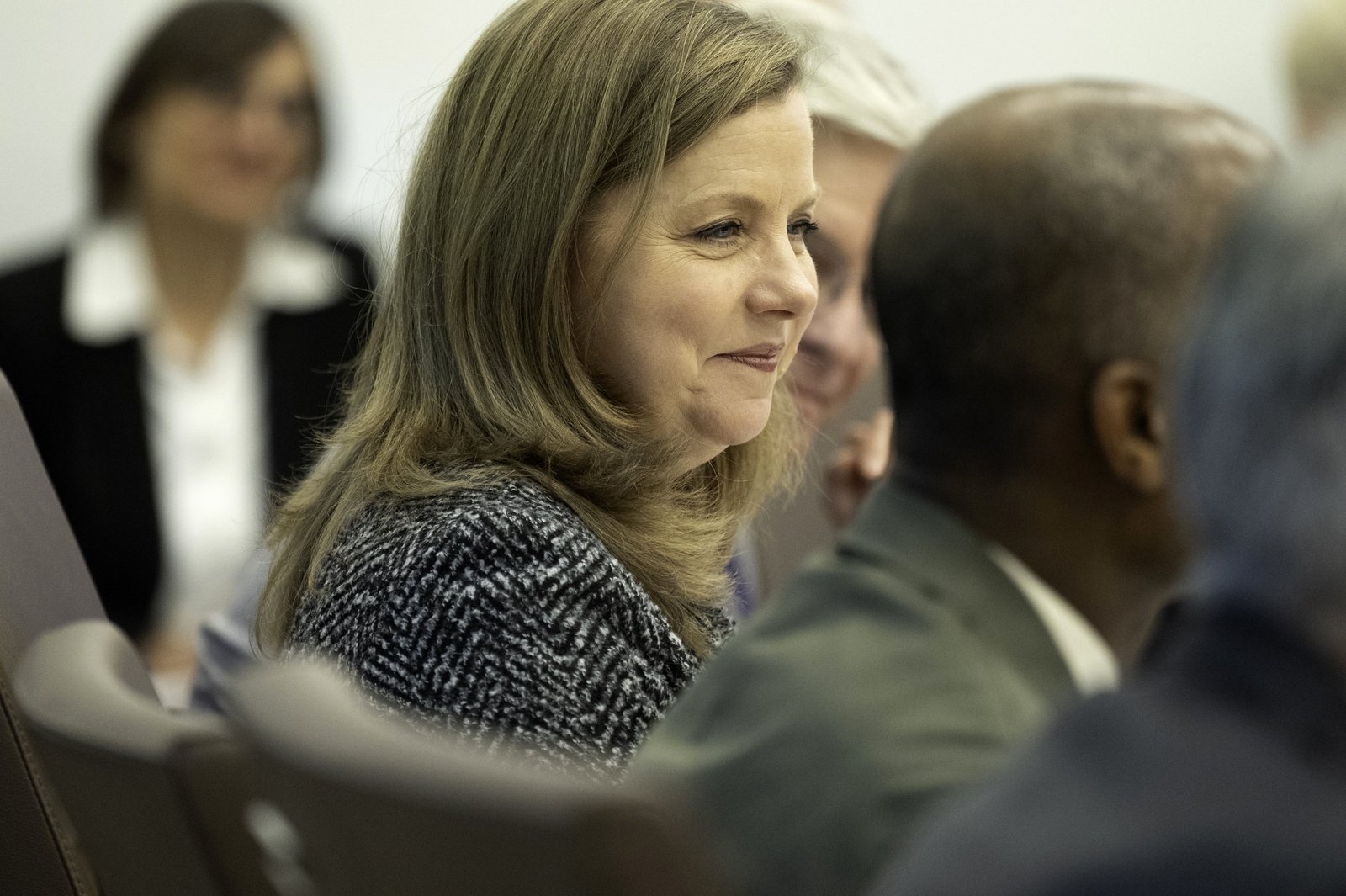
Bangkok · The Federal Reserve's top bank regulator said Wednesday that the central bank's own examiners watched Silicon Valley Bank deteriorate for a year before the 2023 collapse and did not act because they feared being wrong. She added that no one inside the Fed had the authority to make the call.
Michelle Bowman, the Fed's Vice Chair for Supervision, described a supervisory system in which responsibility was spread across committees until nobody owned a decision. "There was no accountability and no power to actually make a decision," she said, "which I think is astonishing." Her answer to that, now under way, is to cut the Fed's 12 supervision heads to five regional leaders, each directly responsible for supervision in their territory.
Bowman spoke in a public conversation in Bangkok with Tim Adams, chief executive of the Institute of International Finance. The session fell during the same week the Financial Stability Board, the Basel-based body that coordinates financial rules among the Group of 20 economies, published its draft principles for what it calls regulatory and supervisory modernization. Bowman chairs the FSB committee that wrote them.
The comments come as the Trump appointee is trying to persuade Washington and the world's other major regulators that the post-2008 rulebook has become heavy, backward-looking and, in her telling, partly self-defeating. The failed bank at the center of her argument gives her evidence, and critics say it also gives her a convenient story. Both sides now have a 3.5-year-old collapse to fight over, and a new report that the Fed paid an outside firm to write.

Beyond a Shadow of a Doubt
Silicon Valley Bank failed on March 10, 2023, the second-largest bank failure in U.S. history. The Fed produced its own post-mortem that spring. According to the American Bankers Association, it blamed bank management for much of the failure but also faulted Fed supervisors for missing problems and moving too slowly once they found them.
Bowman's objection, which she repeated in Bangkok, is that the people who wrote it were the people being judged. The 2023 review, she said, was conducted inside the Fed by staff connected to the supervision of the failed bank. The ABA reports she had pushed for an external review since 2023, arguing it was needed to supply the facts before any regulatory response. She announced on March 20, 2026, in an interview with Fox Business Network, that the Fed had commissioned one.
The work went to Starling Advisory Group, which published initial findings on September 18. Bowman presented them in a speech in London. In Bangkok she said the process took longer than she wanted. A procurement process, a bid and an award came first, and she described the delay as a cost of making the review truly independent.
Key dates in the Silicon Valley Bank review and the Fed’s response
- Fed supervisors “knew, or should have known” about SVB’s vulnerabilities, the review found
- Silicon Valley Bank fails
- Bowman announces that the Fed has commissioned an independent review
- Starling Advisory Group publishes initial findings
- Bowman announces the supervision overhaul in St. Louis
- Financial Stability Board publishes draft principles; comments due Jan. 8, 2027
- FSB final report expected
A Damning Verdict
The report's central finding is that Fed supervisors "knew, or should have known," about SVB's vulnerabilities as early as March 2022, a year before the run. The bank's deposit base was 94 percent uninsured and concentrated in venture-backed technology companies. Its unrealized securities losses exceeded its capital. It was not operationally ready to borrow from the Fed's discount window. Staff did not require the bank to cut its interest-rate risk or its exposure to a run by uninsured depositors, according to a summary by the Bank Policy Institute, an industry group.
The reviewers traced the inaction to culture.
In her London speech, Bowman quoted the finding that staff "believed it was personally safer to take no action unless they were certain the action was exactly right." In Bangkok she called it a decades-long problem and said the review had interviewed earlier vice chairs for supervision, including Randal Quarles. They described the same pattern, she said. Decision rights were unclear. Committees diluted responsibility while nobody could say yes.
The volume of paperwork made it worse.
Bowman told the Bangkok audience the Fed issued 54 supervisory findings to the bank between 2019 and 2023 and that nearly all concerned information technology and administrative process, not financial risk. Her reading is that examiners knew something was wrong but cited what was safe to cite. Directors told the reviewers it felt like "supervisors were moving the goalposts," the BPI summary says.
Figures as reported in the Starling review and in Bowman’s remarks
The review also took on the account that the run was a product of social media. That story had become a common shorthand for failure.
Charles River Associates, an economics consultancy that Starling retained, found no evidence that social media triggered or accelerated the run. About 96 percent of the relevant chatter came after the bank's failure was already inevitable.
Share of relevant social media chatter about the run, percent
View data
| Timing | Share of chatter, % |
|---|---|
| After the bank’s failure was inevitable | About 96 |
| Before (remainder) | About 4 |
Bowman made the point in Bangkok in a slightly different way. Withdrawals, she said, were under way well before the posts.
The policy implication that matters to her the most is that regulators had been designing rules around a cause the evidence does not support.
Five Regions With One Boss
The fix Bowman announced on October 6 at a community banking conference in St. Louis, American Banker reported, reorganizes Fed supervision into five regions that follow state lines instead of the boundaries of the 12 Reserve Bank districts. Each region gets one leader responsible for all supervisory activity there. The Fed also plans to work directly with state bank supervisors, who share oversight of state-chartered banks that belong to the Fed system.
Fed supervision heads, before and under the October 6 plan
View data
| Structure | Leaders |
|---|---|
| Supervision heads today | 12 |
| Regional leaders planned | 5 |
In Bangkok she gave the reasoning in plain terms.
Until now, she said, the Fed relied on internal committees, and "these committees became a source for plausible deniability," as she put it on October 6. No single person could say a given finding would be pursued or an enforcement order issued. Under the new structure, one name sits on each decision.
She also pointed to a geographic quirk that she says has made supervision inconsistent. By her count, 11 states are split between two Reserve Bank districts. A state bank in such a state can find itself dealing with two Reserve Banks that take different approaches, and the state regulator, which issues the charter, has to work with both. Five regions drawn along state lines would end that.
The overhaul has other parts.
The Fed will widen its definition of a community bank beyond the roughly 15-year-old threshold of $10 billion in assets, to include some firms with traditional, simple business models. It will consider raising its fixed-dollar regulatory thresholds for inflation and growth, with a mechanism to update them every five years. Jaret Seiberg of TD Cowen, quoted by American Banker, estimated the increases could be as large as 50 percent, which would move a $100 billion threshold to $150 billion. The Fed said it would only "consider" those changes and gave no timetable.
And then there are the staff cuts.
The Fed's Division of Supervision and Regulation is being cut by about 30 percent, according to one trade outlet's account of the London speech. A member of the Federal Reserve staff Asian Value Investor spoke to said the layoffs would be around that number. She did not want to be identified as she is not authorized to speak to the media.
The same account says examiners must now send monthly reports to supervision leaders on matters where they were unsure whether action was warranted. The aim is to put doubt on paper, where someone has to answer it.
Bowman said foreign supervisors have started calling. In the past two days alone she had held several one-on-one meetings in which counterparts asked about the report and how the Fed plans to respond, she said. When the interviewer suggested she might run tutorials for them, she did not rule it out.
Tailoring and Quarles
The review's most politically loaded finding concerns a 2018 law.
The Economic Growth, Regulatory Relief, and Consumer Protection Act told the Fed to tailor its rules to a bank's size, business model and risk. Some critics have argued that tailoring let SVB slip through the rules meant for larger banks. Starling found otherwise. In Bowman's words in London, the delays in supervisory action "were not caused by the regulatory tailoring mandate."
One datum helps her case.
The Fed's vice chair for supervision when the law took effect, Randal Quarles, stepped down in October 2021. That was before the vulnerabilities became most apparent in 2022. According to one trade report, the review cleared him. Bowman told the Bangkok audience that the report should not be read as exoneration of any individual, and that the point is a problem older than any one official.
Senator Elizabeth Warren called the report an attempt to rewrite history and questioned the review's independence, the same trade report says.
The industry though has its own reading.
The Bank Policy Institute says the findings describe an unfocused regime that issued many findings on technology and governance while the liquidity and interest-rate risks that sank the bank went uncited. It also notes that the first report did not include interviews with frontline examiners at the Federal Reserve Bank of San Francisco, which it expects in later volumes.
That is the opening Bowman is using.
If supervision failed because staff buried real risks under process complaints, then the remedy is fewer, sharper findings and clearer lines of authority. Her argument for easing the rulebook does not depend on the review. The review, though, gives her an evidentiary base that opponents of deregulation will have to answer.
A Forward-looking Rulebook?
Bowman took over as chair of the Financial Stability Board's Standing Committee on Supervisory and Regulatory Cooperation on July 29, 2025, for a two-year renewable term. Interviewer Timothy Adams, chief executive of the Institute of International Finance called her influence there consequential and credited her with bringing modernizing ideas into a body not known for speed.
Bowman described two projects — artificial intelligence and regulatory modernization.
On Wednesday the FSB published a consultation setting out eight high-level principles for authorities in its member jurisdictions. They are meant to make rules and supervision forward-looking and responsive to new vulnerabilities, technologies and products, and they build on existing international standards while preserving or strengthening resilience. Comments are due January 8, 2027, and a final report is expected in the first half of 2027. In a July speech at the Bank Policy Institute's London conference, published by the BIS, she however described four. Focus on material financial risks, tailor rules to risk, ensure transparency and accountability, and stay forward-looking.
Her philosophy, she said in Bangkok, is to stop regulating the last crisis.
Rules written after 2008 made the system safer and added capital, and she said she does not want to undo that. But she argued that the way capital requirements were calibrated restrained economic activity and growth, and that the job now is to identify the risks the next shock will bring and make banks resilient to those. Asked about critics who say loosening those rules invites the next failure, she replied that she is trying to bring banks back to supporting activity and growth, not to roll back the system.
The second project is AI.
This summer the FSB released a consultation on sound practices for banks and other financial firms adopting the technology. Bowman said it was among the fastest reports the FSB has produced and drew more comments than any other in its consultation process. According to InvestmentNews, the paper lists 12 sound practices, suggests smaller or less complex firms may need only a subset, and closed for comment on July 22, with a final report expected later this year.
Bowman said the next steps include updating cyber practices and finding ways supervisors can use AI to identify risk. She also articulated a second AI question that sits on bank balance sheets.
The race to build data centers requires capital, and she wants to make sure banks, and the supervisory system around them, can fund it. She said the FSB is hearing from voices that want AI regulated quickly and from others who say the technology is too new to constrain. Her stated aim is a balance that allows banks to innovate. Without that, she said, banks stand still.
The session ended on a note of self-awareness about how hard the cultural change will be. Sweeping the findings under the rug and moving on to other business would have been easier, the interviewer suggested. Bowman agreed it would have been, and said the work now is to build structures durable enough to outlast her term.
The audience applauded.
Sources
- Central Banking: supervisory culture at Fed a decades-long problem
- Central Banking: Bowman to chair FSB supervisory committee
- FSB consultation, as published by Mondo Visione, Oct. 14, 2026
- Federal Reserve: Bowman speech on initial findings, Sept. 18, 2026
- American Banker: Bowman unveils supervision overhaul
- Bank Policy Institute: SVB report initial reactions
- ABA Banking Journal: Fed commissions independent review
- BIS: Bowman, Modernizing financial regulation
- InvestmentNews: Bowman on lighter-touch AI oversight
- Mortgage Professional America: Fed supervisors knew SVB was vulnerable
- Yahoo Finance: Fed sat on SVB flaws
- PYMNTS: Bowman challenges social media story
Comments
Sign in with LinkedIn to join the discussion. Your LinkedIn name and photo appear publicly beside your comment. Please keep it civil and on topic.