
India's Largest Private Bank Just Fined Its Own CEO
HDFC Bank spent two decades outrunning India's benchmark index. A deposit deal booked as marketing spend, a bond scandal out of Dubai and a chairman who quit over "values and ethics" have turned the country's model bank into its biggest governance story.
HDFC Bank's board fined its own chief executive ₹1 lakh, or roughly $1,150, on July 27. For a bank that booked ₹816.8 billion in revenue last quarter, the number is trivial. The fact of it is not. Sashidhar Jagdishan, chief financial officer Srinivasan Vaidyanathan and retail-assets chief Arvind Vohra were penalized after a board committee reviewed how the bank had courted deposits from a Maharashtra state agency and concluded the conduct amounted to what HDFC Bank itself called "business overreach."
That finding landed four months after Atanu Chakraborty, the bank's part-time chairman, resigned and cited practices "not in congruence with" his personal values and ethics. It landed five months after HDFC Bank fired three senior executives over the mis-selling of Credit Suisse AT1 bonds to NRI clients through its Dubai branch. It landed against a stock trading 27% below its 52-week high, even as HDFC Bank remains India's largest private lender by both assets and market value.
None of it touches the balance sheet. Capital adequacy, asset quality and profitability still look strong in the numbers the bank reports every quarter. What has come under pressure is the premium investors paid for HDFC Bank's decades-old reputation as India's most disciplined, best-governed bank. This report walks through how that premium got tested, one disclosure at a time.
Two Decades Nobody Questioned
HDFC Bank opened in 1994, one of the first private banks licensed after India's liberalization drive, and spent the next thirty years building a reputation for conservative underwriting and steady execution. Academic reviews of the sector describe it as a cornerstone of Indian banking, consistently near the top of the pack on liquidity, profitability, efficiency and asset quality.1 Investors treated it that way too: a study of retail-investor perception found that most shareholders rated HDFC Bank's governance and disclosure practices positively, a view built up over decades of results that mostly matched what management promised.2
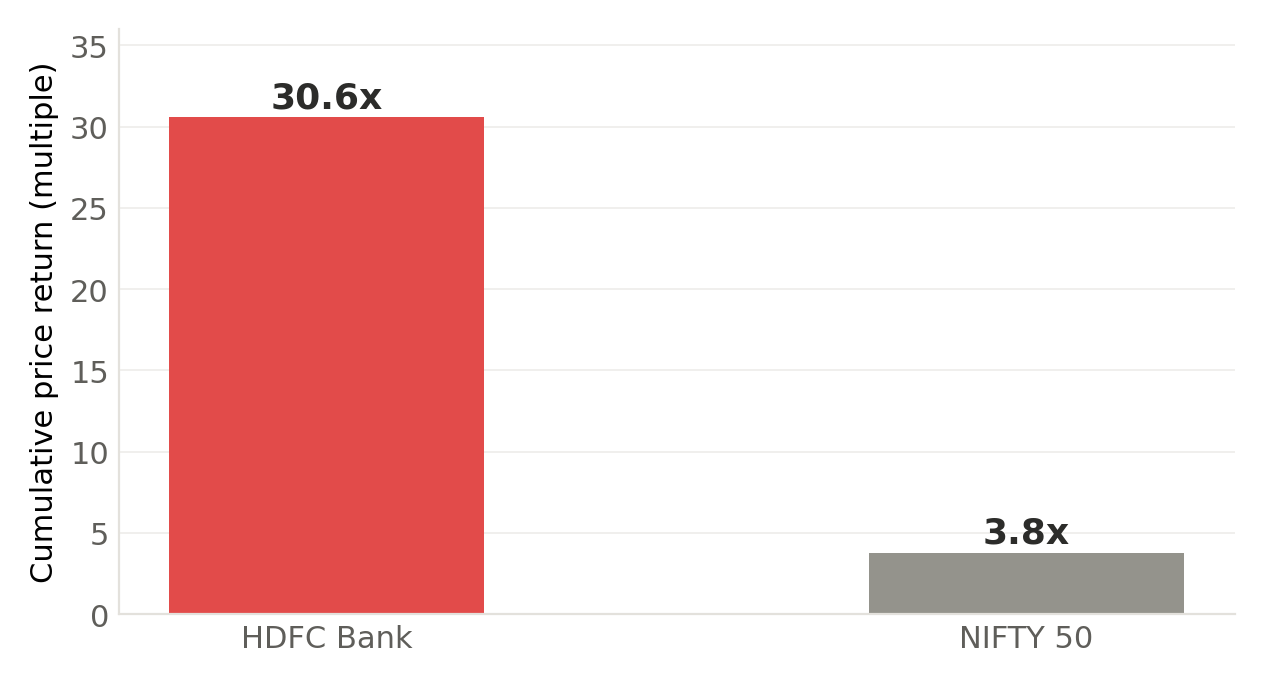
The stock backed up the reputation. Academic work tracking price performance from January 2005 through June 2024 puts HDFC Bank's cumulative price return at roughly 30 times, against roughly 4 times for the NIFTY 50 over the same stretch.3 Exact multiples vary by data source and by how stock splits and bonus issues get adjusted, so treat the precise figures as approximate rather than exact. The direction is not in dispute: for nearly twenty years, HDFC Bank beat India's benchmark index by a wide margin, and did it with a balance sheet regulators and rating agencies rarely flagged.
That record is also why the past sixteen months have registered as such a departure. A bank that rarely made news for the wrong reasons is now generating a steady stream of it: not because its loan book soured, but because of how it has handled conduct, disclosure and oversight.
The Merger That Recut the Index
In July 2023, Housing Development Finance Corporation folded into HDFC Bank in a deal worth about $40 billion, the largest corporate transaction in India's history.4 The combined bank became a universal lender overnight, carrying HDFC Ltd's mortgage book alongside its existing retail and corporate franchise.
MSCI added HDFC Bank to its Global Standard Indexes to replace HDFC Ltd, but applied an adjustment factor of 0.50 to the merged entity's index weight, citing foreign-room constraints tied to the Reserve Bank of India's 74% cap on foreign ownership of the bank.5 Before the merger, HDFC Ltd had carried a weight of roughly 6.61% in MSCI India; the discounted weight for the merged bank triggered estimated capital outflows in the range of $150 million to $200 million as index-tracking funds rebalanced.5 Both HDFC Ltd and HDFC Bank rose in the run-up to completion, but lagged the NIFTY 50 doing it, a reminder that even a well-run merger can leave a stock structurally cheaper than its fundamentals suggest, purely on index mechanics.4,5
Dubai: Bonds Sold as Safety
Credit Suisse's Additional Tier-1 bonds were wiped out entirely when UBS absorbed the bank in 2023, one of the largest AT1 write-downs on record. Years earlier, according to findings from an internal HDFC Bank probe, staff at the bank's Dubai and Bahrain operations had sold those same bonds to NRI clients as if they carried none of that risk: fixed-maturity, capital-safe alternatives to ordinary deposits, the staff allegedly told clients, rather than loss-absorbing instruments that rank near the bottom of a bank's capital structure.6
The Dubai Financial Services Authority restricted HDFC Bank from onboarding new clients in the Dubai International Financial Centre while it investigated.7 Two senior bankers were placed on leave in October 2025 as the probe widened.8 By March 2026, HDFC Bank had terminated three executives: Sampath Kumar, group head of branch banking; Harsh Gupta, executive vice president for the bank's Middle East, Africa and NRI business; and Payal Mandhyan, a senior vice president.9 Roughly a dozen additional employees, senior and mid-level, had pay increments and stock-linked incentives withheld.10
The case now has its own Wikipedia entry, cataloguing the DFSA restrictions, the terminations and the compliance findings in one place.11 That is a small marker, but it says something: this graduated from a client complaint into a documented governance failure with a paper trail regulators and journalists keep returning to.
The Chairman Who Walked
Atanu Chakraborty resigned as HDFC Bank's part-time, non-executive chairman on March 18, 2026, effective immediately. His resignation letter cited practices at the bank over the prior two years that were "not in congruence with" his personal values and ethics.12 He did not elaborate publicly on which practices he meant, but the timing, weeks after the Dubai terminations became public, was hard to miss. HDFC Bank's shares fell more than 5% on the news; its New York-listed depositary receipts dropped about 8%, and the bank's market capitalization declined by more than ₹61,000 crore over the following week.13
The board named Keki Mistry interim part-time chairman for three months, a transition the Reserve Bank of India approved.14 It also retained two outside law firms, Wilson Sonsini Goodrich & Rosati and Wadia Ghandy & Co, to investigate what Chakraborty meant. The review ran three months and covered board and committee minutes, plus witness interviews.15
The firms found no record of Chakraborty raising the concerns his resignation letter described, in board minutes or otherwise, including on what internal parlance had come to call "the Dubai matter."15 Investigators said they tried repeatedly to interview Chakraborty during the review; he declined to take part.15 The RBI, separately, said HDFC Bank remained "systemically important, financially sound, and professionally managed," with "no material concerns on record" regarding its governance or conduct.15 That finding cleared a path for the RBI's pending approval of Jagdishan's reappointment as managing director and chief executive.15
A review clearing the bank of the specific allegations in one resignation letter is not the same as clearing the bank's governance record. Chakraborty quit a listed, systemically important bank over language most executives would never put in writing. Whatever prompted that, the board's own account is that its highest-ranking independent director walked away rather than stay and fix it from inside.
What ₹45 Crore of "Marketing" Bought
The most recent episode is also the freshest: a board finding disclosed just four days before this report went to print. It concerns HDFC Bank's arrangements to mobilize deposits from the Maharashtra State Road Development Corporation in 2017 and again in 2021. Media reports said the bank had booked roughly ₹45 crore in payments to MSRDC as "marketing expenses," when the payments functioned as differential interest paid to win and retain the state agency's deposits.16
A Special Disciplinary Committee of HDFC Bank's independent directors reviewed the arrangements. The board's conclusion, delivered at a meeting on July 23 and disclosed to exchanges on July 27: the conduct amounted to "business overreach," not personal enrichment, mala fide intent or improper motive.17 The board also flagged the possibility that the arrangements diverged from applicable RBI directions.18 On the committee's recommendation, it issued warning letters and levied a monetary penalty of ₹1 lakh each on Jagdishan, Vaidyanathan and Vohra.17
| Executive | Role | Action |
|---|---|---|
| Sashidhar Jagdishan | Managing Director & CEO | Warning letter; ₹1 lakh penalty |
| Srinivasan Vaidyanathan | Chief Financial Officer | Warning letter; ₹1 lakh penalty |
| Arvind Vohra | Group Head, Retail Assets | Warning letter; ₹1 lakh penalty |
Source: HDFC Bank board disclosure, July 27, 2026, as reported by Business Standard and AP7AM.17,18
The penalty is nominal against the executives' compensation. What is not nominal is the label. "Business overreach" is the board's own term for how its three most senior operating executives handled a state-agency relationship, and the disclosure landed on the New York Stock Exchange as well as in Mumbai: HDFC Bank's American depositary receipts trade there, and four U.S. plaintiffs' firms have since said they are examining whether investors were adequately informed about the MSRDC arrangements and their accounting treatment (more in Section 08).19 Shares were down roughly 19% over the six months into late July, a period that overlaps the Chakraborty resignation, the AT1 terminations and the MSRDC disclosure. The market has not tried hard to separate which piece of news did how much damage.20
The Data Kept Leaking
In early 2023, a hacker uploaded roughly 7.5 gigabytes of loan data, covering close to six lakh customers, to a dark-web forum. The records, spanning two-wheeler and consumer-durable loans issued between May 2022 and February 2023, traced back to a third-party processor used by HDB Financial Services, HDFC Bank's non-bank finance arm.21 HDFC Bank's public statement at the time said its own systems had not been breached. It later told Reuters that a service provider handling its customer data had, in fact, been compromised.22 The gap between the first denial and the later confirmation is itself part of the story: it took an international news organization's questions to get a fuller account than the bank's own social-media statement offered.
In November 2024, HDFC Life Insurance, a separate but affiliated entity in the wider HDFC group, disclosed in a regulatory filing that it had received a claim from an outside party asserting possession of customer data, including names, contact details and policy information.23 India's insurance regulator, IRDAI, has since pushed insurers toward more rigorous IT security audits, a response to a pattern that extends well beyond HDFC Life.24
Neither breach touched HDFC Bank's core banking systems, and the bank has said as much both times. Both breaches involved third parties the group relied on to process customer data, and in both cases the public got the full picture only after regulators, reporters or the leak itself forced it into the open.
The Lag Between Knowing and Telling
None of this stems from a weak governance framework on paper. HDFC Bank's own corporate governance report describes board accountability to shareholders, an audit committee, a risk committee and formal compliance structures tied to RBI and SEBI requirements.25 Academic comparisons of governance disclosure among India's largest private banks, HDFC Bank included, generally rate the reporting itself as strong on board structure and shareholder rights.26
The pattern across all three episodes runs the other way: from internal awareness to public accountability. Two bankers went on leave in October 2025; the terminations followed five months later, in March 2026.8,9 The MSRDC deposit arrangements date to 2017 and 2021; the board's finding and the fines came in July 2026, years after the underlying conduct.17 In each case, the structures existed to catch the problem. What took time was the decision to act on what those structures had already found, and even more time to tell the public about it.
What the Fine Doesn't Cover
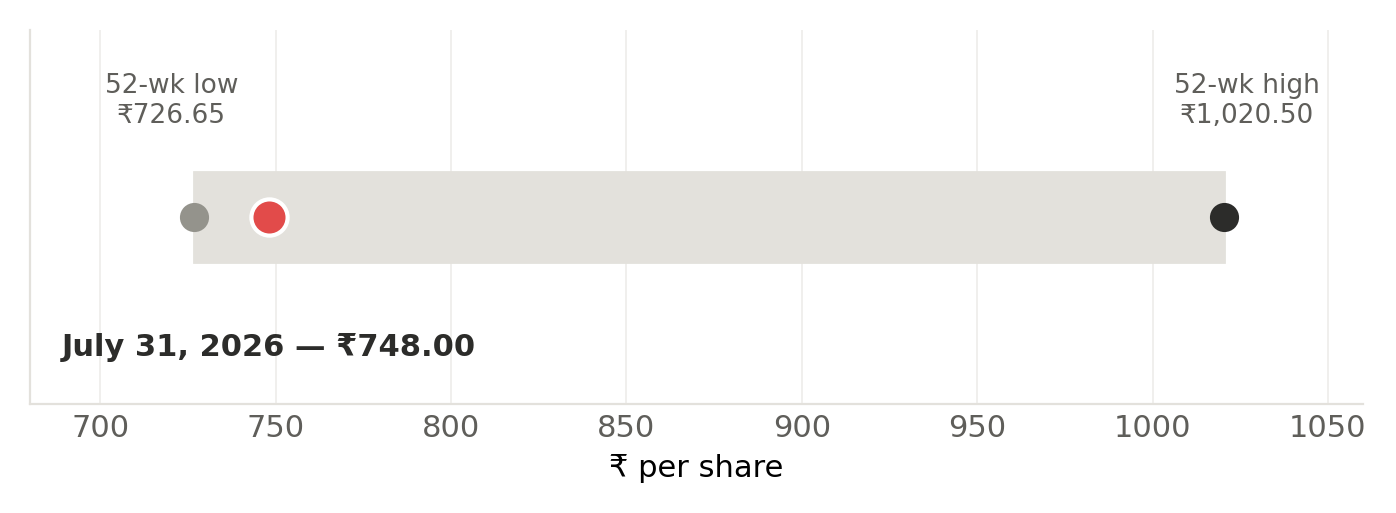
HDFC Bank closed at ₹748.00 on July 31, 2026, down from a 52-week high of ₹1,020.50 and above its 52-week low of ₹726.65.27 The stock trades at roughly 14.6 times trailing earnings and yields about 1.7% at current prices, multiples that reflect a bank the market no longer prices as untouchable, but has not abandoned either.27
| Metric | Value | As of |
|---|---|---|
| Share price | ₹748.00 | Jul 31, 2026 |
| 52-week high / low | ₹1,020.50 / ₹726.65 | Jul 31, 2026 |
| P/E ratio | 14.6x | Jul 31, 2026 |
| Dividend yield | ~1.7% | Jul 31, 2026 |
| EPS (trailing) | ₹51.21 | Jul 31, 2026 |
Source: Google Finance, HDFCBANK:NSE.27 Snapshot data; subject to change intraday.
Three Regulators, Still Watching
RBI, DFSA and IRDAI are all still watching different pieces of this. Further findings on any front, particularly anything that reopens the MSRDC "divergence from RBI directions" question the board itself flagged, could bring restrictions well beyond a ₹1 lakh fine.18
A Second Front, in New York
HDFC Bank's NYSE-listed ADRs put it inside the reach of U.S. securities litigation, and the MSRDC matter has already drawn a response there. The trigger was an Indian Express report on May 27, 2026, that described the ₹45 crore in MSRDC payments in detail and said Jagdishan was aware of them; HDFC Bank's ADRs fell 4.1% that day, to $23.78.28 Four U.S. plaintiffs' firms, Levi & Korsinsky and the law offices of Glancy Prongay Wolke & Rotter, Howard G. Smith and Frank R. Cruz among them, have since opened investigations into potential violations of federal securities law and are soliciting HDB shareholders who lost money.19,28
None of the four had filed a class-action complaint as of this report's publication. Announcing an investigation is a standard precursor to a suit, not a guarantee one follows, and Icarus Asia is not treating it as litigation until a complaint is docketed. HDFC Bank's ADRs faced a securities class action once before, in 2020, over unrelated vehicle-financing disclosures, in the U.S. District Court for the Eastern District of New York.29 That case has no bearing on the current matter. It does mean this shareholder base has been through the motion before.
A Bigger Bank, More Moving Parts
The HDFC Ltd merger turned HDFC Bank into a universal lender spanning mortgages, insurance distribution, NBFC operations and international private banking, each with its own conduct and vendor-risk profile.4 Every incident detailed in this report originated somewhere other than the core banking book: Dubai private banking, a state-treasury relationship, an NBFC's loan-processing vendor. Consistent governance across a more complex group, not balance-sheet strength, is now the swing factor in how this story develops from here.
The financials still work. Capital, asset quality and profitability remain intact by every metric HDFC Bank reports each quarter. What the market is now pricing, alongside those numbers, is the cost of finding out what else the bank already knows and has not yet said.
This report was produced by Icarus Asia Research using publicly available regulatory disclosures, company filings, academic studies and news reporting cited throughout and listed in the appendix below. Figures describing HDFC Bank's 2005–2024 cumulative price return are approximate and derived from third-party academic research; Icarus Asia has not independently recomputed the underlying price series. All other figures are sourced and dated as indicated. This report is for informational purposes only and does not constitute investment advice.
Primary Source Verification
Numbered to match superscript citations in the text above.
- "A Composite Study of HDFC Bank Financial Performance," International Journal for Multidisciplinary Research (IJFMR), 2024. ijfmr.com
- "Retail Investor's Perception on Corporate Governance Practices of HDFC Bank Ltd," IJFMR, 2022. ijfmr.com
- "Impact of Merger on HDFC Bank Financial Performance: A CAMEL Analysis Approach," International Journal of Economics and Finance. ccsenet.org
- Reuters, "India's HDFC Bank to replace HDFC Ltd on MSCI indexes," July 2023. reuters.com
- ICICI Direct Research, "MSCI move and the impact on HDFC and HDFC Bank stocks." icicidirect.com
- Business Standard, "Why Credit Suisse AT1 bond fallout has returned to haunt HDFC Bank," March 2026. business-standard.com
- Gulf News, "Why India's HDFC Bank got penalised, facing new restrictions in Dubai." gulfnews.com
- Business Standard, "HDFC Bank puts 2 senior bankers on leave amid Credit Suisse bond probe," October 2025. business-standard.com
- Business Today, "HDFC fires senior staff after probe into AT1 bond mis selling to NRI clients via Dubai branch," March 2026. businesstoday.in
- BW People, "HDFC Bank Penalises 12 Executives In AT1 Bond Mis-selling Case." bwpeople.in
- Wikipedia, "HDFC Bank AT1 bond misselling case." en.wikipedia.org
- Business Standard, "Chakrabortys sudden exit raised governance questions," and CNBC, "HDFC Bank shares fall over 5% as part-time chair of India's largest private bank resigns over 'ethics,'" March 2026. cnbc.com
- Gulf News, "Story behind HDFC Bank chairman's exit: Dubai curbs, bond scrutiny, rifts." gulfnews.com
- Forbes India, "What HDFC Bank chairman's exit reveals about independent directors in India." forbesindia.com
- Free Press Journal, "HDFC Bank Legal Review Finds No Evidence Supporting Ex-Chairman's Ethical Concerns," 2026. freepressjournal.in
- Reports summarizing HDFC Bank/MSRDC media coverage, May–July 2026, including commentary aggregated on LinkedIn and Instagram citing the ₹45 crore "marketing expenses" characterization. Treated as directional context; see items 17–18 for the board's own disclosed findings.
- Business Standard, "What is business overreach? Why HDFC Bank used the term in MSRDC case," July 2026. business-standard.com
- AP7AM, "HDFC Bank board finds 'business overreach', fines CEO and CFO Rs 1 lakh each," July 2026. ap7am.com; Outlook Business, "HDFC Bank Saga: A Timeline Of MSRDC Case That Led To ₹1 Lakh Penalties." outlookbusiness.com
- Barchart, "HDB Alert: Levi & Korsinsky Investigates HDFC Bank Limited on Behalf of Shareholders Who Lost Money." barchart.com
- Market-data aggregation of HDFC Bank share-price performance over the trailing one- and six-month periods to late July 2026, cross-referenced against Google Finance's 52-week range. Treated as approximate.
- HDFC Bank's non-bank finance arm, HDB Financial Services: Outlook Money, "HDFC Bank's NBFC Arm HDB Financial Services Confirms Customer Loan Data Breach"; Business Standard, "Data of 600,000 HDFC Bank customers' leaked on dark web, bank denies," March 2023. business-standard.com
- Reuters reporting on the confirmed third-party service-provider breach, referenced in BankInfoSecurity, "HDB Financial Services Finds Breach at Data Processor." bankinfosecurity.com
- Business Standard, "HDFC Life Insurance suffers data breach: What customers must know," November 2024. business-standard.com
- AmLegals, "Rising Data Breaches in Financial and Insurance Sectors: Takeaways from the HDFC Life Data Breach." amlegals.com
- HDFC Bank, "Report on Corporate Governance," FY22 Annual Report. v.hdfc.bank.in
- "A Comparative Study of Private Sector Banks Listed In BSE with Reference to Corporate Governance," IJFMR, 2024. ijfmr.com
- Google Finance, HDFCBANK:NSE, intraday quote accessed July 31, 2026. google.com/finance
- American Bazaar, "HDFC Bank comes under scrutiny as US shareholder law firms launch investigation," July 2026, detailing the May 27, 2026 Indian Express report and the ADR price reaction. americanbazaaronline.com; Business Wire investigation announcements from Glancy Prongay Wolke & Rotter LLP, the Law Offices of Howard G. Smith, and the Law Offices of Frank R. Cruz, July 2026. businesswire.com
- Business Wire, "HDB Deadline Alert: Bronstein Gewirtz & Grossman LLC Reminds HDFC Bank Limited Investors of Class Action and Lead Plaintiff Deadline," October 2020, on the unrelated, earlier securities class action (No. 20-cv-04140, E.D.N.Y.) over vehicle-financing disclosures. businesswire.com