
News · Policy · China, US
President Trump Meets Xi With a Weaker Hand
Two former White House China hands spoke to an audience of market makers and fund managers in 2025. A year of summits has tested what they said.
For information only. Not investment advice. Disclaimer
AI-generated summary, reviewed by the editor.
- Rush Doshi and Liza Tobin told a Citadel Securities conference that China holds leverage over U.S. factories; Tobin argued President Trump was bargaining from a weaker position.
- Doshi said Beijing's goal is older than Xi Jinping, and that rare earth magnets, drug ingredients and chips show where U.S. dependence and advantage lie.
- Both disagreed with Nvidia's Jensen Huang on selling chips to China; since the panel, Democrats won the House and Senate and Nvidia has faced scrutiny in Washington.
It restates the article and adds no new facts. How we use AI
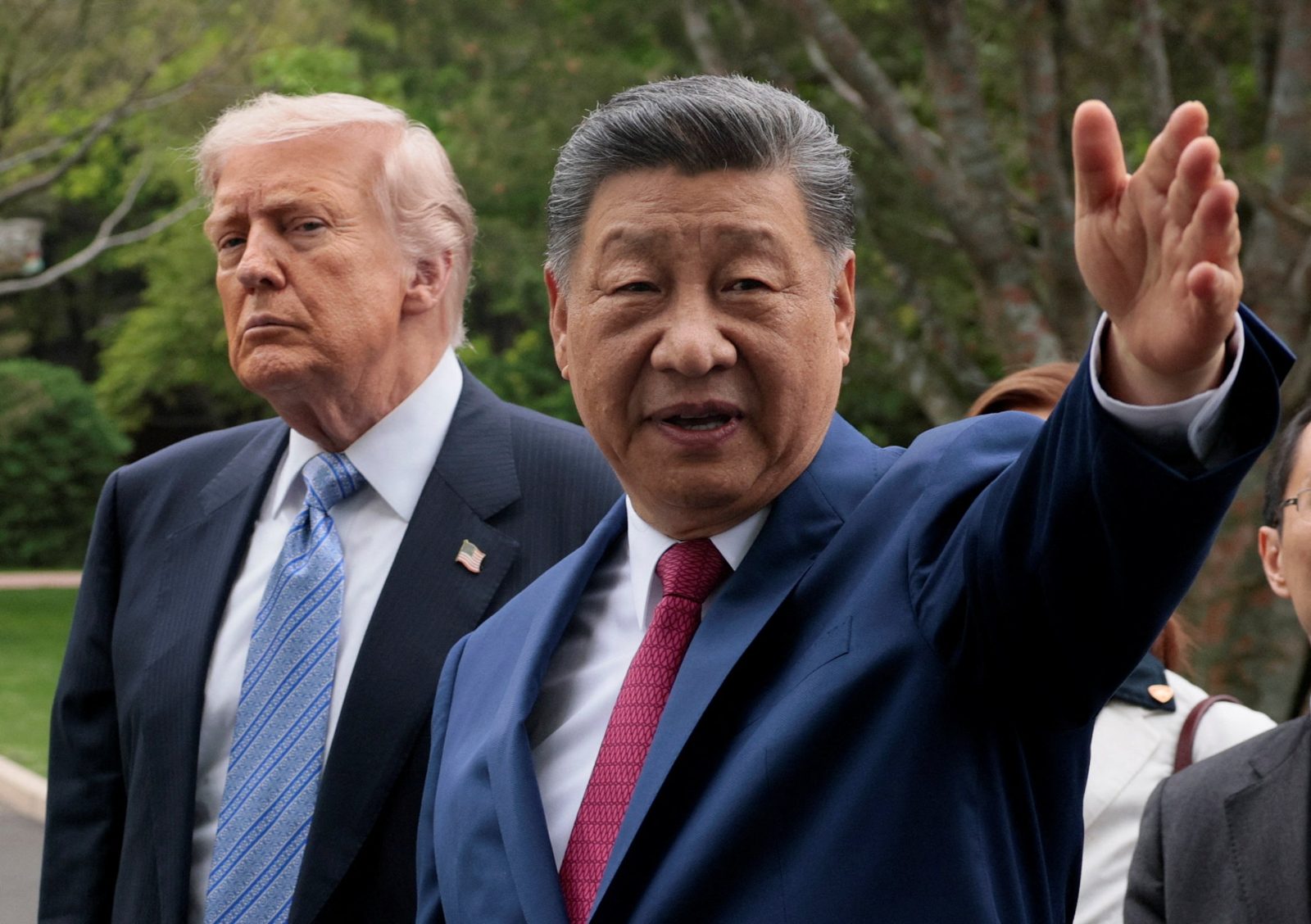
President Trump and Xi Jinping are due to meet again this week on the sidelines of the Asia-Pacific Economic Cooperation summit in Shenzhen, in a session that will also include Vladimir Putin, the White House has announced.
A senior administration official told Reuters not to expect a deal: "We do not expect to get to any kind of agreement."
The meeting comes a week after China said it would hold off until Jan. 10 on the latest limits it had planned for exports of rare earths, the metals that go into the magnets inside every car. The truce that Trump and Xi signed in Busan, South Korea, a year ago was due to lapse on Nov. 10. It now has two more months.
Before the two presidents had met even once this term, two of Washington's most experienced China hands sketched where the contest was heading.
Rush Doshi ran China and Taiwan policy at the National Security Council under President Biden and now directs China strategy at the Council on Foreign Relations. Liza Tobin worked on China at the council under both Mr. Trump and Mr. Biden, and earlier served as a C.I.A. analyst. She is now a managing director at Garnaut Global. They appeared on a panel at a Citadel Securities conference whose attendees, by the firm's own description, included asset managers, hedge funds and central banks.
Their message to that room was that China holds leverage over American factories, hospitals and software that Washington spent decades ignoring, and that Beijing has learned to use it. Tobin went further and argued that Mr. Trump was bargaining from a weaker position of power.
The exposure is easy to measure.
China produces about 90 percent of the world's rare earth magnets, according to the consultancy AlixPartners. When Beijing began requiring export licenses in April 2025, magnet shipments halved that month and Ford shut its Explorer plant in Chicago for a week, Reuters reported. Nvidia booked $17 billion in China in its last full fiscal year before the licensing rules tightened, 13 percent of its sales. And Bloomberg Economics, in a February update, put the first-year cost of a U.S.-China war over Taiwan at about $10.6 trillion, or 9.6 percent of global output.
A Goal Older Than Xi

Doshi began with a correction to the way Americans talk about Chinese ambition.
Washington tends to personalize it, as if the project belonged to Mr. Xi. It does not, he said.
"National rejuvenation" dates to the founding of the Communist Party in the 1920s, a decade when China was emerging from what the party calls a century of humiliation by Japan, Europe and the United States, and the founders wanted fuqiang, wealth and power. Mao and Deng both organized their early lives around that idea. Mr. Xi, Doshi said, believes he can finish the job, and he has the phrases to prove it: "great changes unseen in a century," and "the East is rising and the West is declining."
He broke the goal into four parts.
Militarily, Beijing wants a global presence, and Doshi said his first week at the White House went to resisting Chinese efforts to secure overseas bases in places like Argentina. Economically, it wants the world more dependent on China and China less dependent on the world, the logic behind Mr. Xi's "dual circulation" policy. Technologically, it wants to win what the party calls the Fourth Industrial Revolution after losing the first three. And politically, it wants to rewrite the default settings of the international system in a form friendlier to one-party rule.

Tobin added the other half of the picture.
Every obstacle Beijing sees on that road is a form of American power: the military, the alliance network (frayed as it is), the idea that electoral democracy is morally superior, American leadership in technical standards, and a dollar that lets Washington sanction at will. A party that has to overcome all of those is an insecure one, she said. Pluralism makes it uncomfortable.
Then came her "but."
The party's confidence, she said, had been climbing since spring, and Mr. Trump was the reason. She dated the turn to the rare earth squeeze, when the president "stared the rare earth magnet crisis straight in the face" and saw the auto sector at risk. What followed, in her telling, was a summer of concessions: the reversal on export controls for Nvidia's H20 chip, a TikTok arrangement that Mr. Trump presented as a domestic victory, tariff deadlines that kept getting pushed back. Each one, she argued, told Beijing its strategy was working, and the longer the pattern ran, the more it would ask for. "We're really on this knife's edge," she said.
"We're really on this knife's edge right now while we wait to see which way things tip."Liza Tobin
Things have taken a turn since then.
Two developments since the panel bear on that argument. The first is the election.
The Democrats won control of the House and the Senate in the U.S. midterm elections. Meanwhile, Jensen Huang, the Nvidia chief executive who was President Trump's biggest supporter of selling advanced microchips to China has had a bad autumn.
Bloomberg reported on Nov. 6 that Democrats are set to press him on keeping Nvidia's chips from China. Days later, the South China Morning Post reported that Nvidia's board had opened a probe into whether a foreign intelligence effort targeted Mr. Huang, after earlier reporting by The New York Times that U.S. officials suspected a Chinese asset of helping to divert Nvidia chips. Nvidia has said it complies with the law and that there is no evidence of smuggling. Beijing has called the espionage allegations unfounded.
The legislative fight Doshi lost last year is back.
On Nov. 9, Hakeem Jeffries, the House Democratic leader, told reporters he "strongly supports" chip restrictions in the Senate's version of the annual defense bill, Reuters reported. Those include the Chip Security Act, aimed at smuggling, the AI Overwatch Act, which would expand congressional oversight of advanced-chip exports, and the Match Act, which would push allies to stop selling chipmaking equipment to China, according to the South China Morning Post. On the commercial side, Huang has said the American policy mistake on China is "hard to unwind," according to Bloomberg footage released Nov. 9, and Nvidia has said its outlook assumes no China data center revenue.
The Leverage
The H20 reversal is a good place to see how the pieces fit.
Reuters reported in August 2025 that Nvidia and AMD had agreed to hand the government 15 percent of their China revenue from certain chips in return for export licenses. Mr. Trump had arrived at the figure by bargaining: he told reporters he wanted 20 percent. Howard Lutnick, the commerce secretary, had already said in July that resuming such sales was a way to win access to China's rare earths.
The Magnet Problem
Doshi's account of the rare earth episode was less about diplomacy than about industrial history.
The United States was the leading producer of the magnets in the 1980s, and the technology is neither exotic nor new, but it can no longer be made at scale on American soil. China's decision to withhold supply "may have ended the trade war prematurely from President Trump's perspective," he said.
The same thinking applies to medicine.
Nearly all the key starting materials and active ingredients for antibiotics come from China, he said, and he named heparin, used in IVs and kidney dialysis, as another example. He did not predict that Beijing would reach for those levers ("I don't think they're going to reach for that"), only that planners now have to imagine it.
China holds 90 percent of rare earth magnets, refined rare earths and drug ingredients, Doshi said
China's share of world output, percent, as stated by Rush Doshi at the panel
Figures are Doshi's remarks at the Citadel Securities conference and were not independently verified, except magnets, which match AlixPartners. Source: Citadel Securities panel transcript; AlixPartners.
View data
| Item | China share of world output (%) |
|---|---|
| Rare earth magnets | 90 |
| Refined rare earths | 90 |
| Pharmaceutical ingredients | 90 |
| Batteries | 80 |
| Drones | 80 |
| Electric vehicles | 75 |
The broader numbers he gave were of a country operating at a scale that has no recent parallel.
China makes three times as many cars as the United States, by his own measure, and roughly 80 percent of the world's batteries and drones. On steel, the Guardian's chart of 2024 output has China at 1,005 million tonnes and the United States at 79.5 million, a ratio above twelve to one. The last country to hold that kind of lead over its rivals, Doshi said, was the United States around the Second World War.
China makes 20 times the cement and 11 times the steel of the United States, Doshi said
China's output as a multiple of U.S. output, as stated by Rush Doshi at the panel
Dashed mark: 12.6 times, computed by AVI from the Guardian's 2024 crude steel figures (1,005 million tonnes for China, 79.5 million for the United States). Doshi's other figures were not independently verified. Source: Citadel Securities panel transcript; The Guardian.
View data
| Item | Multiple of U.S. output |
|---|---|
| Power generation | 2x |
| Manufacturing value added | 2x |
| Car production | 3x |
| Steel | 11x |
| Cement | 20x |
| Steel (Guardian 2024 data, AVI calculation) | 12.6x |
The Air Gap
Tobin gave the method a name.
"Brute force economics," she called it, a mix of force (the party, state companies, the intelligence services and the foreign ministry all pulling toward state goals), ruthlessness (cyberattacks on foreign competitors, among other tools) and sheer scale.
American trade negotiators, she said, had spent decades since the late 1990s pleading with Beijing to accept market logic. "We're not going to persuade Beijing to stop. This is their strategy." Her answer was what she called an air gap: no total separation, but insulation around the technologies that touch critical infrastructure or that anchor the dual-use fields of artificial intelligence and biotechnology.
When Cybersecurity Becomes Trade Policy
The cyber example is the one with a paper trail.
U.S. officials said in January 2024 that they had disrupted a Chinese hacking operation, known as Volt Typhoon, that had targeted American critical infrastructure and could be used in a future crisis, Reuters reported. A year later, the Commerce Department finalized a rule that effectively bars Chinese software from connected cars starting with the 2027 model year, and hardware from 2030.
"We don't want two million Chinese cars on the road and then realize ... we have a threat," Gina Raimondo, then the commerce secretary, told Reuters. Doshi said he worked on that effort, and drew the lesson plainly.
"The cybersecurity problem is becoming a trade problem."
He asked what comes after cars. Medical devices, he said, were an obvious candidate.
Three Ways October Could Go
Tobin knows Mr. Trump's habits from the inside.
He moves between deal-making and decoupling, she said, and in spring 2020, angry at Mr. Xi over the pandemic and sensing his reelection slipping away, he told her team it was time to separate the two economies.
The second term began differently.
She said the National Security Council had been "dismembered" over the spring and summer of 2025, leaving the president with fewer voices arguing the national security case. His trade advisers, meanwhile, came in with an ambition to rewire global commerce, shrink the trade deficit and rebuild American industry, and they have used leverage to extract investment, lower tariffs and even equity stakes (in Intel, for one) from nearly everyone.
China was the exception. There, she said, he was the one being squeezed.
She told the audience what she would watch for as signs of which way he was leaning: a flood of Chinese investment into the United States, which she called a possible Belt and Road for America; approval for Nvidia to sell its Blackwell chips in China; and language on Taiwan along the lines of "we oppose independence." She described Mr. Trump and Mr. Xi as "the two most hubristic men in the world," and doubted Mr. Trump would stay content in the junior position for long.
It is the approval for Nvidia to sell its latest generation of chips to China that will be untenable for the U.S. President under the current political circumstances since Doshi and Tobin spoke on the panel.
Doshi laid out the autumn as three branches. A grand bargain, with Chinese investment, purchases of American goods, a TikTok settlement that holds, lower fentanyl tariffs and perhaps a little language on Taiwan.
A freeze, an uneasy truce that grinds on.
Or a rupture, in which a meeting goes fine and the follow-through fails, the way he said Mr. Trump's talks with Narendra Modi and Mr. Putin had soured and been followed by tougher policy.
Even then, he did not expect full decoupling.
What worried him was a third phase of the conflict. The first had been a tariff war, the second an export control war (ethane and aircraft licenses on one side, rare earth magnets on the other). China is strong in goods and weaker in finance, so the next escalation, he said, could be sanctions on Chinese banks, a step he said Treasury had planned for under Mr. Biden and kept planning for under Mr. Trump.
The Quarantine Nobody Is Asking About
Doshi was in the White House for what he called the Fourth Taiwan Strait Crisis, after Nancy Pelosi's 2022 visit to the island, and said it consumed 90 percent of his time for some weeks. He asked the room to separate the stakes from the risks and the response.
The stakes start with chips.
If the Taiwanese facilities that make the world's most advanced semiconductors were destroyed or lost power, he said, the artificial intelligence build-out under discussion at the conference "is gone," and no one can replace that capacity elsewhere at scale. Bloomberg's original January 2024 estimate put a blockade of Taiwan at about 5 percent of global output in the first year, and a war that drew in the United States at about $10 trillion, or 10 percent. A Chinese-controlled Taiwan would also let Beijing lean harder on its neighbors, he said, and allies that decided Washington would not defend Taiwan would drift toward China, "because China's next door."
The risk, in his view, is manageable but getting worse.
American policy works through two instruments, reassurance (that Washington does not back independence) and deterrence (that an amphibious invasion is the hardest operation in military history). Both are weakening: deterrence because of China's military buildup, reassurance because Beijing distrusts the political leadership now in Taipei. He wanted a standing channel between the two governments, like the one Jake Sullivan had with Wang Yi, and said he did not see one in the current administration. He also wanted more drones, more munitions and a more dispersed American force posture.
The Danger at the Low End
Then he turned the audience's attention away from invasion.
"The risk of a high-end contingency is probably lower than people think; the risk of a low-end contingency is higher than people think."
The low end, in his list, meant an offshore island such as Jinmen, overflights, cyberattacks, or a Chinese move into Taiwan's territorial waters. All of it, he said, was more likely than five years earlier. The year since has not resolved the question. After the Beijing summit, Mr. Trump told reporters he had made no commitment to Mr. Xi on Taiwan but had not decided whether to send a large arms package to Congress, the Associated Press reported, and he said he would speak first to the person "running Taiwan." Some Republicans in Congress objected, AP said.
Slower Growth, Bigger Factories
Asked to end on the Chinese economy, Doshi said Americans still underestimate it, and that the standard evidence for its decline would matter on a clock that investors do not keep.
Demographics come in waves, he said: the grandchildren of the Mao-era baby boom are entering the workforce, and the under-15 share of the population has risen over the past decade, which he said most people do not know. The harder consequences, he said, arrive in 20 years, maybe. On debt, he put China's total, public and private, at roughly 300 percent of output and said the figure was not far from the American one. And on the slowdown, he pointed to the other side of the equation, in which China leads the world in patent filings and in top-cited papers.
A Contested Debt Count
The debt comparison is contested.
Mark Williams, the chief Asia economist at Capital Economics, calculated in May that China's total debt excluding financial firms had topped 300 percent of G.D.P. and that, aside from a few small economies, only Japan owed more, Fortune reported. "China's current indebtedness puts it in a league of its own," Williams said.
Growth keeps coming in near the bottom of Beijing's range. The economy expanded 4.5 percent in the third quarter, a touch above forecasts and up from 4.3 percent in the second, which was its slowest in more than three years, Reuters and the Associated Press reported in October. Exports did the lifting, while consumers did not.
Doshi's closing point was about what he thought could be fixed.
Dependence on Chinese supply, rare earth magnets included, was a problem the United States could solve. The harder one was to keep the lead in the industries that come next. "We can find a way to bring back rare earth magnets production, but we also have to find a way to win robotics," he said, a field where he sees China at the leading edge.
Who Gets the Chips
The sharpest disagreement on the panel's last topic was between the panelists and the Nvidia chief executive who had spoken earlier in the day. Jensen Huang had argued for selling to China and keeping its developers on American technology. Doshi and Tobin said that was not how Beijing thinks.
"Every chip that's sold there is one chip that's not sold in the United States or to an ally or partner country."Rush Doshi
Doshi quoted China's premier, Li Qiang, and the chief executive of DeepSeek, both of whom have said computing power is their biggest obstacle.
Compute is the one area, he argued, where the United States holds a decisive lead: the chips are made in Taiwan but designed in America. He cited American government estimates that China could make perhaps 200,000 of Huawei's Ascend chips, not enough to run AI at scale. And every chip that goes to China, he said, "is one chip that's not sold in the United States or to an ally or partner country." He supported a Senate measure called the GAIN AI Act, which would have required chipmakers to offer their products to American customers and allies first, and called it "sensible." He also noted that Mr. Xi, years before the trade war, had compared building on someone else's core technology to building a house on a weak foundation.
Huang's side won the legislative fight.
The White House asked Congress in November 2025 to drop the measure, Bloomberg reported, and Bloomberg Law later said Congress had rejected it. Whether Beijing would have bought the chips anyway is another matter. In January, Reuters reported that Chinese customs agents had been told that Nvidia's H200 chips were not permitted into the country, weeks after Washington cleared them.
From rare earth licenses to Shenzhen: the chip and truce timeline
April 2025 to November 2026, dots placed to scale
Dates are from Reuters, Bloomberg, the Associated Press and the sources listed below; some are report dates rather than effective dates.
View data
| Date | Event |
|---|---|
| Apr. 2025 | Beijing starts licensing rare earth exports |
| Aug. 11, 2025 | Nvidia, AMD to share China chip revenue with U.S. |
| Oct. 30, 2025 | Trump and Xi sign the Busan truce |
| Nov. 20, 2025 | White House asks Congress to drop GAIN AI Act |
| Dec. 9, 2025 | Trump clears Nvidia H200 sales to China |
| Jan. 14, 2026 | China tells customs the H200 is not permitted |
| Nov. 3, 2026 | U.S. midterm elections |
| Nov. 9, 2026 | Jeffries backs chip limits in defense bill |
| Nov. 14, 2026 | Trump, Xi and Putin summit announced |
A Speed Bump, Not a Wall
Tobin's version of the argument was historical.
Nortel, Cisco, Google, Facebook, Boeing, Airbus and Ericsson all held large shares of the Chinese market at one point, she said, and Beijing's goal has never been integration. It is self-reliance. Export controls, in her view, are "a sort of speed bump that buys the United States a little bit of extra time" to fix immigration policy and out-innovate at home. The Biden administration's October 2022 rules, written while Doshi was in government, had that premise.
She did not claim to know whether Nvidia's lead was permanent. Was the moat around its chips, the CUDA software ecosystem and the speed of its product cycle, wide enough that China would never catch up?
"I don't know," she said. "I don't think anyone in this room knows; we'd be the richest people ever if we could know that."
For information only. Not investment advice.
SOURCES
- Al Jazeera (reporting from AP and Reuters), "Trump, Xi and Putin to hold first three-way summit in China," Nov. 14, 2026.
- The National, "China extends pause on rare earth export curbs for two months," Nov. 9, 2026.
- Reuters, China's rare earth controls and automaker shutdowns, June 2025
- Reuters, "Trump-Xi 'amazing' summit brings tactical truce, not major reset," Oct. 30, 2025
- Reuters, "Nvidia, AMD to pay 15% of China chip sale revenues to US," Aug. 11, 2025.
- Reuters, "US to allow Nvidia H200 chip shipments to China, Trump says," Dec. 9, 2025.
- Reuters, "China blocks Nvidia's H200 AI chips despite US export approval," Jan. 14, 2026.
- Bloomberg, "White House Asks Congress to Reject Bill Curbing Nvidia Exports," Nov. 20, 2025; Bloomberg Law, "Nvidia Scores Lobbying Win as Congress Rejects Chip Export Bill."
- Bloomberg Economics, "The $10 Trillion Fight: Modeling a US-China War Over Taiwan," Feb. 10, 2026; Bloomberg Economics, Jan. 2024 estimate (as carried by Insurance Journal and The Day).
- Reuters, ABC News on the Commerce Department connected-vehicle rule, Jan. 14, 2025; Reuters
- Associated Press and Reuters on the May 14-15, 2026 Beijing summit
- CNBC, "Bessent, China's He to hold talks on AI, trade, critical minerals: Reuters," Sept. 20, 2026.
- Associated Press, "TikTok signs deal to sell US unit to American investors, including Oracle, Silver Lake," Dec. 18, 2025; CBS News on China's account of the deal.
- Fortune, "Forget U.S. debt, China's total borrowing is in 'a league of its own,'" May 11, 2026.
- Reuters and AP, on China's third-quarter 2026 growth, Oct. 19, 2026.
- The Guardian, interactive chart on 2024 crude steel output, April 2025.
- Reuters, on the Oct. 7, 2022 export controls.
- Associated Press, U.S. House and Senate results for the Nov. 3, 2026 midterms
- Bloomberg, report on Nov. 6, 2026 that Democrats are set to press Nvidia's chief executive on China, and Bloomberg interview footage released Nov. 9, 2026
- Reuters, report on Nov. 9, 2026 of Hakeem Jeffries' remarks on chip restrictions in the defense bill
- South China Morning Post, "US lawmakers push for tougher China export controls in defense bill amid Nvidia scrutiny," Nov. 11, 2026.
- The New York Times, October 2026 reporting on U.S. officials' suspicions about a Megaspeed executive
Comments
Sign in with LinkedIn to join the discussion. Your LinkedIn name and photo appear publicly beside your comment. Please keep it civil and on topic.