
News · Macro · China
AI Investment Fails to Cushion China's Housing Slump
Four economists specializing in the Chinese economy broadly agreed on what ails the world's second-largest economy. They split, though, on what it will take to fix the problem.
For information only. Not investment advice. Disclaimer · Special coverage: IMF–World Bank Annual Meetings, Bangkok
AI-generated summary, reviewed by the editor.
- Economists at a Bangkok conference said AI investment is too small to offset China's housing slump; Bank of America research puts it below 1 trillion yuan a year.
- Fixed-asset investment was down 7.2 percent through August and property investment down 19.9 percent, while exports grew 36.3 percent in September from a year earlier.
- Panelists agreed on the diagnosis but split on the remedy, including whether AI is deflationary, and none would date the bottom of the slump.
It restates the article and adds no new facts. How we use AI
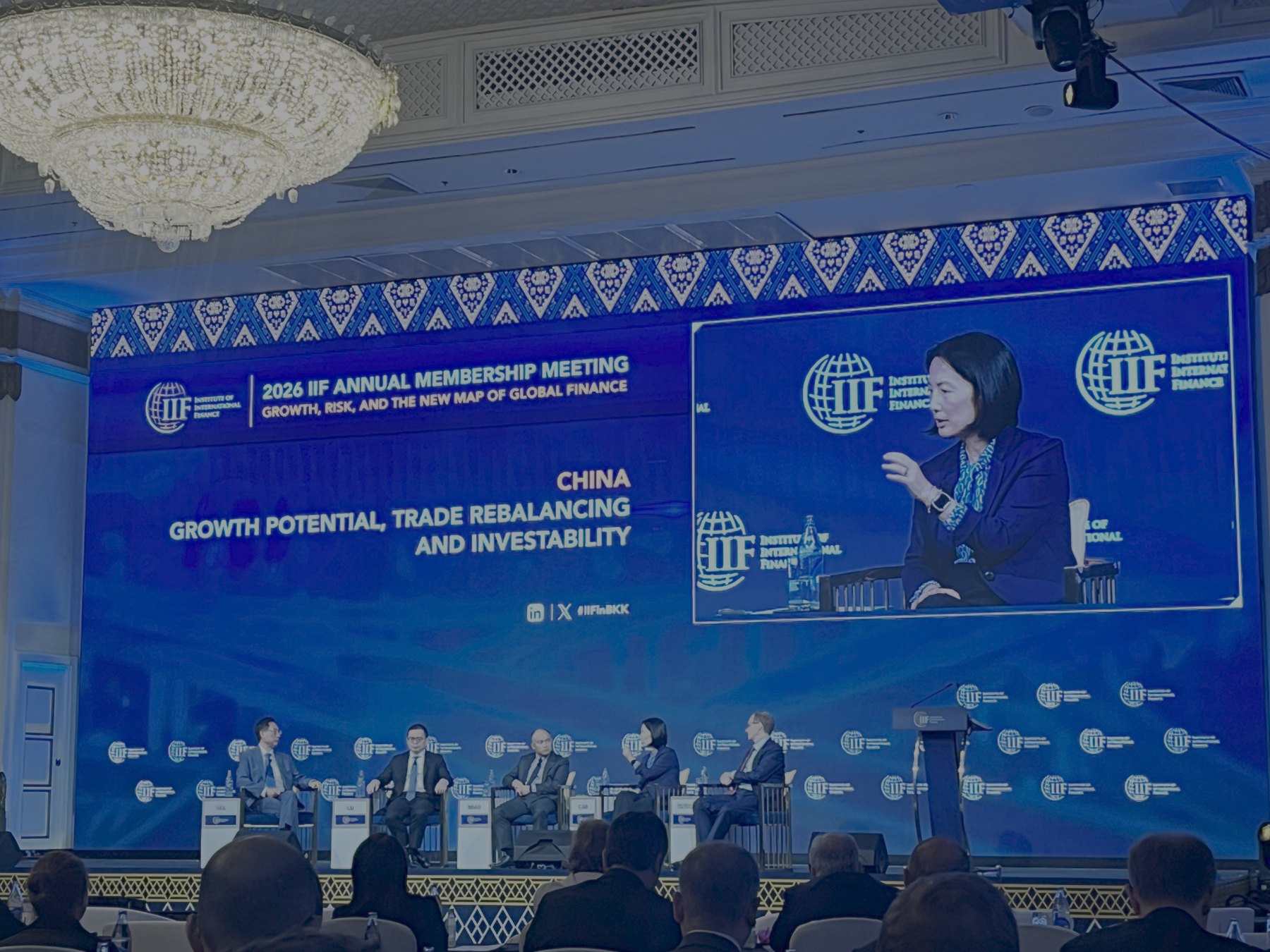
Bangkok · Investment in artificial intelligence is too small to offset China's five-year housing slump, economists said at a conference on Thursday, leaving the world's second-largest economy without a replacement for the sector that once drove its growth.
The shortfall shows up in an economy running on one engine.
Exports grew 36.3 percent in September from a year earlier, beating expectations by a wide margin, according to customs data released Wednesday. Shipments of semiconductors were up 108.1 percent in the first nine months of the year and autos were up 54.3 percent. The monthly trade surplus reached $133.5 billion, and the surplus for January through September stood at $938.1 billion.
Export value growth by category, January-September 2026 (% year on year)
View data
| Category | Export growth, Jan-Sept 2026, % y/y |
|---|---|
| Semiconductors | +108.1 |
| Automatic data-processing equipment and parts | +54.6 |
| Autos | +54.3 |
Prices tell the same story of uneven demand. Factory-gate prices rose 3.8 percent in August from a year earlier, while consumer prices rose 0.8 percent, according to the National Bureau of Statistics.
That divergence between booming factories and cautious households dominated a panel of economists from Bank of America Securities, China International Capital Corporation, Nomura and Goldman Sachs. Their word often steers billions of dollars in investment.
They agreed on much of the diagnosis. They were split over the fix.
Domestic demand is the weak spot. Fixed-asset investment rebounded briefly in the first quarter on stimulus, then contracted from April onward, said Helen Qiao, chief economist for Greater China at Bank of America Securities, extending a slowdown that began in the second half of 2025. Official data bear that out. Investment rose 1.7 percent in the first quarter from a year earlier, fell 1.6 percent through April and was down 7.2 percent through August. Property investment, the largest drag, was down 19.9 percent.
Year-to-date change in investment, 2026 (cumulative, % year on year)
View data
| Month | Fixed-asset investment, % | Property investment, % |
|---|---|---|
| Feb | +1.8 | n/a |
| Mar | +1.7 | −11.2 |
| Apr | −1.6 | −13.7 |
| May | −4.1 | −16.2 |
| Jun | −5.7 | −18.0 |
| Jul | −6.7 | −19.2 |
| Aug | −7.2 | −19.9 |
"The problem is demand is too weak," she said. Consumption is doing little better.
Clients keep asking her whether artificial intelligence can fill the gap, Qiao said. China has a new power grid to feed data centers and, as clients put it to her, model-development teams second only to America's.
The numbers do not add up.
Bank of America's research puts AI-related investment at less than 1 trillion yuan a year, far below what it would take to replace the output lost from property, she said. China's data-center investment is about one-ninth of America's, according to Gene Ma, head of China research at the Institute of International Finance and the session's moderator.
The property problem is one Beijing has had five years to solve.
Ma asked why officials have not copied the playbooks other countries used after their own housing busts.
Qiao said the United States lets households file for bankruptcy and lets banks take losses quickly, a shock that allows recovery to start sooner. China chose a soft landing. Banks cannot write off bad loans fast, developers that are effectively bankrupt have not been wiped out, and households keep paying mortgages for years or decades. The approach means less pain now and more of it over time. No panelist was willing to put a date on the bottom.
Official price data show the slide has not stopped. In August, new-home prices fell from the previous month in 49 of the 70 large and medium-sized cities the statistics bureau tracks. Second-hand prices fell in 62 of them.
Cities (of 70 surveyed) where prices fell from the previous month, August 2026
View data
| Home type | Cities with a monthly price fall (of 70) |
|---|---|
| New homes | 49 |
| Second-hand homes | 62 |
The central bank has little room to help.
Ma noted that the benchmark lending rate has been cut by only 10 basis points in the past year and asked whether the People's Bank of China should push rates to zero. Yanliang Miao, senior managing director and chief strategist at CICC, said it will not. Chinese households still keep most of their savings in bank deposits, Miao said, and rates near zero would drive money out of the banking system and cut bank profits. The seven-day open market operation rate, at 1.4 percent, leaves some room to cut.
The central bank already eases in another way.
It lends to commercial banks at subsidized rates on the condition that the money goes to favored sectors, including artificial intelligence, green industry and agriculture. Miao called the approach "structural monetary policy" and described it as credit easing. In an economy that is deleveraging, the effect is limited.
The transmission is "short-circuited," Miao said, "because nobody's borrowing."
That points to fiscal policy, where the panel saw a shrinking tool rather than a growing one.
Ma put the deficit at 4 percent of gross domestic product on the headline measure and about 9 percent when broader borrowing is counted. Ting Lu, chief China economist at Nomura, said the deficit is the wrong place to look. Spending, counting on-budget and off-budget outlays, fell about 2.5 percent in the first eight months of the year after growing 3.6 percent last year, Lu said. "A true fiscal cliff," Lu called it.
Tax revenue rose 6.6 percent over the period and personal income tax revenue rose 15 percent, as national and local officials step up enforcement against individuals, companies and offshore trusts. Land-sale revenue, once a major source of local funding, is still down almost 30 percent this year. If officials try to collect on all of it within a few months, Lu said, the effect on stocks and the economy would not be small.
The debt left behind by property is larger than the programs meant to contain it, Lu said.
Beijing's local-government debt swap, started in late 2024 and sized at 10 trillion yuan, is about 80 percent complete and probably has little real effect. It is too small against total local debt and too narrow, aimed mainly at local government financing vehicles. Lu estimated corporate-to-corporate debt owed by developers at close to 30 trillion yuan, with perhaps 30 percent of it nonperforming. Any bank cleanup on the Japanese model would also have to clear those arrears between companies, Lu said, or the channels through which monetary policy works will stay blocked.
Banks sit in the middle of it.
Qiao said the official bad-loan ratio, below 3 percent, looks fine, but reporting may lag and the quality of household consumer credit and mortgages is deteriorating. Margins are thin. The 10-year government bond yield is about 1.7 percent, one of the lowest among major economies, and average yields on long-term loans are slightly below 2 percent. Yet bank shares have gone "through the roof," Qiao said, because investors are avoiding consumer, property and other cyclical stocks and retreating into AI-related companies and financials. Ma said shareholders also collect dividend yields of 4 percent to 5 percent. Money is crowding into the stocks tied to AI even as the investment behind it falls short of what the economy needs.
Whether the technology helps or hurts prices split the panel.
Miao argued that artificial intelligence will lift productivity fastest in services that cannot be exported, such as education. Those gains will not raise wages or export income. They will lower prices, a reversal of the classic Balassa-Samuelson effect, in which fast productivity growth in traded goods pushes a currency up. "AI is deflationary," Miao said, "and China is already facing pressure on that front."
Miao said that limits how far the renminbi can rise. Qiao disagreed, saying new technology can raise prices by creating demand. Miao allowed that AI could lift prices in the short run because of supply constraints, though only in specific sectors, and held that the longer-term effect is the opposite.
Exports are the outlet for all that weak demand, and they invite friction.
Andrew Tilton, chief Asia-Pacific economist at Goldman Sachs, said a narrow voluntary export restraint agreement on plug-in hybrids makes sense from Beijing's point of view but covers a tiny share of exports, leaves conventional vehicles untouched and is temporary. It will not change the trajectory of Chinese export growth, Tilton said. More meaningful steps would include faster currency appreciation, an end to threats to restrict rare-earth exports, an end to export tax rebates and cuts to local-government subsidies, which feed excess supply. The last, Tilton said, is "easier said than done." Appreciation of less than 3 percent a year would not ease trade tension, Tilton said, while much more than 5 percent would erode competitiveness. Ma said the renminbi has gained roughly 6.5 percent to 7 percent over the past year and a half.
Qiao objected to the rebate idea, though.
Refunds of value-added tax on exports are justified under World Trade Organization rules and are standard practice for any country with a VAT system, she said, and cutting them sector by sector would treat exporters unfairly. "This is the wrong way to do it," Qiao said. China should rebalance by lifting domestic demand. Ma said he had worried the panelists would read from scripts. "You see the sparks now?" Qiao replied.
The pressure on households may grow as AI spreads. Lu said the case for stronger pensions is rising because of aging, youth unemployment and the arrival of AI. More than 12 million college graduates enter the workforce each year, and many work as gig or flexible workers. More than 70 percent of them are not formally covered by the pension system, Lu said. More than 55 percent of China's elderly receive about $1 a day, Lu said. Lu's remedy is to raise pensions for the old and subsidize pension contributions for the young, so households feel less need to save.
For global investors, the story of strong manufacturing and weak domestic demand is now widely shared, Tilton said, and so is the view that the renminbi will rise. Unhedged Chinese bonds have been among the top three performers in the world this year, Tilton said, though they are unlikely to repeat that in 2027 with the 10-year yield below 1.7 percent. Hedge funds have cut risk across markets lately, but long-only investors have kept their equity positions steady, and foreign buyers have shown interest in Chinese initial public offerings.
Tilton named two risks: what Tilton called "profitless growth," as efficient Chinese companies gain market share in a market with excess capacity, and regulatory risk from both Beijing and Washington. Qiao added that volatility is very low across currencies, bonds, credit and some equities, which dampens the appetite for Chinese assets. More volatility, she said, could bring investors back.
In closing remarks, the moderator said low volatility invites carry trades, with investors short low-yielding currencies and long the renminbi and Chinese bonds.
The economy looks K-shaped, with exporters and a few top-tier cities leading in AI doing well.
Chinese companies and individuals are also sending large sums abroad. Call it capital flight or overseas investment, the panelists said.
Either way, the advice to investors was short: follow the money.
Panelists
- Gene Ma, head of China research and chief representative, Asia/Pacific region, Institute of International Finance (moderator)
- Helen Qiao, managing director and chief economist, Greater China, and head of Asia economics research, Bank of America Securities
- Yanliang Miao, senior managing director and chief strategist, China International Capital Corp. (CICC)
- Ting Lu, managing director and chief China economist, Nomura Securities
- Andrew Tilton, chief Asia-Pacific economist and head of EM economic research, Goldman Sachs
Sources
Data cited outside the panel discussion:
- National Bureau of Statistics, Investment in Fixed Assets from January to August 2026 (fixed-asset investment down 7.2 percent).
- National Bureau of Statistics, Investment in Fixed Assets from January to February 2026 and January to March 2026 (up 1.8 percent and 1.7 percent).
- National Bureau of Statistics, Sales Prices of Commercial Residential Buildings in 70 Medium and Large-sized Cities in August 2026.
- Trading Economics, China fixed asset investment, January to August, and January to April (monthly year-to-date fixed-asset and property investment series).
- Mysteel, NBS: China's Jan-Aug FAI drops 7.2%, property investment slump widens to 19.9%.
- ABC News (wire report), China's trade surplus hits $938 billion for Jan-Sep as pressure ramps up to rebalance trade (September export growth, trade surplus, category growth).
- Trend News Agency, China's factory-gate prices outrun consumer prices by 3 points (August CPI and PPI, citing the National Bureau of Statistics).
Comments
Sign in with LinkedIn to join the discussion. Your LinkedIn name and photo appear publicly beside your comment. Please keep it civil and on topic.