
News · Markets · Global
IMF Warns Calm Markets Hide Rising Risks From AI, Bonds and Cyberattacks
The fund's latest stability report finds high leverage, thin buffers and little room for governments to cushion a fall.
For information only. Not investment advice. Disclaimer · Special coverage: IMF–World Bank Annual Meetings, Bangkok
AI-generated summary, reviewed by the editor.
- The IMF warned calm markets mask three threats, an AI stock sell-off, a bond rout and a cyberattack, which turn systemic when they meet high borrowing.
- Hyperscalers are 10 percent of global investment-grade bond issuance, up from less than 1 percent in 2024; an AI unwinding could cut output by up to 0.4 percent.
- In the stress test the aggregate bank capital ratio falls to roughly 11.5 percent, but banks holding 22 percent of assets would drop below 7 percent.
It restates the article and adds no new facts. How we use AI
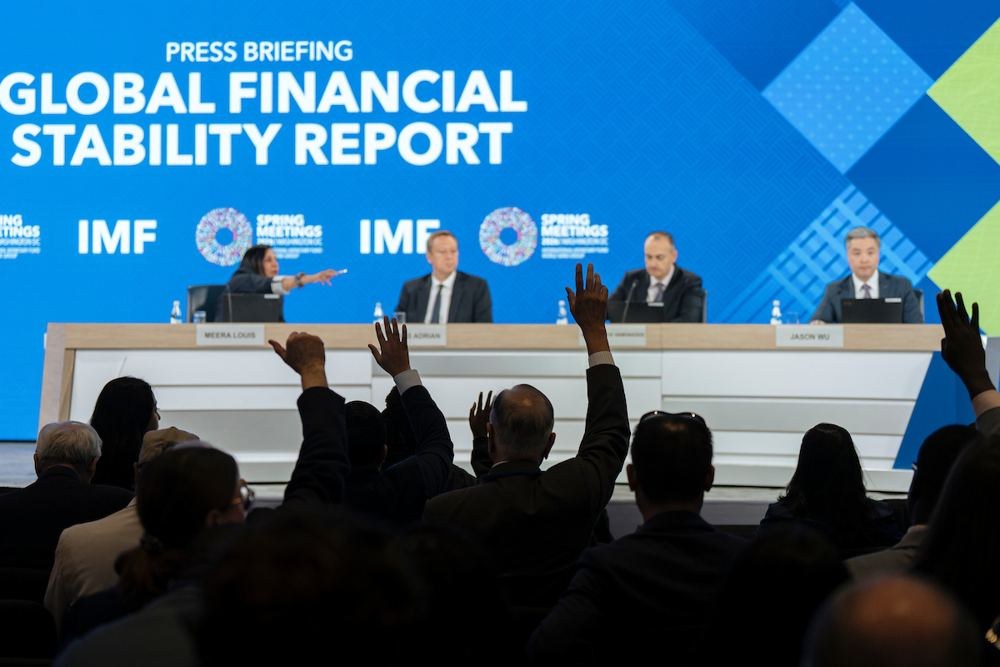
The International Monetary Fund warned on Tuesday that calm financial markets are masking three growing threats from an artificial intelligence stock sell-off, a bond rout and a major cyberattack.
In its latest Global Financial Stability Report, the fund said markets have held up since April on strong corporate earnings and solid growth, and that financial conditions remain easy by historical standards. The risks sit underneath. "There is no room for complacency," Athanasios Vamvakidis, the fund's deputy director for monetary and capital markets, and Jason Wu, an assistant director in the same department, wrote in a blog post that accompanied the report.
None of the three risks would threaten the financial system alone, the report said. They become systemic when they meet high borrowing, thin liquidity and tightening links between banks and lenders outside the banking system. Governments and central banks also have less room to respond than during much of the past two decades, the fund said, because public debt is high and inflation remains above target in many countries.
Direction since the April 2026 report
Risk scorecard
| Risk or vulnerability | Since April | Staff assessment |
|---|---|---|
| AI-driven market correction | About the same | Core AI firms remain profitable, but leverage is rising. |
| Sharp rise in sovereign bond yields | Worse | High debt and rollover risks are unresolved; market functioning has been orderly. |
| Cyber threats | Worse | Rapid digitization has widened the attack surface. |
| Weak banks in a stress scenario | About the same | Banks remain resilient overall; vulnerable institutions remain and links to nonbanks deepened. |
| Emerging market buffers and alternative financing | Worse | Reserves of weaker emerging markets have eroded; frontier borrowing is less transparent. |
| Liquidity mismatches of institutional investors | Worse | Insurers and pension funds hold more illiquid, concentrated assets. |
| Leverage and liquidity in private credit | About the same | Defaults have fallen, but liquidity pressure is elevated and borrowers are more leveraged. |
| Household debt burden | Better | Debt burden has eased and households hold sizable assets. |
The AI risk is the one the fund tied most closely to debt. Hyperscalers, the companies that run the largest data centers, now account for 10 percent of global investment-grade corporate bond issuance, up from less than 1 percent in 2024. Hedge funds' stock positions and margin loans have grown to about 15 percent of advanced-economy output from 10 percent. The share of single stocks in leveraged exchange-traded funds has climbed to 28 percent from 16 percent.
Percent
View data
| Measure | End-2024 | 2026 |
|---|---|---|
| Hyperscalers' share of global investment-grade bond issuance | less than 1 (0.5 in the report's background analysis) | 10 |
| Hedge fund equity positions plus margin loans, as % of advanced-economy GDP | 10 | about 15 |
| Single stocks as a share of leveraged ETFs | 16 | 28 |
The fund also examined 14 public deals since 2023 in which AI companies invest in, lend to and sign revenue contracts with one another. They involve about $300 billion in equity investment, $650 billion in debt and $1.4 trillion in promised future revenue, with the equity flowing mostly from hyperscalers to financially weaker AI firms. If a key borrower stumbled, the report said, the equity and debt would lose value at the same moment the revenue behind them was in doubt, a "wrong-way risk" for the whole ecosystem.
US$ billion
View data
| Item | US$ billion |
|---|---|
| Equity investment | 300 |
| Debt | 650 |
| Future revenue commitments | 1,400 |
The fund's World Economic Outlook models an unwinding of AI investment that cuts global economic output, investment and consumption by as much as 0.4 percent, 1.3 percent and 0.6 percent by 2028. Advanced Asian equity markets, which move most closely with global AI stocks, would probably suffer the most, the stability report said.
At a news briefing, an IMF official said the exposure of the rest of the world to American assets, particularly AI, is "the highest it has ever been." An AI correction would widen credit spreads, shrink risk-taking and feed back into the real economy, the official said. Another IMF official at the briefing said fiscal and monetary policy offer little cushion, and that "we should not expect macroeconomic policies to come to the rescue."
Sovereign bonds, which underpin pricing across the financial system, are the second worry. Yields have risen since the war in the Middle East began, pushed up by higher expected policy rates and by larger term premiums, the extra pay investors demand to hold long-dated debt. Term premiums sit at the upper end of their historical ranges, especially in advanced economies. Fourteen of 33 major central banks have raised rates since the second quarter, up from two in the first. The fund rated bond-market risk worse than in April.
An IMF official told reporters that much of the recent move reflected positioning adjustments and triggered stop-loss orders, that markets had kept functioning, and that yields and volatility had returned to levels last seen in the decade before the global financial crisis. Rates, the official said, had not overshot what fundamentals justify. Countries with large fiscal deficits are more vulnerable to the move, the official added, even though deficits were not what set it off.
The report points to a combination that last appeared in 2007: a 10-year US Treasury yield above 4.5 percent alongside unusually narrow bond spreads in frontier economies. Spreads typically widen when yields are that high. Governments are also issuing more debt, and so are AI companies, at a time when central banks are shrinking their balance sheets and leaving more of the market to price-sensitive investors.
The third risk is cyberattack. In more than 70 percent of cases this year, software providers had almost no time to patch a vulnerability before attackers exploited it, a jump of 20 percentage points from a year ago, the report said. Frontier AI models can help attackers and defenders alike, and regions such as Asia face significant shortages of cybersecurity talent. An IMF official said emerging markets often lack the capacity to respond and should build incident reporting, domestic and cross-border coordination, and oversight of the third-party providers that financial firms depend on.
Banks, for now, look sturdy. In the fund's global stress test, which combines an energy shock, long-term yields 300 basis points higher, short-term yields 150 basis points higher and an AI-led market correction, the aggregate common equity capital ratio falls about 1.5 percentage points to roughly 11.5 percent, well above regulatory minimums. But banks holding 22 percent of global banking assets would end up below 7 percent, up from 18 percent in last year's test. In Asia, the weak spots are banks in oil- and gas-importing economies. In North America, losses on government bonds at a small number of large banks drive the result.
Percent
View data
| Stress test | Weak banks, % of assets |
|---|---|
| 2025 | 18 |
| 2026 | 22 |
The fund is more concerned about lenders outside the banking system. Direct lending now totals nearly $2 trillion globally, and some funds have committed more credit to borrowers than they have cash and borrowing capacity to provide, a test the sector has not yet faced. Loans by US banks to nonbank financial firms rose 18 percent this year, and their exposures to private equity and private credit firms rose 30 percent. Hedge fund assets have more than tripled since the previous decade, to about $13 trillion. An IMF official said the worry is the mix of rising hedge fund leverage and overlapping positions, and that central clearing could reduce counterparty risk in a stress.
Emerging markets have been resilient, with risk premiums back near their pre-war levels. An IMF official called that unusual given how high yields are and how narrow spreads remain, and said even countries with sound policies should rebuild buffers before conditions turn. Asia faced the most pressure on currency interventions this year, the report said, and economies that relied on intervention alone saw little recovery in their exchange rates.
The report also reviews tokenization, the recording of financial assets on shared digital ledgers. It calls the market small and fragmented and says systemic risks remain limited for now. Hong Kong is among the leading issuers of tokenized government bonds, with about $2.2 billion issued in total.
The fund's recommendations: put public debt on a sustainable path, limit leverage in AI, private credit and other nonbank lending, including through sector capital requirements and concentration limits on banks' exposures, and strengthen cyber defenses through incident reporting and resilience testing.
Mr. Vamvakidis closed the briefing on a note of conditional optimism. "Right now, despite the pressure we see in the rates markets, risk appetite has been strong," he said. The danger, he said, is if policies themselves cause that appetite to fall. "A lot of shocks can be unpredictable," he said, which is why governments need to build buffers now.
Sources
- International Monetary Fund, Global Financial Stability Report, October 2026 (Chapters 1 to 3, Box 3.3).
- Athanasios Vamvakidis and Jason Wu, "Global Financial Markets Face Rising Risks From AI, Bond Yields, and Cyberattacks," IMF blog, October 13, 2026.
- IMF Global Financial Stability Report press briefing, October 13, 2026 (speakers Athanasios Vamvakidis, Jason Wu and Caio Ferreira, moderated by Camila Perez).
Comments
Sign in with LinkedIn to join the discussion. Your LinkedIn name and photo appear publicly beside your comment. Please keep it civil and on topic.