
News · Rates & FX · Global
Bank of Korea Chief Says Rates Stay Tight Until Inflation Heads Back to 2%
Governor Hyun Song Shin says an AI export boom and the Middle East war are pushing prices up together, and that currency and financial-stability goals now point the same way.
For information only. Not investment advice. Disclaimer · Special coverage: IMF–World Bank Annual Meetings, Bangkok
AI-generated summary, reviewed by the editor.
- Governor Hyun Song Shin says the Bank of Korea will keep policy restrictive until it is confident inflation is returning to its 2% target.
- The bank raised its benchmark rate to 3.00% on Aug. 27, a second 25-basis-point increase; Shin said an AI export boom and the Middle East war both push inflation higher.
- Shin said the won has room to rise and financial imbalances are building; the article says chip prices or the war could change the outlook.
It restates the article and adds no new facts. How we use AI
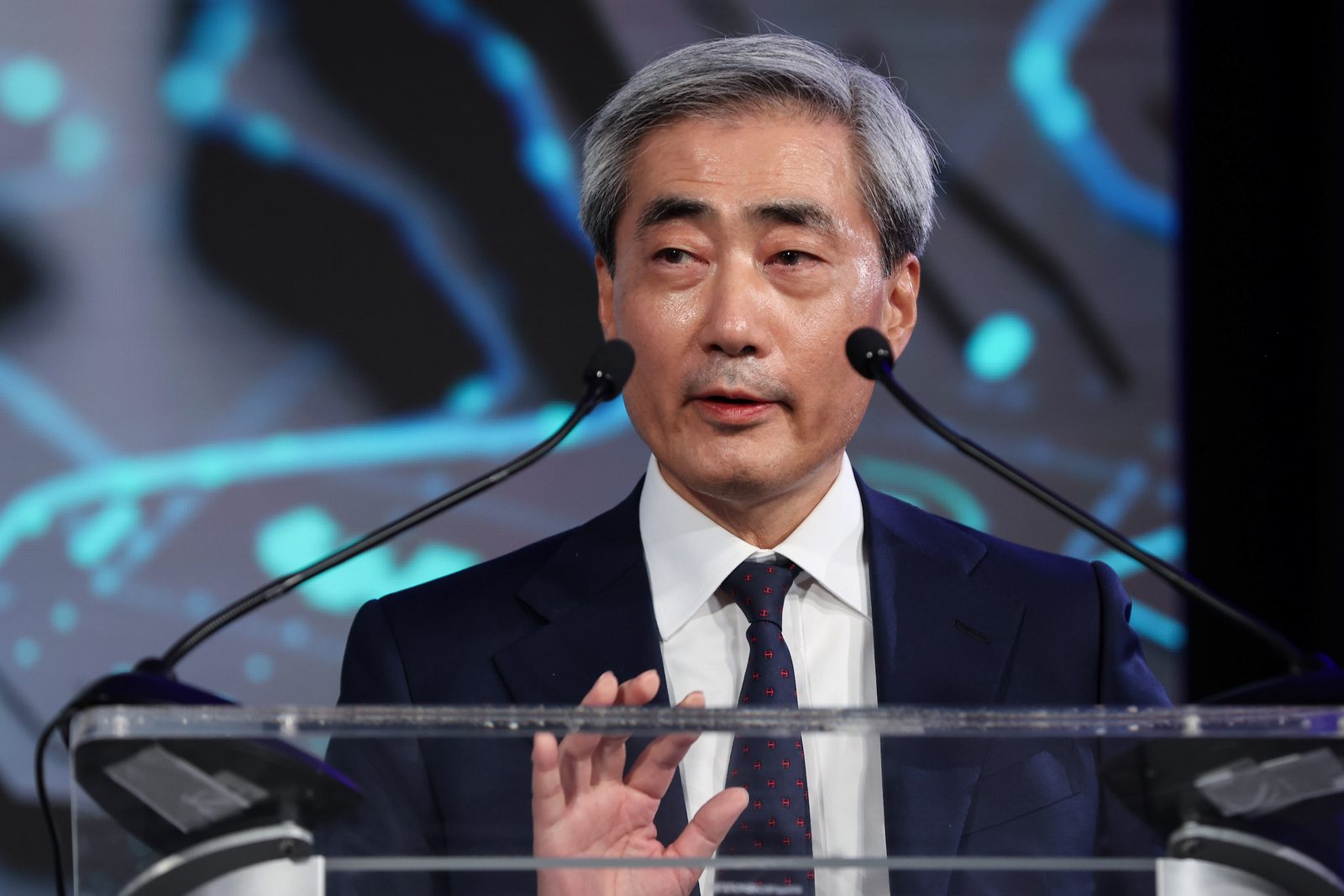
Bangkok · The Bank of Korea will keep monetary policy restrictive until it is confident inflation is returning to its 2% target, Governor Hyun Song Shin said on Tuesday at the IMF and World Bank annual meetings, describing an economy squeezed by an artificial-intelligence export boom on one side and the war in the Middle East on the other.
Korea sits at the intersection of those two forces, Shin said in a public interview with Krishna Srinivasan, director of the International Monetary Fund's Asia and Pacific Department. The AI cycle "really swamps the negative effect" of the war on activity, he said, but both push inflation higher, one through costs and the other through demand. He expects headline and core inflation to stay above target "for some time."
The central bank has already acted. It raised its benchmark rate to 3.00% on Aug. 27, a second straight 25-basis-point increase after a move to 2.75% in July. The board's next meeting is Oct. 22, according to FocusEconomics, whose panel mostly expects one more quarter-point hike by year-end.
Shin, who ran research at the Bank for International Settlements before taking over the Korean central bank around April 21, used the session to explain why he thinks the policy choices in front of him are easier than usual.
"If you're chasing two rabbits and they're running in different directions, where do you go?" he said, repeating a line from an earlier press conference. "If they're all running in the same direction, it becomes easier." Inflation is too high, he said, the won has strengthened but has room to run, and financial imbalances are building. "All three point in the same direction."
Bank of Korea benchmark rate, percent
View data
| Decision | Rate, % |
|---|---|
| May 28 (hold) | 2.50 |
| July (hike) | 2.75 |
| Aug. 27 (hike) | 3.00 |
Numbers Behind the Hawkish Turn
The numbers behind that view are not small. Consumer prices rose 2.8% in July from a year earlier, with core inflation at 2.6%, Trading Economics reported. In August the bank lifted its 2026 growth forecast to 3.3% from 2.6%, driven by semiconductor exports and investment. Shin said that growth is projected to stay strong next year. FocusEconomics put inflation above the 2% target for five months, and tied it to an energy shock from the conflict with Iran.
The August decision was not unanimous. Six of the board's seven members voted to hike; one wanted to hold at 2.75%, FocusEconomics reported. Three months earlier, on May 28, the board held at 2.50% with two members dissenting in favor of an immediate increase.
Dots and Guidance
That May meeting also produced the bank's latest "dot plot," which Shin described Tuesday with a Korean twist on the name. Each of the seven board members submits three dots showing where they expect the policy rate to be six months out. In May, 19 of the 21 dots pointed above the then-current 2.50%, according to Investing Live. Shin called the "K-dot plot" a way for members to show uncertainty and disagreement, but warned it can also "tie your hands." He said the bank, which has used the tool since February, will review it, and "will give it at least a year" before doing so. In August, he said, the dots let the bank signal both a rate increase and the likely slope of future ones, which had "a pretty beneficial effect on long-term yields."
His stance on communication marks a small break with his predecessor, Rhee Chang-yong, who made heavier use of forward guidance. Shin has questioned its value because it reduces flexibility, the JoongAng Daily reported. On Tuesday he said "just the right amount" of guidance can soften its known flaws, and that the trick is finding "the sweet spot between too much and too little."
The AI Dividend
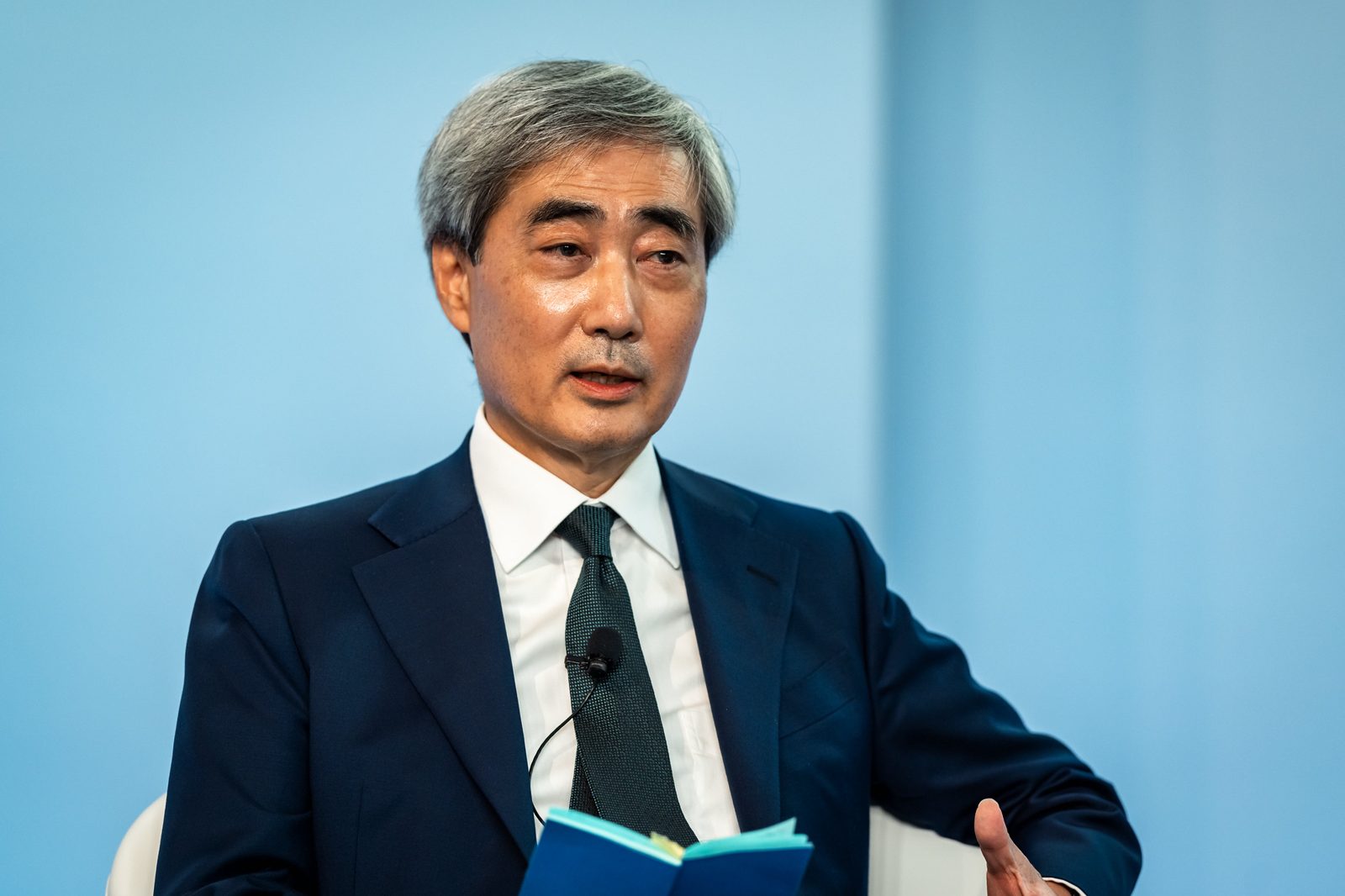
The AI boom also complicates the question of where interest rates should settle over the long run. Shin said hyperscalers' investment is expected to exceed $1 trillion every year through 2030 and that much of that demand will land in Korea, a major chip supplier. He raised the possibility that faster productivity growth lifts the neutral rate, and said the very long-dated bonds hyperscalers have issued are "fishing from the same pool of funding" as governments and have contributed to higher long-term yields. The sums are small, he allowed, but not once converted into duration.
Korea's government is collecting some of the proceeds. The AI-driven export boom has produced what Shin called a "fiscal dividend," with tax revenue next year estimated at 40% above this year's. He said that has played out differently from other countries wrestling with the fiscal sustainability concerns the IMF has put at the center of this year's meetings.
A K-Shaped Economy
The gains are uneven. Large technology companies have prospered while other sectors and regions have not, a split Shin called a "K-shaped" economy. His answer for lower-income households is price stability. The poorest fifth of Korean households spend 32% of their income on food and energy, he said, so "getting inflation under control is actually a very effective way of helping the least well off."
Borrowers are a harder case. Small businesses and some households are straining under high debt-service costs, and Shin said the central bank cannot fix that alone. Fiscal resources should cushion the worst effects, he said, and there may be "some scope to adjust the debt obligations," weighed against moral hazard.
The won is the other lever. Weak through the first half of the year, it has risen over the past two to three months, which Shin said raises households' purchasing power and tilts the economy toward domestic demand and away from exporters. He sees room for further gains, and called the exchange rate "a gauge of the confidence in the whole economy."
Chips, Credit and the Won
On asset prices, Shin said the bank watches chip prices more closely than chip stocks. Contract and spot prices for chips matter more to the real economy than share prices, he said, which swing on news such as a report a day earlier of potential new technology.
For financial stability, the bank tracks a Financial Vulnerability Index that blends leverage, house prices and other measures. Shin said the gauge sits near its long-term average, around 46 on a scale that started at 100 in the second quarter of 1997, just before the Asian financial crisis, and is rising. The bank hopes tighter policy slows the climb. Its macroprudential tools are aimed mostly at households and housing, he said. Fixing imbalances after the fact, he added, is "like taking a needle and popping a balloon."
Asked by an audience member how interest rates and macroprudential tools should be balanced, Shin said they work as complements, not substitutes, and that tools reinforce each other when policy is tight. He urged governments not to weaken their own and leave everything to the central bank. "Being at the central bank can be very lonely," he said. "We need all the help that we can get."
Whether the rabbits keep running the same way is the open question. The won could weaken, chip prices could break, or the Middle East war could change course on the cost side. The bank gets its next look at the data on Oct. 22.
Sources
- IMF Annual Meetings: Governor Talks session with Hyun Song Shin, Oct. 13, 2026
- Trading Economics: Bank of Korea delivers second straight rate hike
- FocusEconomics: Bank of Korea raises rates for the second consecutive meeting
- Investing Live: Bank of Korea holds at 2.50% but dot plot points to hikes
- Korea JoongAng Daily: Shin Hyun-song's playbook
Comments
Sign in with LinkedIn to join the discussion. Your LinkedIn name and photo appear publicly beside your comment. Please keep it civil and on topic.