
News · Ideas · Global
Google Finds a Way to Skip the Training Step for Spreadsheet Predictions
Google Research has built an artificial intelligence model capable of analyzing spreadsheet-style data and generating predictions without the hours of manual setup that such work has traditionally required — a step the…
A new model called TabFM applies the "zero-shot" trick behind chatbots to rows and columns of data, and Google plans to fold it into BigQuery within weeks
Google Research has built an artificial intelligence model capable of analyzing spreadsheet-style data and generating predictions without the hours of manual setup that such work has traditionally required — a step the company says could reshape how businesses forecast everything from customer churn to fraudulent transactions.
The model, called TabFM, is designed to read a table of data — the kind found in a company database or a research dataset — and make a prediction about a missing value, such as whether a customer will cancel a subscription, in a single pass. That distinguishes it from the tree-based algorithms, such as XGBoost and random forests, that have dominated this corner of machine learning for years and typically require data scientists to spend "countless hours" tuning settings and engineering features for each new dataset, according to the researchers who built it.
The approach borrows a technique from large language models known as in-context learning, the same mechanism that lets a chatbot follow instructions or complete a new task simply by being shown examples in its prompt, rather than being retrained. Weihao Kong and Abhimanyu Das, the Google research scientists who led the project, wrote in a blog post announcing the model that this "zero-shot" logic — first applied by Google to forecasting in its TimesFM model — could now be extended to the two-dimensional world of tables.
Given that TabFM targets classification and regression on structured, tabular data — which is the native format of most financial datasets — likely applications include credit scoring and loan default prediction, since these are standard tabular classification problems banks currently solve with XGBoost-style models. Fraud and anti-money-laundering detection is where the model is likely to be effective the most given that the work is inherently a tabular pattern-recognition problem, for example in transaction amount, location, time, account history and others.
Meanwhile, in the insurance industry, underwriting and claims-risk scoring is another natural fit, as actuarial tables are tabular by definition. Algorithmic trading and quant research could use it for feature-based signal generation on structured market or fundamentals data, though the document gives no benchmark results on financial time-series specifically — TabFM is positioned for static tabular prediction, not sequential forecasting.
The new foundation model "eliminates the need for manual model training, hyperparameter tuning, and complex feature engineering.," Kong and Das wrote.
Tabular data — information organized into rows and columns — underpins much of corporate record-keeping and is the format behind a large share of applied predictive machine learning in industry, according to the researchers. Fitting a conventional model to a new table, they wrote, "is not merely a matter of a single .fit() step," a reference to the line of code that starts training in popular machine-learning libraries.
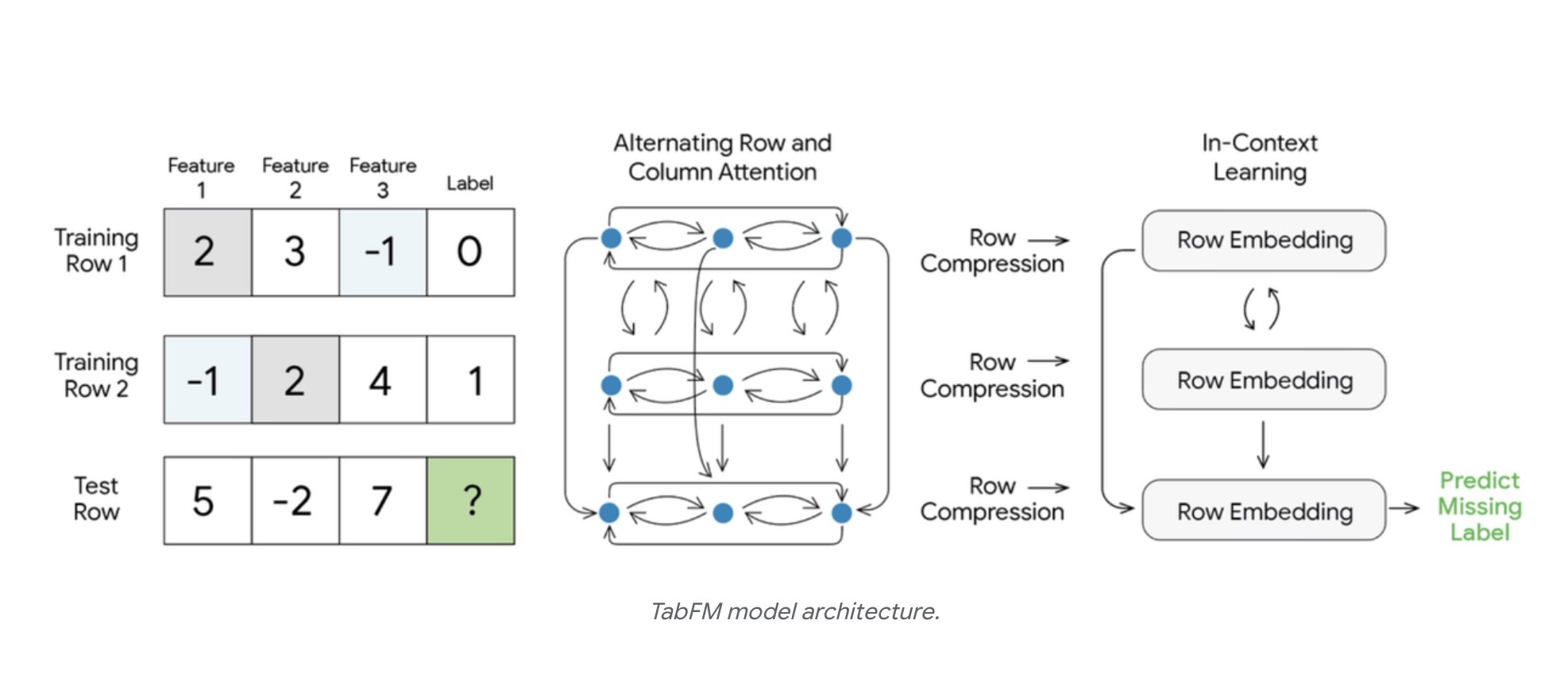
Building a model that can read a table the way a language model reads a sentence required solving a structural problem, according to the blog post. Text is one-dimensional and ordered; a table is not. Swapping two rows or two columns in a spreadsheet does not change what the data means, but standard language models are not built to handle that kind of orderless, two-dimensional structure. To get around this, Google's researchers combined design elements from two existing research models, TabPFN and TabICL, into what they describe as a hybrid architecture.
The system works in three stages.
First, an attention mechanism scans the table by alternating its focus between rows and columns, allowing it to pick up on relationships between features without a person having to hand-craft them. Each row is then compressed into a single, dense numerical summary. Finally, a separate transformer network performs the in-context learning step over those compressed rows rather than the raw grid, which the researchers say keeps the computational cost manageable even as datasets grow larger.
Perhaps the more unusual choice was how Google trained the model in the first place.
Foundation models are typically built by feeding a neural network enormous quantities of real-world data, but Google's researchers said that genuine, large-scale tabular datasets are scarce in the open-source world, partly because companies treat their own tables — often full of proprietary schemas and sensitive information — as closely held assets. So instead, they trained TabFM entirely on synthetic data: hundreds of millions of artificial datasets generated using what researchers call structural causal models, mathematical constructs that use random functions to mimic the kinds of relationships found in real-world tables.
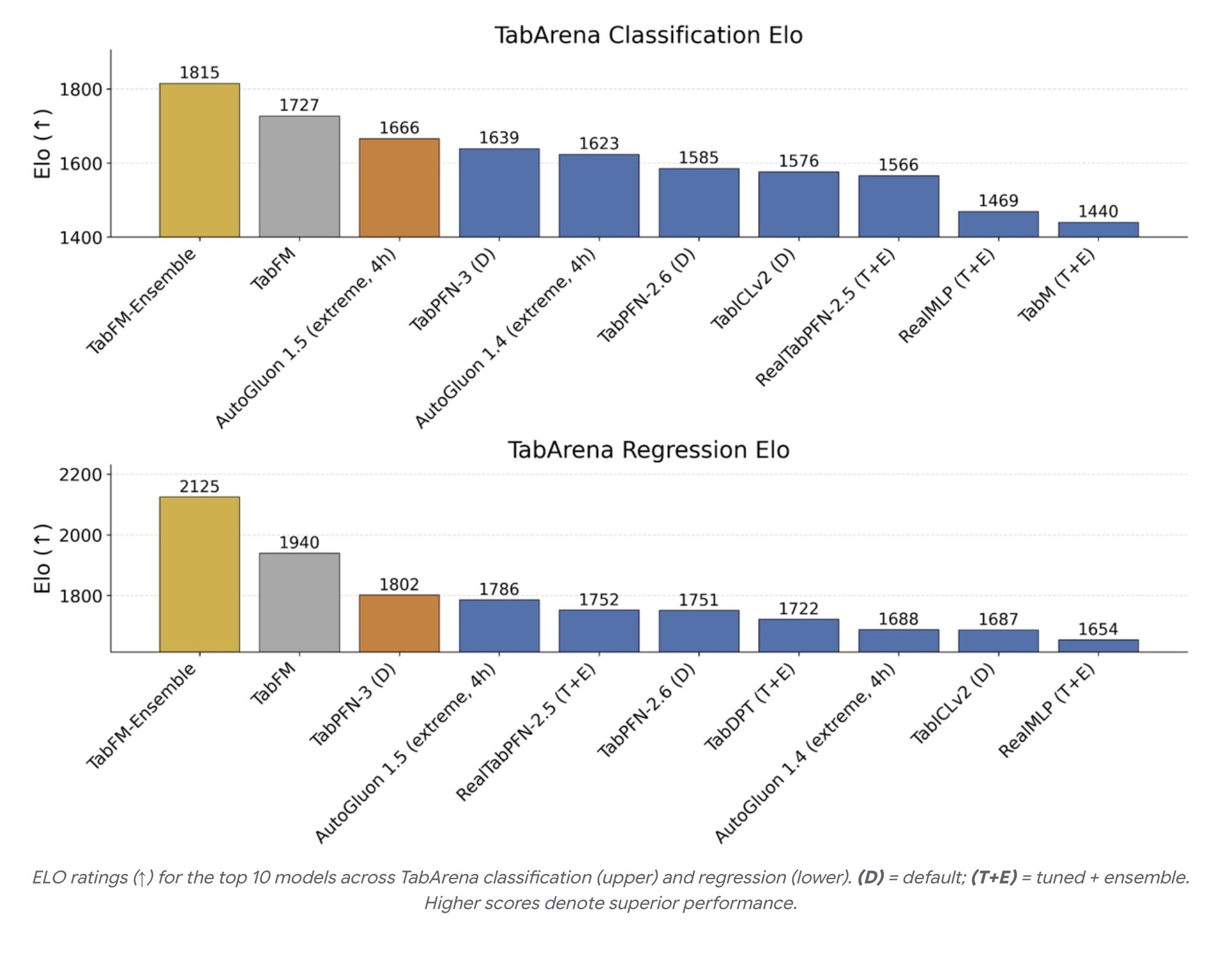
To test whether a model trained on invented data could handle genuine problems, Google evaluated TabFM on TabArena, a benchmarking system that ranks models using chess-style Elo scores derived from head-to-head comparisons, across 38 classification datasets and 13 regression datasets ranging from 700 to 150,000 samples. In its out-of-the-box form — described in the post as requiring "no tuning or cross-validation" — TabFM scored an Elo of 1,727 on classification tasks and 1,940 on regression tasks, according to the figures Google published, in both cases placing second among the ten models shown. A more heavily engineered version, called TabFM-Ensemble, which adds cross features and techniques such as Singular Value Decomposition and a calibration method known as Platt scaling, topped both leaderboards, with Elo scores of 1,815 for classification and 2,125 for regression — ahead of tuned versions of established rivals including TabPFN-3 and AutoGluon.
Google did not disclose which specific companies or products have tested TabFM internally, and the blog post does not name external customers. The comparisons are drawn from Google's own account of the TabArena results and have not been independently verified beyond what the company has published on its GitHub page, where it says more detailed per-fold metrics are available.
The company said the model is already available through the developer platforms Hugging Face and GitHub, and that it plans to build TabFM directly into Google BigQuery, its cloud data warehouse product. Within weeks, Google said, BigQuery users will be able to run classification and regression tasks using a single SQL command, AI.PREDICT, without needing machine-learning expertise — a move that would push the technology from a research demonstration toward a mainstream business tool used by analysts who may have no background in data science.
The more organization-wide impact may be operational.
TabFM claims to skip manual feature engineering and hyperparameter tuning, a bank or fund could in principle let analysts without ML training run predictive models directly in BigQuery, compressing a workflow that today requires a dedicated data science team. Whether this holds up outside Google's own benchmarks is something researchers will eventually be able to attest to. To be sure, the TabArena scores in the report are Google's own published figures, not independently replicated results.
The project was developed jointly by Kong, Das and a team of Google researchers that included Erez Louidor Ilan, Taman Narayan, Shuxin Nie, Rajat Sen, Yichen Zhou, Joe Toth, Deqing Fu and Samet Oymak, according to the blog post's acknowledgments.
The author is the Head of Research and Analysis for Icarus Asia, a Hong Kong based risk and advisory firm.