
News · Rates & FX · Japan
Yen's Record Slide puts Tokyo on Notice
With speculative shorts at a nine-year extreme and the currency at its weakest since 1986, Tokyo's reserves are depleting faster than the carry trade is breaking.
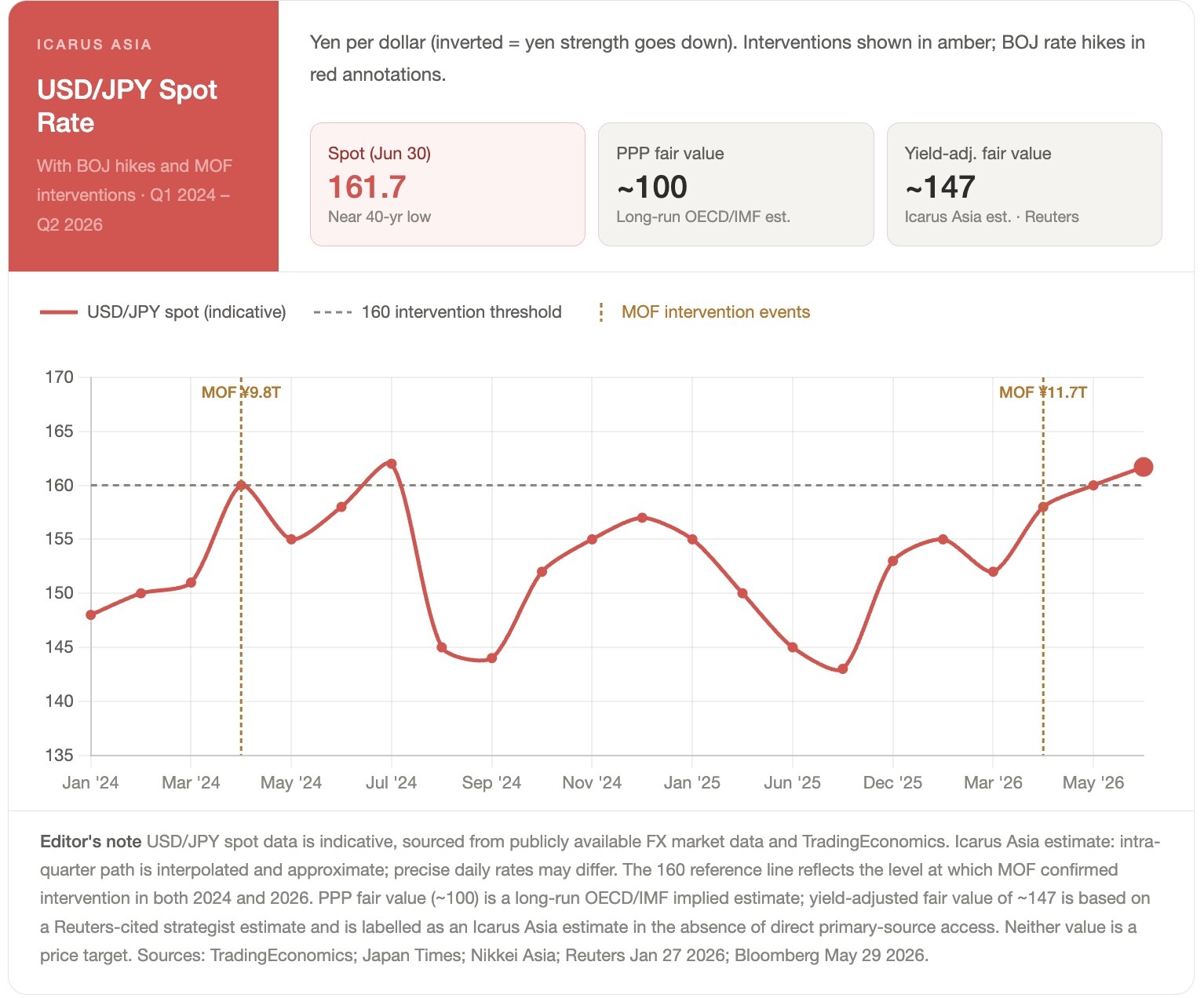
The Japanese yen hit its lowest level against the dollar since 1986 on Tuesday, touching 162.50 before settling at 162.42 in New York trading — extending a slide that has now survived Japan's largest currency intervention on record, a Bank of Japan rate hike, and months of warnings from Tokyo that authorities stand ready to act.
Japan's Ministry of Finance spent ¥11.73 trillion ($73.6 billion) between April 28 and May 27 defending the currency. The yen rallied sharply on intervention days, briefly. Then carry traders came back. By Tuesday, Finance Minister Satsuki Katayama was once again telling reporters that authorities were "ready to respond appropriately at any time" — the same language Tokyo has used before every major intervention of the past two years. The market, well-practiced at reading the script, kept selling.
The pattern raises a question Tokyo has yet to answer: if the biggest monthly currency defense in Japan's history couldn't hold the line, what comes next?
The Perfect Storm
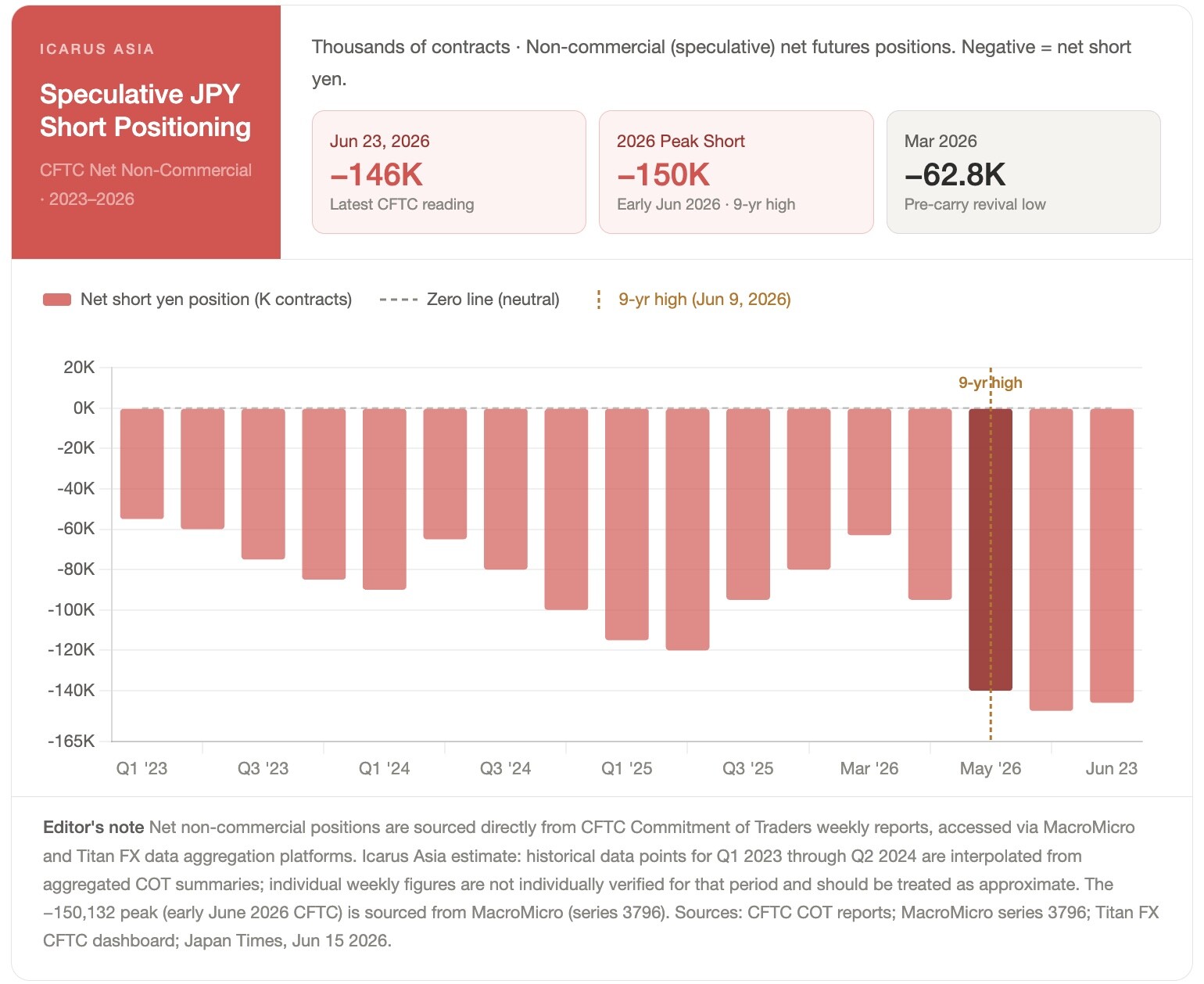
The currency's four-quarter losing streak against the dollar — it is down 2.3% in the second quarter alone — reflects a carry trade that is, by some measures, more entrenched than at any point in nearly a decade. Data from the U.S. Commodity Futures Trading Commission for the week ending June 23 show non-commercial speculators holding a net short yen position of 146,104 contracts in yen futures. Earlier in June, that figure briefly reached 150,132, a level not seen since 2017. Gross shorts stand at 259,800 contracts against gross longs of just 113,700 — a ratio that leaves the market badly one-sided.
The logic of the trade is straightforward.
The Bank of Japan raised its policy rate to 1.0% at its June meeting — the highest since the mid-1990s, and a 7-to-1 vote that signalled genuine determination to continue — but rates in Japan remain far below those in the United States. Investors borrow cheaply in yen, deploy the proceeds in higher-yielding currencies or assets, and pocket the difference. As long as that gap persists and spot stays elevated, the income keeps coming.
"The dollar is the main story at the moment and dollar/yen the key focus," said Lee Hardman, senior currency analyst at MUFG said in an interview with Reuters. "We think they'll come in again at some point, though the move in April and May didn't really reverse the trend so maybe that's made them more reluctant."
Federal Reserve policy is part of what keeps the trade alive.
U.S. inflation remains above target, the economy is growing, and the Fed's latest quarterly projections show nine of 19 policymakers anticipate a rate hike by year-end. Markets are pricing those hikes in. The dollar index rose 0.15% to 101.26 on Tuesday and is on track for a 1.4% quarterly gain.
Calling the Bluff
Against this backdrop, Tuesday's tone from Tokyo was notably restrained.
Katayama reiterated readiness to act but stopped short of the escalating language that has historically preceded buying operations.

Karl Schamotta, chief market strategist at Corpay, read the statement as a deliberate choice. "Katayama's comments avoided the verbal escalation that often precedes a buying effort, instead reiterating that authorities stand ready to respond at any time," he told Reuters.
The timing matters.
Thursday brings the U.S. non-farm payrolls report for June — the week's main economic event — with economists expecting 110,000 jobs added and the unemployment rate holding at 4.3%. Three consecutive months of employment gains above expectations have reinforced the case for a hawkish Fed. Friday is the Independence Day holiday in the United States, when liquidity in foreign exchange markets thins sharply.
Schamotta noted that those conditions could cut both ways. "Thursday's non-farm payrolls report and Friday's Independence Day holiday — when U.S. liquidity will thin dramatically — could provide attractive opportunities for wrong-footing speculative short positions," he said.
An Unkind Unwind?
What complicates the carry trade's staying power is a set of fundamentals that, on paper, do not support a yen this weak.
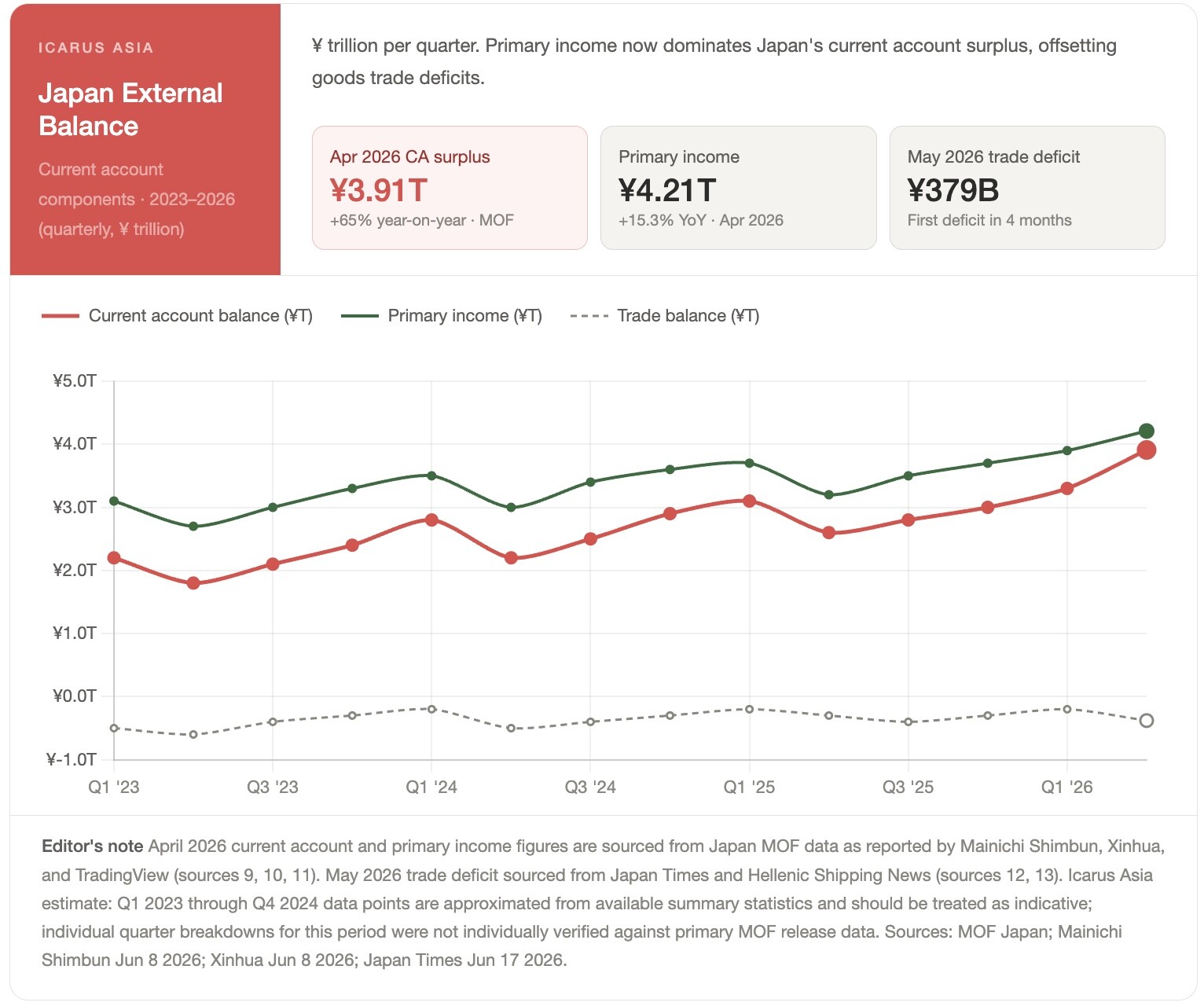
Japan's current account surplus reached ¥3.91 trillion in April, up 65% year-on-year, driven not by export competitiveness but by primary income — the returns Japan earns on its enormous overseas investment holdings, which rose 15.3% year-on-year to ¥4.21 trillion in April alone.
The Bank for International Settlements' real broad effective exchange rate for Japan stood at 65.93 in May on a 2020=100 basis, near a multi-decade low. On purchasing-power-parity models, fair value for USD/JPY sits somewhere between 100 and 149. The market is at 162.
The structural case for yen weakness that dominated the 2010s rested heavily on Japan running persistent current account deficits through energy shocks and sustained outbound investment. That case is materially weaker now. The external balance supports the yen. Rates are rising. Markets have not adjusted.
Brace for Impact
For investors still holding large unhedged short-yen exposures above 160, the question is whether the carry income still justifies what is increasingly a tail-risk position.
Speculative short positioning is at a nine-year extreme. The Bank of Japan is no longer pinned at zero and voted 7-to-1 in June in a way that markets read as a signal of further hikes to come.
Japan's government has now demonstrated twice — in 2024 and again this spring — that it will intervene at scale when spot approaches 160 and will promise more. Reports earlier this year indicated Tokyo requested USD/JPY assessments from the New York Federal Reserve, a procedural step that precedes coordinated G7 FX action.
None of this means the trade breaks immediately. Carry misalignments can persist for years. PPP is not a timing tool. But the distribution of outcomes has shifted. The gap between where the yen trades and where the fundamentals point has never persisted indefinitely.
Crowded positioning, a central bank that is no longer pinned at zero, and a government with the demonstrated willingness to intervene at scale all raise the probability that the next 10% move in USD/JPY is down, not up — and that when it comes, it comes fast.
We are witnessing the beginning of what could be a global cycle of non-dollar currencies weakening from a stronger dollar and wider fiscal deficits weakening home currencies. Wall Street will bet against economies heavily dependant on crude.
The vultures are circling in. The question is if Japan, and others in a similar predicament will be able to fight back.
The author is the Head of Research and Analysis at Icarus Asia, a risk and advisory consultancy based in Hong Kong.
To read our full research note as well as positioning frameworks click on the image below:

Disclaimer
Not investment advice. Please do your own research and consult with a registered financial advisor.
Sources
MQL5 Economic Calendar — CFTC JPY Non-Commercial Net Positions, June 23 2026: mql5.com
Titan FX Research — JPY IMM Futures Positions and USD/JPY Chart: research.titanfx.com
Nikkei Asia — Japan confirms record $73bn yen-buying intervention in April–May: asia.nikkei.com
Bloomberg — Japan Used Record $73.6 Billion to Support Yen in Past Month, May 29 2026: bloomberg.com
Japan Times — Japan used record $73.6 billion to support yen over past month, May 30 2026: japantimes.co.jp
TradingEconomics — Japanese Yen Quote, Jun 29 2026: tradingeconomics.com
OECD — Purchasing Power Parities (PPP): oecd.org
IMF World Economic Outlook (April 2026) — Implied PPP conversion rate: imf.org
Reuters — Yen intervention risk still looms large, Jan 27 2026: reuters.com
Mainichi Shimbun — Japan April current account surplus at 3.91 tril. yen on overseas investments, Jun 8 2026: mainichi.jp
Xinhua — Japan logs current account surplus of 24.4 bln USD in April, Jun 8 2026: english.news.cn
Japan Times — Japan's trade balance swings to deficit as yen inflates imports, Jun 17 2026: japantimes.co.jp
Hellenic Shipping News — Japan trade balance shrinks less than expected in May as exports surge: hellenicshippingnews.com
LinkedIn / CNBC — BOJ Raises Policy Rate to 1% Amid Inflation Concerns: linkedin.com
TradingEconomics — Japan Interest Rate: tradingeconomics.com
Oxford Economics — Japan faces further BoJ rate hikes — but how much?: oxfordeconomics.com
FRED / BIS — Real Broad Effective Exchange Rate for Japan (RBJPBIS), May 2026: fred.stlouisfed.org
Japan Times — Yen short bets jump to nine-year high as carry trade revives, Jun 15 2026: japantimes.co.jp
CNBC — Japan confirms first currency intervention since 2022, May 31 2024: cnbc.com
CNBC video — UBS outlines scenario for risk of yen carry trade unwind, Apr 28 2026: cnbc.com
MacroMicro — CFTC Japanese Yen Non-Commercial Net Position, series 3796: macromicro.me
Bloomberg — BOJ Is Said to Mull June Rate Hike With Another Possible in 2026, Jun 4 2026: bloomberg.com
CME Group — The Yen Carry Trade and the Bank of Japan's Dilemma, May 5 2026: cmegroup.com
Titan FX — USD/JPY Tests 162 as Strong U.S. Data Supports the Dollar: titanfx.com
Bruegel — The implications of the weakening Yen: bruegel.org
TradingView — Japan Current Account Surplus Tops Estimates: tradingview.com