
News · Rates & FX · Japan, US
U.S. and Japan's Intervention to Save the Yen Was More Bark Than Bite
The instructions were four words, scrawled by hand: "To Do: Buy Japanese Yen $5-10 bil."
The joint intervention may have pulled USD/JPY back from a 40-year low in four trading days. But it still doesn't address the main causes of Japan's fiscal overhang, its energy-driven trade deficit and its rate gap with Washington
The instructions were four words, scrawled by hand: "To Do: Buy Japanese Yen $5-10 bil."
A Reuters photographer caught them on a notepad in front of Treasury Secretary Scott Bessent at a cabinet meeting on July 31, the day the United States joined Japan in an operation to prop up a currency that had just hit its weakest level against the dollar in roughly 40 years.
Japan had already done the heavy lifting.
On Thursday, July 30, the Ministry of Finance sold an estimated $52.8 billion to buy yen, the largest single-day intervention Tokyo has ever conducted, according to Bank of Japan data cited by FT Alphaville.
The United States joined the following day.
Hours before Washington's side of the operation became public that Friday, the Bank of Japan held its policy rate at 1%, forgoing a quarter-point hike some traders had expected, according to Richard Katz, who writes the Japan Economy Watch newsletter. Japan's finance ministry confirmed the joint operation publicly the following Monday, August 3.
It was the first time the two governments had bought yen together since June 1998, according to the Dutch bank ING, when the currency was cracking 150 to the dollar during the Asian financial crisis. And by one measure, it worked. USD/JPY, which had slid to about 164 in late July, rallied to roughly 157 by Friday's close and touched an intraday low near 155 the following Monday, according to Federal Reserve exchange-rate data.
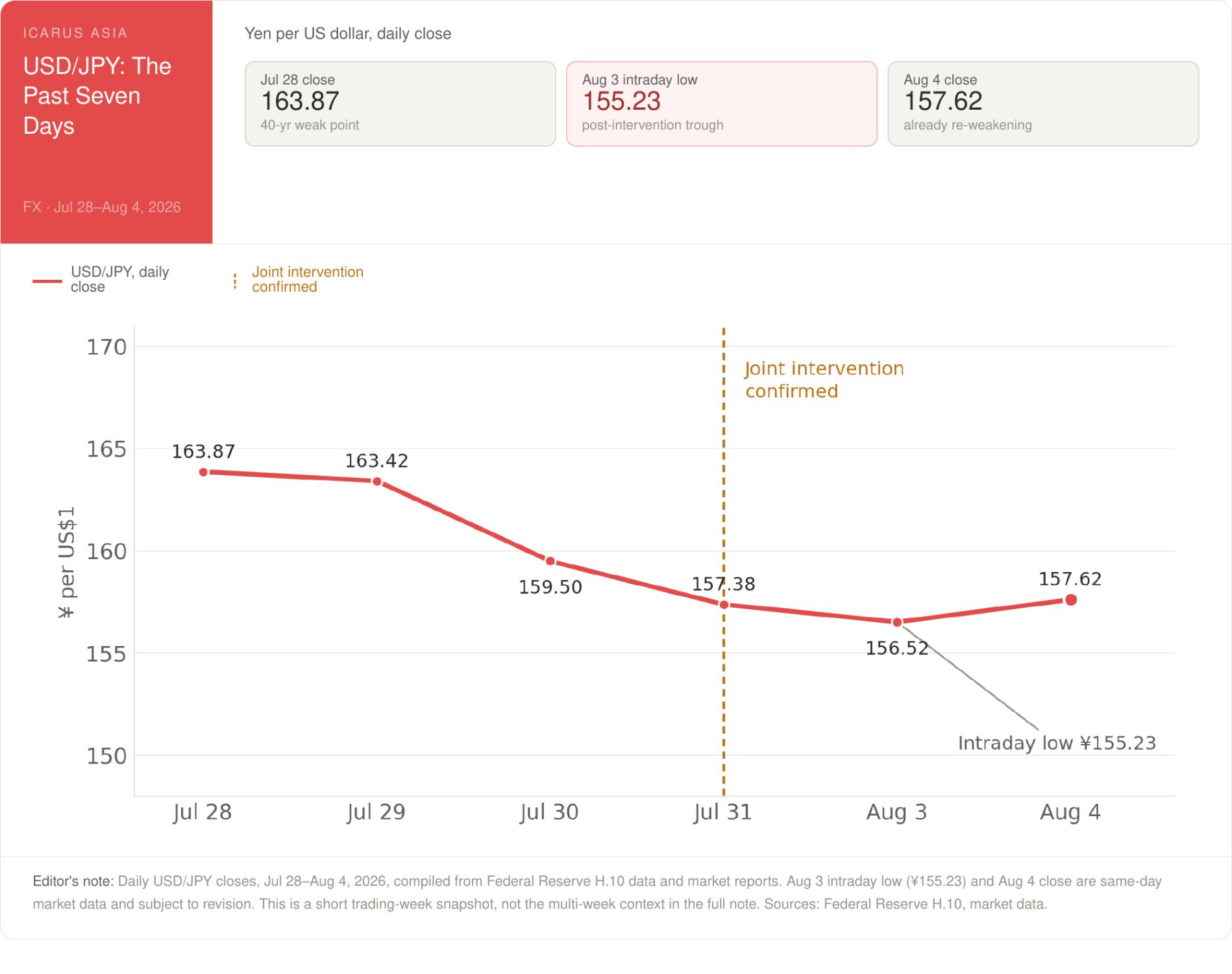
Then the question became what four days of currency support was actually supposed to fix.
A Sisyphus Task
"Economists are of the overwhelming opinion that interventions in currency markets are a fool's game when they are trying to prevent depreciation that is being driven by fundamentals," William Dickens, professor emeritus of economics and public policy at Northeastern University, told Northeastern Global News.
Three fundamentals are doing the driving here, and none of them moved over the last week of July.
The first is debt.
Japan's gross public debt stood at 227.8% of GDP in 2026, according to the International Monetary Fund, easily the highest ratio among advanced economies, Northeastern Global News reported. (The IMF's separate World Economic Outlook database puts the figure closer to 204%, a gap that reflects differing debt measures rather than a factual dispute. Either number tells the same story.)
Fabricius Somogyi, who studies international finance at Northeastern, told the outlet that the Bank of Japan has spent years buying government bonds specifically to hold yields down, because a faster rise in rates would make refinancing that debt far more expensive. That is the real constraint behind the BOJ's quarter-point pace, not caution for its own sake.
The second is energy.
Japan imports nearly all its crude oil and refines almost none of it at home. Higher global prices, driven in part by the war in Iran and by tariffs out of Washington, mean the country has no choice but to keep paying the bill in dollars, Northeastern Global News reported. "In these situations, the speculators almost always win," Dickens said, describing what happens to a currency backing a persistent trade deficit.
In these situations, the speculators almost always win - William Dickens, Professor Emeritus of Economics and Public Policy, Northeastern University
The third is the rate gap between Washington and Tokyo, and here the textbook explanation is starting to fail.
Katz, writing on Japan Economy Watch the same day he discussed the intervention with CNN, points out that the 10-year yield gap between the two countries actually narrowed by half between October 2024 and this summer, from about 4 percentage points to less than 2.
Under the standard model, that narrowing should have made the yen stronger. Instead it kept falling, from around 150 to 164.
"Many of the experts cited in the press focused on only one fundamental, the gap between American and Japanese rates," Katz wrote. "They argue that if the Bank of Japan hikes rates, that will do a lot to boost the yen." Contrary to that view, he argued, "the data says that higher rates in Japan will not be enough to reverse the yen's fall very much."
The data says that higher rates in Japan will not be enough to reverse the yen's fall very much. - Richard Katz, Japan Economy Watch
The math behind the intervention raises questions of its own.
Robbing Peter to pay Paul
Toby Nangle, writing for FT Alphaville, calculates that total U.S. foreign-exchange reserves, split between the Treasury's Exchange Stabilization Fund and the Federal Reserve's own account, come to around $38 billion, of which roughly 69% sits in euros rather than yen or dollars.
If the New York Fed liquidated every euro asset in both accounts, Nangle figures, it could raise about $26.3 billion in spot capacity. That's less than half the size of Japan's Thursday trade by itself. Rather than sell dollars outright, the Fed reportedly funded its share by selling euros from reserves on the Treasury's behalf, FT Alphaville and Fortune both reported.
If the New York Fed liquidated every euro asset in both accounts, Nangle figures, it could raise about $26.3 billion in spot capacity. - Toby Nangle, FT Alphaville
Fortune canvassed several former officials who called that an odd way to run the play.
"Weird," is the word Edwin Truman, a former Treasury assistant secretary for international affairs, used, telling Fortune that selling a third currency would not be as effective as selling dollars directly.
Robin Brooks, a senior fellow at the Peterson Institute for International Economics, put it more bluntly in a Substack post that Fortune quoted.
"This kind of twist in my opinion undercuts the efficacy of U.S. participation. FX intervention is a confidence game. The last thing you want is to give markets any kind of reason to ask questions." Mark Sobel, who spent four decades at Treasury and now chairs the U.S. arm of the Official Monetary and Financial Institutions Forum, framed it as a mandate problem rather than a mechanical one in an emailed comment to Fortune: "The Treasury's Exchange Stabilization Fund isn't a hedge fund."
The reserve math points toward the Fed's FIMA repo facility, which lets foreign central banks borrow dollars against Treasury collateral for up to seven days without an outright bond sale, currently capped at $60 billion per counterparty, per ING.
Bessent has pushed publicly for that cap to be raised, a sign of how quickly the ceiling could bind if Tokyo needs to act at Thursday's scale again. Selling Treasuries outright is the obvious alternative.

A Game of Whack-a-Mole
Japan holds more than $1.14 trillion of them, the largest foreign stake of any country, according to U.S. government data cited by Northeastern Global News. But doing so would push U.S. yields higher at a moment when Washington, running record deficits, badly needs foreign buyers to keep showing up.
Those yields have their own story running in parallel.
The Senate confirmed Kevin Warsh as Federal Reserve chair on May 13 by a 54-45 vote, the closest confirmation margin for a Fed chair in the modern era, according to CNBC. Long-end Treasury yields have climbed through his early tenure even as he has held the policy rate steady. The 30-year closed at 5.21% on July 30, its highest level since 2007, according to bond-market data compiled by Takuji Okubo of Japan Macro Advisors.
Okubo has built what he calls a "Warsh factor" into his JGB forecasting model: a risk-premium shock he estimates has been building since May and will keep building until November, adding an estimated 10 to 15 basis points to Japanese 10- and 30-year yields by year-end. Okubo describes that as his own model, not a consensus view. But the direction fits what's already showing up in Japan's own bond market, where the 30-year yield has set repeated records this year.
There's a recent precedent for what happens once the current squeeze wears off, and it isn't encouraging.
Japan already spent an estimated $70 billion on unilateral yen intervention in April and May, ING noted. USD/JPY hit a new high of 164 anyway, a few months later. Chris Turner and Michiel Tukker, who cover foreign exchange for ING, argue that Japan's one real success with this playbook, in 2024, worked mainly because it lined up with an actual turn in the U.S. rate cycle, not because intervention itself changed anything.
Absent a similar turn now, they wrote in their ING Think note, "even coordinated intervention risks being remembered as another attempt to slow the dollar's rise rather than reverse it."
The clearest evidence of what the two governments actually bought will surface on its own schedule, regardless of what markets do between now and then.
Under the Gold Reserve Act, the Treasury secretary must disclose the Exchange Stabilization Fund's monthly financial statement to Congress within 30 days of month's end, a requirement Nangle flagged at FT Alphaville.
The report covering July, expected around August 30, will be the first real look at what Washington bought, and how.
The author is the Head of Research and Analysis at Icarus Asia, an independent consulting and financial research firm specializing in strategic advisory, geopolitical risk assessment, macroeconomic analysis, and corporate investigations.
To read our full report, click here - https://icarusasia.com/research/us-japan-yen-intervention
Please note -- The research is only available to accredited investors that self-attest to their classification as such. Retail investors are not allowed to access this research.
DISCLAIMER: Strictly not investment advice. Please do your own research and consult with a registered financial advisor.
Sources
C-SPAN. "Senate Confirms Kevin Warsh as Fed Chair, 54-45." Video, May 13, 2026. https://www.c-span.org/clip/us-senate/senate-confirms-kevin-warsh-as-fed-chair-54-45/5200274
CNBC. "Kevin Warsh Wins Senate Confirmation as the Next Federal Reserve Chair." May 13, 2026. https://www.cnbc.com/2026/05/13/kevin-warsh-wins-senate-confirmation-as-the-next-federal-reserve-chair.html
International Monetary Fund. "IMF Executive Board Concludes 2026 Article IV Consultation with Japan." Press Release No. 26/105, April 3, 2026. https://www.imf.org/en/news/articles/2026/04/02/pr-26105-japan-imf-executive-board-concludes-2026-article-iv-consult
International Monetary Fund. World Economic Outlook Database, April 2026. https://www.imf.org/en/publications/weo
Katz, Richard. "CNN Interviews Me On Joint US-Japan Intervention To Strengthen the Yen." Japan Economy Watch(Substack), Aug. 4, 2026.
Nangle, Toby. "How Big Was the American JPY Intervention?" FT Alphaville, Financial Times, Aug. 2026. https://www.ft.com/content/e279135e-cd6e-46d4-b80b-2e6b0c0901a9
Okubo, Takuji. "The Warsh Factor in the JGB Curve." Japan Macro Advisors (Substack), Aug. 3, 2026, with accompanying chart-data pack.
Osmonbekov, Mia. "The U.S. Is Using Euros, Not Dollars, to Prop Up the Yen, and It May Backfire." Fortune, Aug. 3, 2026. https://fortune.com/2026/08/03/yen-dollar-intervention-euros-bessent-japan-debt-yields/
Stening, Tanner. "US-Japan Joint Intervention in the Yen May Have Worked — for Now, Experts Say." Northeastern Global News, Aug. 3, 2026.
Turner, Chris, and Michiel Tukker. "Washington Joins the Fight for the Yen." ING Think, Aug. 3, 2026.