
News · Policy · US
Trump Rules Out Military Force on Greenland, but Tariff Threat Stands
The U.S. President's remarks at the World Economic Forum in Davos, Switzerland offer limited reassurance to markets after steep selloff; European allies face escalating trade tensions
The U.S. President's remarks at the World Economic Forum in Davos, Switzerland offer limited reassurance to markets after steep selloff; European allies face escalating trade tensions
U.S. President Donald Trump said Wednesday he won't use military force to acquire Greenland, a statement that provided modest relief to financial markets but did little to resolve the broader dispute threatening U.S. relations with key European allies.
In remarks to the World Economic Forum, Mr. Trump said the U.S. needs control of the Danish territory for national security and called for immediate negotiations on its acquisition. He paired his no-force pledge with a warning: countries that refuse to cooperate on Greenland would face consequences.
"We probably won't get anything unless I decide to use excessive strength and force where we would be, frankly, unstoppable," Mr. Trump said. "But I won't do that," he told an audience of chief executives, finance ministers and world leaders. "I don't have to use force. I don't want to use force. I won't use force."
"I don't have to use force. I don't want to use force. I won't use force."
U.S. stocks rose modestly in Wednesday trading after tumbling a day earlier.
The S&P 500 gained 0.7%, recovering a fraction of Tuesday's 2.06% decline--the index's worst daily performance in three months. The Dow Jones Industrial Average added 0.6%, while the Nasdaq Composite rose by a similar margin.
The president's remarks came after he threatened Monday to impose tariffs of 10% on eight of the North Atlantic Treaty Organization (NATO) members, including France, Germany and the U.K., starting Feb. 1 unless Greenland negotiations advanced. Those tariffs would rise to 25% by June. He also threatened a 200% tariff on French wine in a separate dispute with President Emmanuel Macron, who earlier spoke at the annual jamboree wearing shades, ostensibly due to an issue with his "eyes."
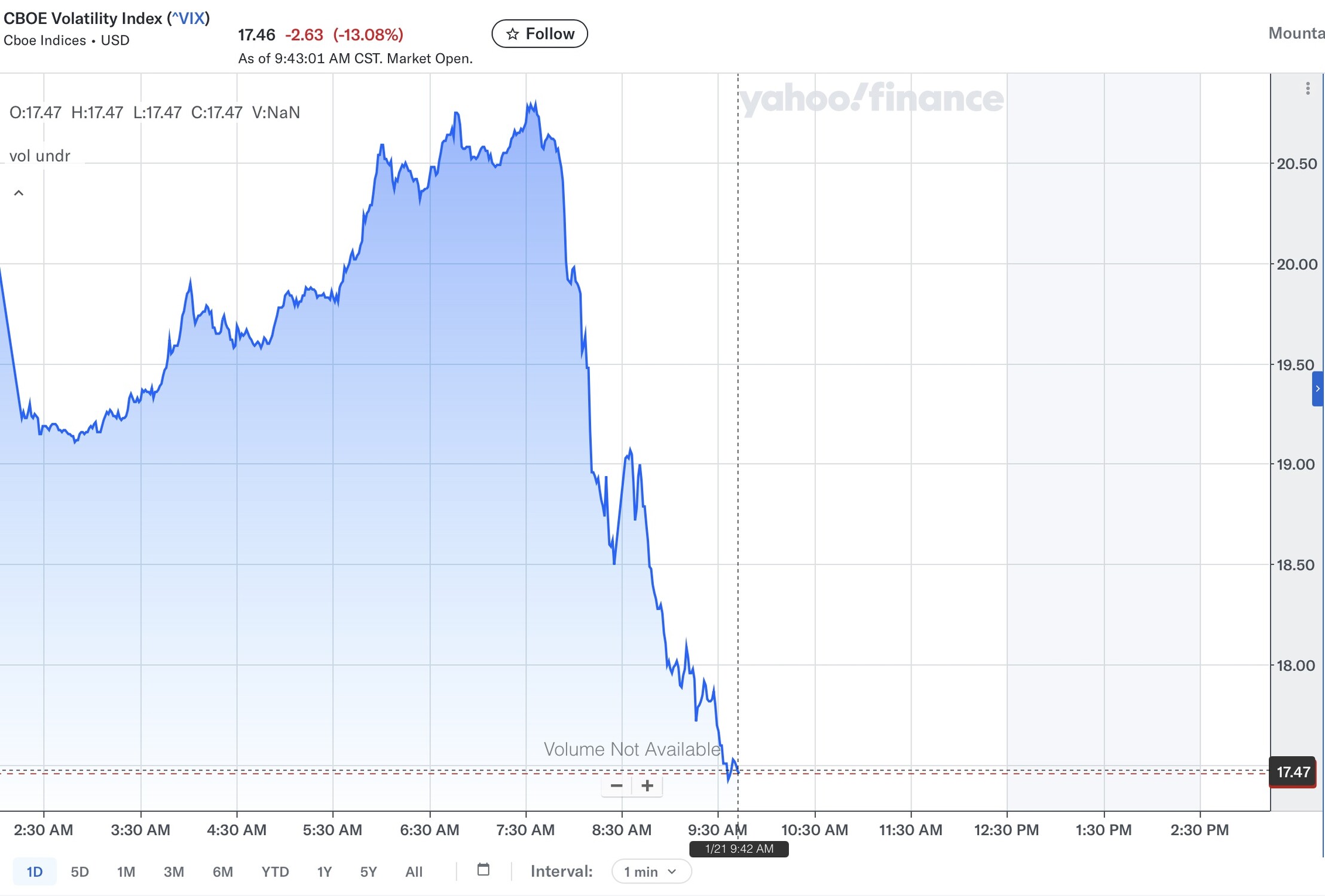
The tariff threats triggered Tuesday's market selloff and sent the CBOE Volatility Index, a measure of expected stock-market turbulence, to 20.69—its highest level since late November. The index, which tends to rise when stocks fall, settled at 18.87 after Mr. Trump's speech but remained elevated by historical standards.
Gold prices climbed above US$4,800 a troy ounce for the first time as investors sought safer assets. The dollar weakened against major currencies despite trade tensions, a sign that foreign investors were reducing exposure to U.S. assets. Treasury yields were little changed.
European stocks declined. The Stoxx Europe 600 fell 0.2% despite Mr. Trump's no-force statement. London's FTSE 100, Frankfurt's DAX and Paris's CAC 40 all closed lower, suggesting investors in the region viewed the speech as providing little clarity on the trade dispute.
Mr. Trump devoted much of his some 70-minute speech and later interaction with WEF President Børge Brende to defend his policy on Greenland, which has drawn sharp criticism from European governments. He described Greenland as "a piece of ice" but said its strategic location makes U.S. control essential.
The president framed the issue in terms of burden-sharing within NATO. "What I'm asking for is a piece of ice," he said. "It's a very small ask compared to what we have given them for many, many decades."
"What I'm asking for is a piece of ice," he said. "It's a very small ask compared to what we have given them for many, many decades."
The dispute represents an unusual test for NATO. Mr. Trump is seeking to acquire territory from Denmark, a NATO ally, and has threatened trade retaliation against multiple alliance members if they don't support the initiative. European officials say they have never encountered similar pressure from a U.S. administration.
Canadian Prime Minister Mark Carney, speaking at the forum on Tuesday, said the global order faces "a rupture, not a transition." Without naming Mr. Trump, Mr. Carney said major powers were using trade relationships as weapons and treating supply chains as vulnerabilities to exploit.
Mr. Trump addressed Mr. Carney's speech directly. "Canada lives because of the United States--remember that, Mark, the next time you make your statements," he said. "I watched your prime minister yesterday. He wasn't grateful."
The Trump administration has cited Russian and Chinese activities in the Arctic as justification for acquiring Greenland. Treasury Secretary Scott Bessent told Fox Business on Tuesday that Greenland is "becoming more and more attractive for foreign conquest" and U.S. control would prevent conflict.
European officials have largely rejected that reasoning.
They note the U.S. already maintains military installations in Greenland under agreements with Denmark and has access to the island's resources through commercial channels. Several NATO members have increased their military presence in Greenland in recent days.
Denmark and Greenland have said the territory isn't for sale. A delegation from both governments met with Vice President JD Vance and Secretary of State Marco Rubio and afterward said they had reached a "fundamental disagreement" with the administration.
Greenland's minister for business and mineral resources, Naaja Nathanielsen, told CNBC that residents are worried by Mr. Trump's statements. Opinion polls show strong opposition among Greenlanders to joining the U.S. Protests have taken place in Greenland's capital, Nuuk, and in Danish cities.
NATO Secretary General Mark Rutte said he was working on the issue but declined to comment publicly on the tensions.
The dispute comes as companies are reporting fourth-quarter earnings.
About 81% of S&P 500 companies have beaten profit estimates, according to Bloomberg Intelligence. But their stocks have underperformed the index by an average of 1.1 percentage points--the worst reaction to positive earnings surprises since Bloomberg began tracking the data in 2017.
The disconnect indicates investors are more focused on trade policy than corporate results. Companies with significant European operations have been particularly affected.
3M Co. fell 7% Tuesday despite beating earnings estimates after Chief Executive William Brown said proposed tariffs could reduce 2026 earnings by US$60 million to US$70 million. State Street Corp. dropped 6.1% after executives said trade uncertainty was affecting their outlook.
Analysts said the market reaction reflects concern that trade tensions could offset benefits from the administration's tax and regulatory policies. Companies face the choice of absorbing tariff costs or passing them to consumers already concerned about inflation.
"Geopolitics matters for markets," said Jamie Dimon, chief executive of JPMorgan Chase & Co., when asked about the Greenland dispute. He declined to elaborate.
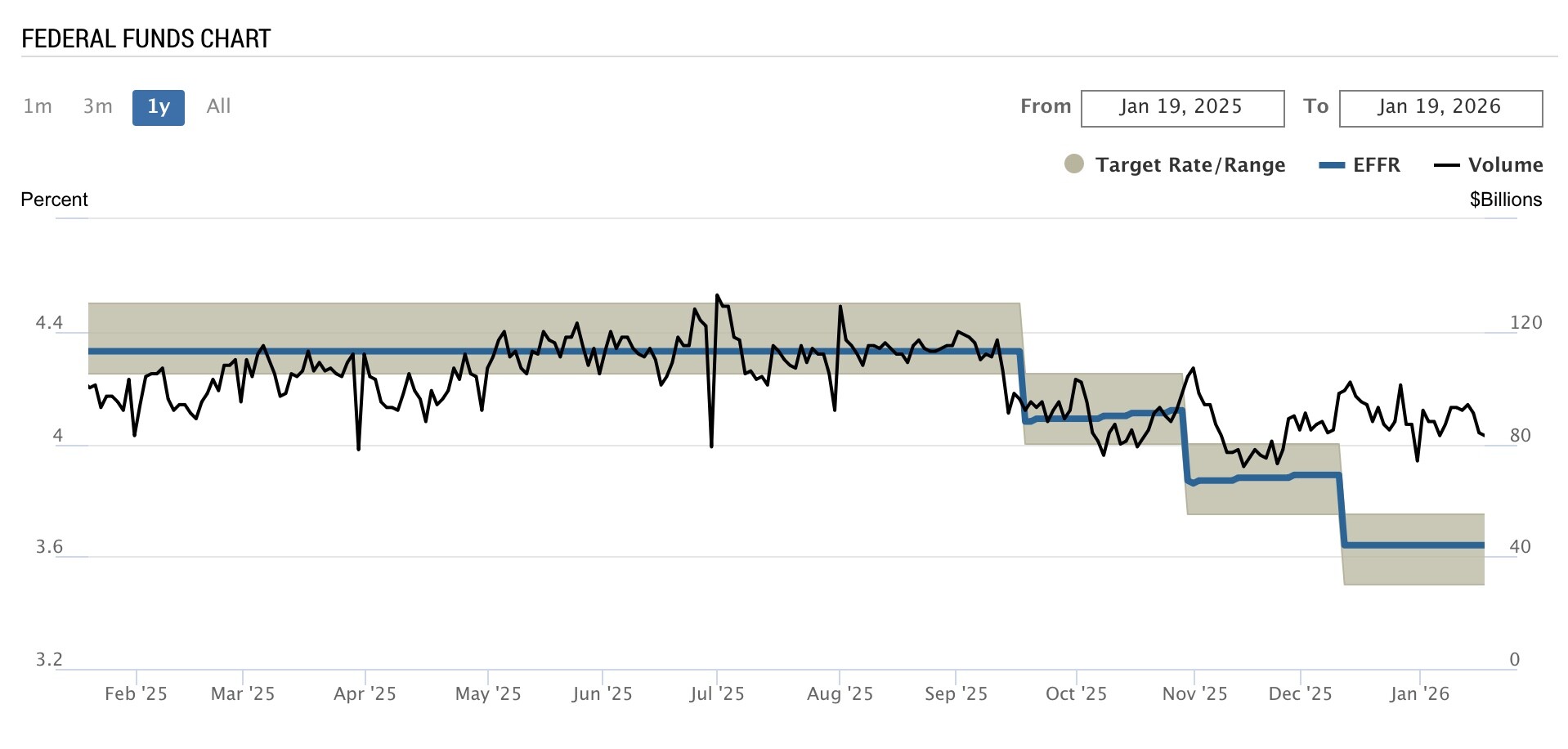
The Federal Reserve is scheduled to meet next week. Economists expect the central bank to leave interest rates unchanged but say officials will likely face questions about how they are assessing the economic impact of trade tensions. The Fed paused rate increases last year after Mr. Trump's April 2025 tariff announcements triggered a sharp market selloff.
Some investors said Mr. Trump's Greenland push would likely follow the pattern of his previous trade disputes: threats followed by negotiations that produce limited changes. That approach characterized the U.S.-Mexico-Canada trade agreement in his first term and the resolution of last year's tariff crisis.
But others said the Greenland dispute appears different. Mr. Trump's statements have been more categorical, and he is targeting treaty allies rather than primarily trade competitors. European leaders face domestic pressure to respond firmly rather than accommodate U.S. demands.
"Until now we tried to appease the new president," Belgian Prime Minister Bart De Wever said during a panel discussion at the forum.
France has indicated it would propose coordinated European Union tariffs on U.S. goods if Mr. Trump proceeds with his threatened levies. German and U.K. officials have made similar statements, though the EU hasn't formally announced retaliatory measures.
The outcome will help determine whether the current tensions represent a temporary dispute or a more fundamental shift in transatlantic relations. U.S.-European trade totaled more than US$1.5 trillion in 2024, and many American companies have extensive operations in Europe.
Mr. Trump also criticized European energy policies in his remarks, saying renewable-energy investments had weakened the continent economically. "There are windmills all over Europe," he said. "They are losers." He said Britain should increase North Sea oil drilling and suggested European electricity prices were unnecessarily high.
"There are windmills all over Europe," he said. "They are losers."
Energy executives said Mr. Trump's comments could affect U.S. companies' European investments, though they noted renewable energy remains a significant part of many firms' long-term strategies.
Commerce Secretary Howard Lutnick, speaking at a separate Davos panel Tuesday, said "globalization has failed" and suggested trade relationships needed restructuring. His comments reflected the administration's view that existing trade arrangements have disadvantaged the U.S.
European officials disputed that characterization. They said the current system has benefited all participants and that unilateral changes would reduce economic efficiency and potentially trigger a broader trade war.
The administration had said Mr. Trump would use his Davos speech to announce housing-affordability proposals, an issue of concern to voters ahead of this year's midterm elections. But he devoted only brief remarks to domestic policy, focusing instead on the Greenland dispute and criticism of European policies.
Market participants said the coming weeks would be crucial in determining whether the situation stabilizes or escalates. If European governments impose counter-tariffs, the resulting trade conflict could affect economic growth on both sides of the Atlantic.
The dollar's weakness despite trade tensions was notable. Typically, trade disputes strengthen the dollar as investors seek safety in U.S. assets. The recent pattern suggests some foreign investors are reducing their U.S. holdings--a development market participants are monitoring closely.
Currency traders said sustained dollar weakness could complicate the Fed's policy decisions by potentially adding to inflation pressures through higher import costs.
For now, financial markets are operating on the assumption that Mr. Trump's threats are primarily negotiating tactics. But the administration's willingness to target NATO allies has created uncertainty about how far the president might go to achieve his objectives.
The World Economic Forum traditionally emphasizes international cooperation and open trade. Mr. Trump's appearance represented a sharp departure from those themes, creating an uncomfortable atmosphere among attendees who have built careers on cross-border business relationships.
Some executives privately asked if Mr. Trump's tactics are "negotiating theater" or a genuine shift in American policy. The answer to that question will likely determine both market direction and the future of the Atlantic alliance in the months ahead.