
News · Policy · Japan, US
The U.S. has a blunt message for its biggest ally: you're on your own
Treasury Secretary's Tokyo visit puts him at odds with Prime Minister Takaichi's economic program — and exposes how Japan's bond market instability lands directly on American borrowing costs.
Treasury Secretary's Tokyo visit puts him at odds with Prime Minister Takaichi's economic program — and exposes how Japan's bond market instability lands directly on American borrowing costs.
When U.S. Treasury Secretary Scott Bessent landed in Tokyo on Sunday, he carried a blunt message for Japan's new government in a private conversation. Stop depleting foreign reserves to defend the yen. Raise interest rates instead.
Over three days of meetings with Prime Minister Sanae Takaichi, Finance Minister Satsuki Katayama and Bank of Japan Governor Kazuo Ueda, Bessent was pressing for faster monetary tightening. His stance collided head-on with the agenda that carried Takaichi to power as Japan's first female prime minister earlier this year.
Takaichi secured a two-thirds supermajority in the lower-house elections on promises of fresh fiscal stimulus, consumer subsidies and only gradual interest-rate increases. That mix has helped drive the yen to 160 per dollar and unnerved bond markets already wary of bigger government borrowing.
Bessent has said publicly that currency intervention offers only temporary relief. People familiar with his thinking say he expresses that view more forcefully in private. He believes the yen's weakness is best fixed by narrowing the interest-rate gap with the United States through policy, not by spending down Tokyo's $1.37 trillion in foreign reserves.
That argument has a significant caveat.
The US-Japan 10-year government bond differential — now roughly 2 percentage points — has narrowed considerably since its peak, yet the yen has continued to weaken. Since early 2025, the once-tight correlation between the rate gap and the yen has frayed. Structural factors have stepped in: Japan's widening energy import bill, persistent capital outflows into foreign equities, and the after-effects of the August 2024 carry-trade unwind have driven the currency lower independent of rate spreads.
Bessent's prescription is conventional. Whether it still fits the mechanism is genuinely contested.
The visit doubles as groundwork for President Trump's meetings with Chinese President Xi Jinping in Beijing on Wednesday. Currency imbalances and trade issues top that agenda. Japan's bilateral trade surplus with the U.S. was large enough to earn it a spot on the Treasury's monitoring list in January.
Since late April, Japan has spent an estimated ¥10 trillion ($64 billion) intervening in currency markets, according to Bloomberg estimates based on Bank of Japan data — with Bloomberg citing roughly $34.5 billion deployed on April 30 alone, and a further $30 billion around May 7. Bank of America puts the total across all intervention occasions at closer to $72 billion. Much of that firepower came during the Golden Week holiday, when thin trading volumes let even modest dollar sales move the exchange rate. Finance Minister Katayama and currency diplomat Atsushi Mimura signaled the operations in advance — a deliberate tactic to maximize impact.
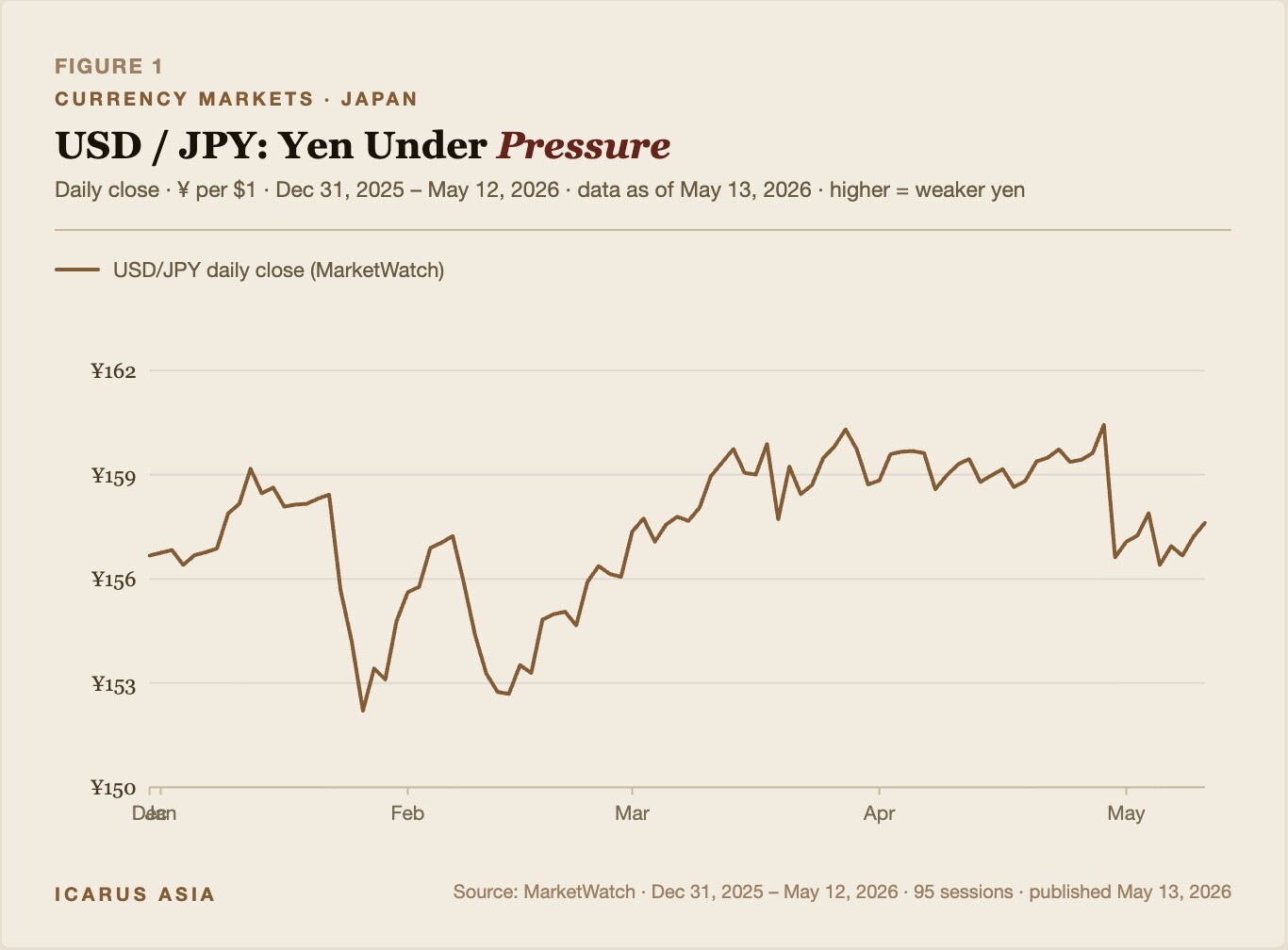
Editor's Note: USD/JPY daily close prices sourced from MarketWatch (Dec 31, 2025 – May 12, 2026; 95 sessions). Apr 30 intervention: open ¥160.44, intraday low ¥155.56, close ¥156.62.
The 10-year Japanese government bond yield climbed to within touching distance of 2.5% — its highest level since 1997 — as investors priced in the risks of Takaichi's spending plans. Her proposal to suspend the food sales tax for two years helped steepen the yield curve. That move rippled into U.S. Treasuries in January, when 30-year JGB yields jumped nearly 30 basis points in one session. The New York Fed responded with what markets read as a pointed rate check.
America's Last Friend?
The reason Bessent tracks Japan's bond market with such attention goes beyond currency policy. Japan holds roughly $1.24 trillion in U.S. government bonds — more than any other foreign government. When Tokyo intervenes to support the yen, it does so by selling dollars drawn from reserves held overwhelmingly as U.S. Treasury securities. Those sales impose direct upward pressure on yields. When Treasury yields rise, borrowing costs rise across the entire U.S. economy: for the federal government financing its deficit, for homeowners with adjustable mortgages, for corporations rolling over debt.
While those sales exert upward pressure on yields, the magnitude of that impact has been debated. Japan's holdings represent roughly 3% to 4% of total U.S. debt outstanding, and the Federal Reserve has instruments to absorb the selling pressure in isolation. The more acute risk is not mechanics but rather the sentiment — the signal that the world's largest foreign creditor is a forced seller.
The January episode made the transmission mechanism, albeit debatable, visible in real time.
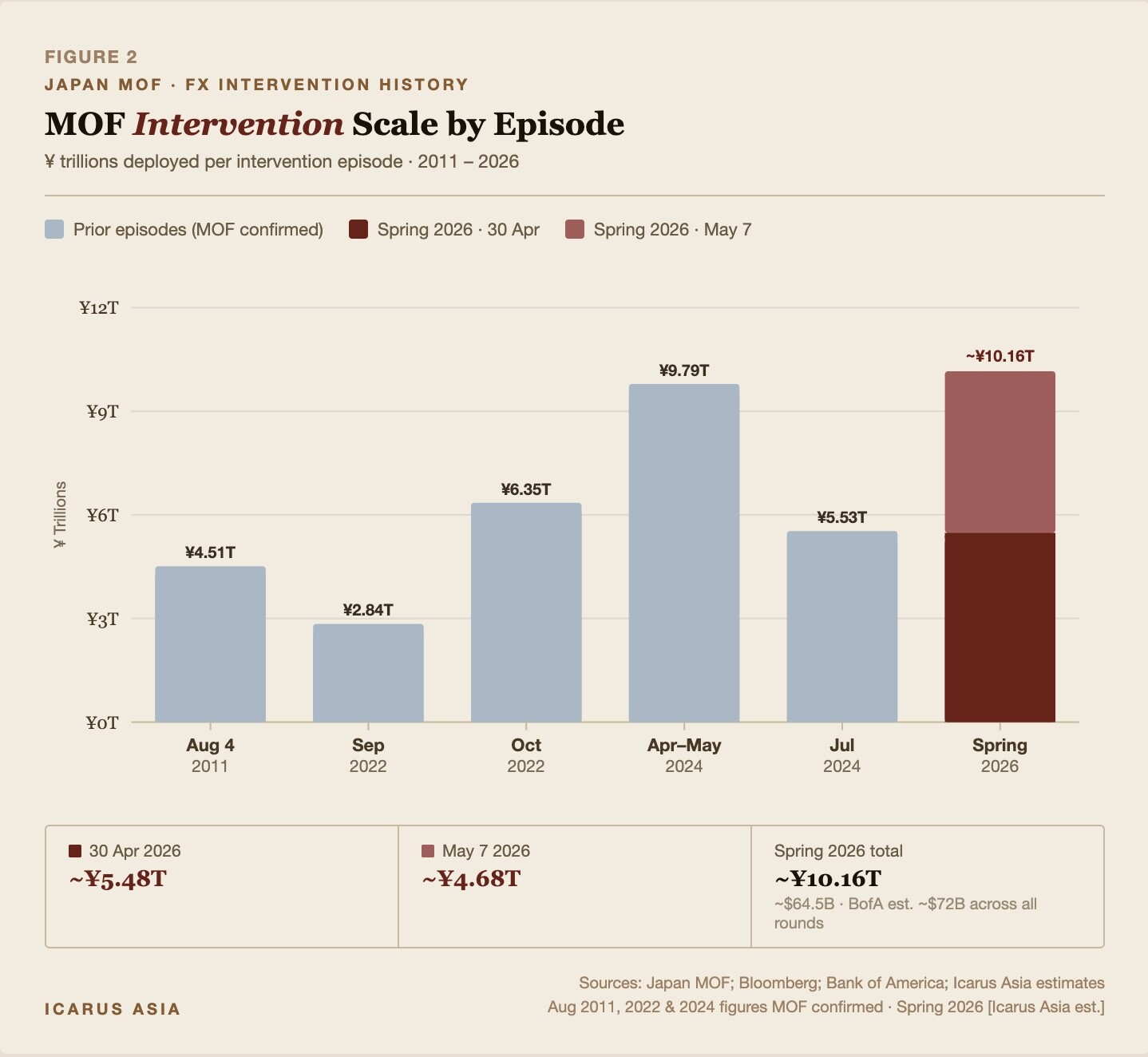
Editor's note: Spring 2026 intervention totals are estimates; the MOF will publish confirmed figures on a quarterly basis. Bar chart: Sep 2022 (¥2.84T) and Oct 2022 (¥6.35T) are confirmed MOF figures; Apr–May 2024 (¥9.79T) and Jul 2024 (¥5.53T) are confirmed MOF quarterly disclosures. USD conversion uses ~¥158/USD (late April 2026 rate); Bank of America's $72B all-in estimate uses a slightly different rate and episodic count.
When Japanese bond markets seized and 30-year JGB yields surged in a single session, U.S. Treasury yields moved within hours. It showed that Japan's currency problem isn't just its own. If bond markets destabilize in Tokyo, Washington's funding costs go up. That is why a Treasury secretary — rather than a diplomat or trade negotiator — sat across the table from Japan's prime minister this week.
"Tokyo holds more U.S. government debt than any country on earth. When it sells, Wall Street feels it."
Bessent confronted Katayama about Japan's messaging on rates during a tense sidebar at the World Economic Forum in Davos in January, shortly after the bond market disruption. According to people familiar with the recent exchange, the Treasury secretary's critique was so detailed that one of Katayama's aides struggled to keep up with the note-taking.
Few Treasury secretaries arrive with Bessent's technical edge.
After leaving George Soros's firm, he founded the macro hedge fund Key Square Capital. He built a name as an investor who watches the Bank of Japan and the yen carry trade closely — the strategy of borrowing cheaply in yen to buy higher-yielding assets elsewhere. He once held short positions in the yen himself. That background makes him a harder counterpart for Japanese officials to manage. One Tokyo-based diplomat called Bessent's latest Foreign Exchange Report "unusually direct."
Now or never
Bessent wants the BOJ to lift its policy rate to 1% at its June 15–16 meeting. Some dissenting board members have signaled support for that pace. Governor Ueda has preferred smaller steps, citing economic uncertainty.
External shocks have compounded the yen's slide.
The effective blockade of the Strait of Hormuz amid the escalated U.S.-Israel-Iran conflict has raised oil import costs for a nation that buys nearly all its crude abroad. Higher energy prices have widened Japan's trade deficit, creating structural pressure on the currency that monetary policy alone cannot quickly reverse. Japanese utilities have raised electricity rates four times in the past year.
Those energy ties broaden Bessent's brief here.
He is also expected to press Japan on its reliance on Chinese-controlled critical minerals and its energy relationships in the Middle East, including links to Iran that have irritated the Trump administration. The conversations push the Treasury secretary into diplomatic territory normally reserved for the State Department and the National Security Council.
Japan's about $1.24 trillion in US Treasuries against an about $36 trillion US debt load is roughly 3–4%, a small share. While the argument that sales by Tokyo do impose a "direct upward pressure on yields" is technically true, the magnitude is easily absorbable by the Fed through normal open market operations, according to Richard Katz, a veteran journalist who authors a newsletter on the Substack platform called Japan Economy Watch. The framing implies a transmission mechanism more acute than the data supports, the author of "The Contest for Japan's Economic Future: Entrepreneurs vs Corporate Giants," "The System That Soured" and "Japanese Phoenix" said.
That said, the January episode — where JGB yields moved and US yields followed within hours — reflects a real contagion channel, even if the reserves-burning argument is overstated.
A Hobson's choice
Takaichi's political bind is real.
Many voters backed her in part because she pledged to shield households and businesses from higher borrowing costs at a time of elevated living expenses. Even a modest rate hike that might stabilize the yen would lift mortgage and corporate loan rates at a delicate moment for Japanese consumers.
Such tensions are familiar.
American pressure on Japan to strengthen the yen produced years of talks and modest results in the late 1990s and early 2000s. Japanese officials and analysts say Bessent's command of the details leaves less room for them to manage the conversation through technical complexity.
The June BOJ meeting will test how far Governor Ueda is willing to go. A decisive rate increase would undermine the case for further large-scale intervention and give the yen durable support without burning more reserves. Standing pat would force Japan back into the market — drawing fresh scrutiny from both the U.S. Treasury and the International Monetary Fund. Analysts say Tokyo has room for only about two more major intervention episodes before November under current IMF guidelines.
A Japan that keeps spending reserves rather than raising rates stays on the Treasury's monitoring list, keeps the yen vulnerable, and keeps U.S. Treasury yields under upward pressure from Tokyo's own balance sheet.
That's the message that the key member of the group that broke the Bank of England's back came to deliver. He now finds himself on the other side of the table.
The author is the Head of Research and Analysis at Icarus Asia, a Hong Kong-based risk and advisory firm. He covered Asia's foreign exchange markets as a journalist.
Correction — May 14, 2026 : A LinkedIn post summarizing this article originally stated a "5-percentage-point interest rate gap" between the U.S. and Japan.
That figure was incorrect.
The US-Japan 10-year government bond differential is approximately 2 percentage points; the policy rate gap (Fed funds vs. BOJ overnight rate) is approximately 3.5-4 percentage points. Neither reaches 5 points. The post has been corrected and this article has been updated to reflect the qualified nature of the rate-gap/yen relationship and the bounded scale of Japan's reserve-selling pressure on U.S. yields.
Update - This article was updated on May 14, 2026 at 8 p.m. Hong Kong time to reflect that Bessent's views were expressed in a private conversation. There has been no clarification from the Treasury Department or the BOJ and the Ministry of Finance, Japan is he specifically asked for a rate increase.
References & Further Reading
Sources cited in this article and selected works for readers who wish to go deeper on currency intervention mechanics, Japan's monetary framework, and US-Japan financial diplomacy.
Of particular note, and a personal favorite has been An Exchange Rate History of the United Kingdom: 1945–1992 published by the Cambridge University Press, 2022. It is easily available through any public or university library.
OFFICIAL SOURCES & DATA
Japan Ministry of Finance. Foreign Exchange Intervention Data (quarterly disclosures). Tokyo: MOF, 2022–2026.
U.S. Department of the Treasury. Report to Congress on Macroeconomic and Foreign Exchange Policies of Major Trading Partners of the United States (Semi-Annual). Washington D.C.: Treasury, 2024–2026.
U.S. Department of the Treasury. Treasury International Capital (TIC) System — Major Foreign Holders of U.S. Treasury Securities. Washington D.C.: Treasury, 2026.
Bank of Japan. Monetary Policy Decisions and Outlook for Economic Activity and Prices. Tokyo: BOJ, 2025–2026.
International Monetary Fund. Japan: Article IV Consultation Staff Report. Washington D.C.: IMF, 2024–2025.
International Monetary Fund. Integrated Policy Framework — Intervention Guidelines. Washington D.C.: IMF, 2022.
FX INTERVENTION: HISTORY & MECHANICS
Naef, Alain. An Exchange Rate History of the United Kingdom: 1945–1992. Cambridge: Cambridge University Press, 2022. DOI: 10.1017/9781108878333. — A rigorous archival study of sterling crises and managed exchange-rate regimes from Bretton Woods through Black Wednesday; the intervention mechanics and political constraints Naef documents map closely onto Japan's contemporary dilemma between rate defense and reserve depletion.
Dominguez, Kathryn M. and Jeffrey A. Frankel. Does Foreign Exchange Intervention Work? Washington D.C.: Peterson Institute for International Economics, 1993. — The foundational empirical study on whether central bank intervention moves rates and how signalling amplifies impact; essential background for reading the MOF's Golden Week operations.
Bordo, Michael D., Owen F. Humpage, and Anna J. Schwartz. Strained Relations: U.S. Foreign-Exchange Operations and IMF Surveillance, 1962–1985. Chicago: University of Chicago Press / NBER, 2015. — Traces how the U.S. Treasury and Federal Reserve coordinated (and clashed) on intervention; directly relevant to Bessent's use of the FX Report as diplomatic leverage.
Sarno, Lucio and Mark P. Taylor. The Economics of Exchange Rates. Cambridge: Cambridge University Press, 2002. — Standard graduate-level text covering intervention theory, purchasing-power parity, and carry-trade dynamics; chapters 5–6 are directly applicable to the yen case.
Ito, Takatoshi. "Is Foreign Exchange Intervention Effective? The Japanese Experience in the 1990s." NBER Working Paper No. 8914. Cambridge, MA: NBER, 2002. — Japan-specific empirical study by one of the architects of the MOF's intervention strategy; the playbook described here remains the template for 2024–2026 operations.
Fatum, Rasmus and Michael Hutchison. "Is Sterilised Foreign Exchange Intervention Effective After All? An Event Study Approach." Economic Journal 113, no. 487 (April 2003): 390–411. — Evaluates effectiveness using event-study methodology; findings inform how markets interpret Japan's current "jawboning" alongside actual operations.
JAPAN MACRO, BOJ POLICY & JGB MARKETS
Koo, Richard C. The Holy Grail of Macroeconomics: Lessons from Japan's Great Recession. Singapore: Wiley, 2008. — Introduces the balance-sheet recession framework that shaped BOJ thinking for two decades; explains why rate normalization has been so politically fraught in Japan.
Shirakawa, Masaaki. Tumultuous Times: Central Banking in an Era of Crisis. New Haven: Yale University Press, 2021. — Memoir and policy analysis by the former BOJ governor (2008–2013); candid on the limits of monetary policy in a low-growth, ageing economy and on managing U.S. pressure.
Takagi, Shinji. "Exchange Rate Policy in Japan: From the Plaza Accord to Abenomics." Asian Economic Policy Review 11, no. 1 (2016): 102–119. — Traces the policy evolution across thirty years of US-Japan currency diplomacy; provides essential historical context for Bessent's visit.
Obstfeld, Maurice, Jay C. Shambaugh, and Alan M. Taylor. "The Trilemma in History: Tradeoffs among Exchange Rates, Monetary Policies, and Capital Mobility." Review of Economics and Statistics 87, no. 3 (2005): 423–438. — The canonical trilemma paper; frames why Japan cannot simultaneously keep rates low, defend the yen, and maintain open capital markets.
Ueda, Kazuo. "The BOJ's Yield Curve Control Policy: A Review." Remarks at the Bank for International Settlements Annual Meeting. Basel: BIS, June 2023. — Governor Ueda's own account of the constraints and exit logic of YCC; essential for understanding his cautious pace on rate hikes.
US-JAPAN FINANCIAL DIPLOMACY & THE DOLLAR SYSTEM
Eichengreen, Barry. Exorbitant Privilege: The Rise and Fall of the Dollar and the Future of the International Monetary System. Oxford: Oxford University Press, 2011. — Places the dollar's reserve-currency role at the centre of US financial diplomacy; explains why Treasury secretaries — not diplomats — lead currency negotiations.
Funabashi, Yoichi. Managing the Dollar: From the Plaza to the Louvre. Washington D.C.: Peterson Institute for International Economics, 1988. — The definitive insider account of the Plaza and Louvre Accords; the template for understanding how coordinated G7 currency agreements actually get made — and why Bessent is pressing Japan bilaterally rather than through multilateral channels.
Gagnon, Joseph E. Currency Conflict and Trade Policy: A New Strategy for the United States. Washington D.C.: Peterson Institute for International Economics, 2017. — Lays out the analytical framework the Treasury's Monitoring List is built on; co-authored by a former Fed official whose work directly influenced the criteria Bessent is now applying to Japan.
Tooze, Adam. Crashed: How a Decade of Financial Crises Changed the World. London: Allen Lane, 2018. — Chapter 21 covers the dollar swap lines and carry-trade unwind of 2008; the mechanism by which Japanese balance-sheet decisions transmit to U.S. Treasury markets is shown in sharp relief.
CARRY TRADE & CAPITAL FLOWS
Brunnermeier, Markus K., Stefan Nagel, and Lasse H. Pedersen. "Carry Trades and Currency Crashes." NBER Macroeconomics Annual 23 (2009): 313–347. — Shows how carry trades unwind in sudden crashes rather than gradual reversals; the August 2024 and late-April 2026 yen squeezes fit the pattern precisely.
Galati, Gabriele, Alexandra Heath, and Patrick McGuire. "Evidence of Carry Trade Activity." BIS Quarterly Review (September 2007): 27–41. Basel: Bank for International Settlements. — Documents the scale and leverage of yen carry trades during the pre-GFC period; the structural features that made the trade so popular then persist today.