
News · Markets · US
South Korea's $2 Trillion Wreck Is a Warning for Wall Street
South Korea's stock market lost as much as $2.18 trillion in value over two trading days this week. The cause wasn't a Korean problem. It was a chip company's earnings report that beat every record in its history and still wasn't good enough.
The Kospi sank as much as 12.6 percent Wednesday before paring losses to close down 6 percent, on top of an 11 percent drop Tuesday. Circuit breakers, the exchange-wide halt that stops all trading for a fixed window, fired on both days. That has never happened on consecutive sessions since the Korea Exchange adopted the mechanism.
The guardrails implemented by Seoul pause programmatic trading in a single direction for five minutes rather than freezing the whole market. Korea has triggered sidecars also known as Market Volatility Safeguards (MVS) more than 40 times this year. The prior full-year record, set during the 2008 financial crisis, was 26. Different outlets count the exact tally slightly differently depending on cutoff date, but every count this year clears the old record by a wide margin.
When Walking on Water isn't Enough
SK Hynix lit the fuse Tuesday with what should have been the best earnings call in its history. The chipmaker posted roughly 60.5 trillion won in operating profit, about $41 billion, more than five times what it earned a year earlier. Analysts had modeled in more. The stock fell as much as 13 percent on the shortfall. Samsung Electronics, which together with SK Hynix supplies close to 90 percent of the world's memory chips, dropped by a similar margin the same day.
Both companies had run hard into that earnings report.
Samsung and SK Hynix have pledged a combined figure north of $576 billion toward new memory fabs over the coming decade, most of it aimed at high-bandwidth memory, the chip type that sits inside every AI accelerator built by Nvidia and its rivals. Their share prices reflected that bet: various market trackers put SK Hynix's 2026 gain, before this week, somewhere near 180 percent, and Samsung's somewhere near 110 percent. (These year-to-date figures move by the day and differ across trackers. Readers are advised to use them as a general sense of scale, not a precise number.)
A quarter that grows profit fivefold and still misses the model is the kind of gap that shows up only after a stock has been priced for something close to perfection.
When an Index is Really a Bet on Two Companies
Two stocks moving an entire national index this hard says something about how the rally was built in the first place. Estimates of exactly how much of the Kospi's total value sits in Samsung and SK Hynix vary by source and by date, ranging from just over 40 percent to more than half. Whichever number is right, the Kospi has not traded like a diversified basket of Korean industry this year. It has traded like a leveraged position in two companies' AI chip exposure, with 900-odd other listings riding along for the move.
(Note: Please read my colleague and my story for The Wall Street Journal in December of 2017 on this precise risk. This panned out a couple of months later wiping billions off investor wealth.)
When Mom-and-Pop Investors bet the House
Retail investors made that leverage literal.
Korean regulators approved single-stock leveraged ETFs tracking Samsung and SK Hynix on May 27, products designed to double the daily return, and the losses along with it, of the underlying stock. Individual investors piled in roughly 14 trillion won, about $9.7 billion, far outpacing foreign buying in the same products.
Leveraged ETFs reset their exposure every day, which means the losses compound faster than the simple math of "double the stock's move" would suggest once a stock falls several days running. That mechanical drag is why some of the Samsung- and SK Hynix-linked funds lost more than a quarter of their value within days of the SK Hynix miss. (Loss figures vary by a few percentage points across reporting by financial outlets, but the direction and rough scale are consistent.)
Leveraged ETFs reset their exposure every day, which means the losses compound faster than the simple math of "double the stock's move" would suggest once a stock falls several days running.
More than 120,000 margin accounts received calls. Brokers forcibly liquidated somewhere between 32,000 and 46,000 of them down to zero, wiping out the entire position rather than just the leveraged portion.
Finance Minister Koo Yun-cheol apologized Wednesday, saying regulators hadn't thought through the leveraged-ETF rollout carefully enough, according to CNBC's account of his remarks.
(Note: I have not seen a transcript of what he actually said, only secondhand reporting of it.)
The Contagion that Crossed the Pacific
The Korea story is loud partly for reasons specific to Korea: heavy retail leverage, an index dominated by two stocks, trading curbs built for exactly this kind of day.
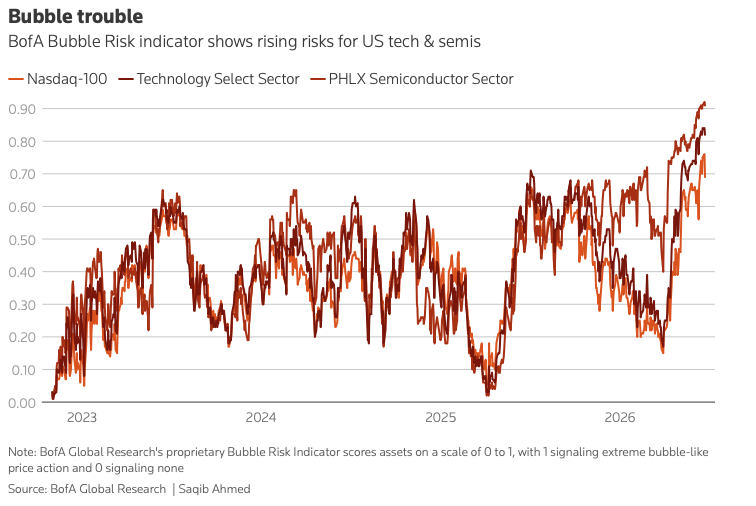
But the same week Seoul was triggering circuit breakers, the Philadelphia semiconductor index fell as much as 6 percent, its fourth straight losing session, and the Nasdaq-100 slid roughly 9.7 percent off its record high, closing in on correction territory.
Micron and SanDisk dropped alongside their Korean counterparts. Nvidia was reportedly in talks to backstop as much as $250 billion of OpenAI's data center buildout, according to CNBC, a detail that matters here mainly because it shows how much of the entire AI trade already runs through a small number of companies financing each other's expansion.
Bank of America's semiconductor "bubble risk" gauge hit 0.91 out of 1 earlier this month. That is one bank's proprietary measure, built on its own methodology, not an industry consensus, and I have not reviewed how the indicator is constructed.
Not Quite the Broken Clock
My employer, Icarus Asia, a Hong Kong-based markets research firm, has published a run of notes since May that read, in hindsight, like a map of exactly where this week's stress showed up.
In May, Icarus Asia's “Chasing IPO Gains in AI is a High-Wire Act” stress-tested Anthropic's roughly $900 billion pending IPO valuation against a $725 billion annual AI infrastructure spending figure and a Chinese open-weight price war, warning that the trade required several assumptions to hold at once.
In early June, “When Both Gauges Red-Line” noted that the Shiller CAPE ratio and the Buffett Indicator, two entirely different ways of asking whether stocks are expensive, sat at or near all-time highs simultaneously, concluding that markets can stay expensive for a while but cannot stay wrong indefinitely. Later that same week, “The Last Bears” argued that a fraud conviction, a decade of one-directional gains and a wave of retail traders have pushed short sellers out of the business, meaning fewer voices are left to bet against a rally before it runs too far.
A few days after that, “AI's Inflationary Footprint Arrives First” argued that the case for near-term rate cuts rests on a productivity story from AI that hasn't shown up yet, while the AI buildout itself is already pushing some prices higher. By late June, “Goldman's AI Loan Short” described Goldman Sachs structuring total return swaps to short investment-grade, AI-related private credit, which Icarus Asia called the first institutional hedge against a $1.5 trillion private-credit AI buildout. And “The Private Credit Wall,” published the same week, found that 11.4 percent of private business development company revolver capacity comes due within 12 months, roughly eight times the exposure at listed peers.
To be sure, none of those five notes mentions Korea by name.
Read together, though, they describe the same structure that broke in Seoul this week at a different scale: a rally concentrated in a handful of names tied to AI infrastructure, financed partly with leverage, priced for a productivity payoff that hasn't arrived, and increasingly short of anyone willing to bet against it.
Read together, though, they describe the same structure that broke in Seoul this week at a different scale: a rally concentrated in a handful of names tied to AI infrastructure, financed partly with leverage, priced for a productivity payoff that hasn't arrived, and increasingly short of anyone willing to bet against it.
Korea just happened to be the market where retail margin debt and a two-stock index made that structure visible first, and fast, and in public.
When Churchgoers Start Praying to the God of Greed
The Kospi is still up roughly 41.5 percent in dollar terms this year even after the crash, by some measures the best return of any major index in 2026. Some analysts cited in this week's coverage argue the U.S. semiconductor selloff reflects a shift in sentiment more than any real change in chip demand. That's one read. It's not the only one.
Korea just showed what happens when a leveraged, concentrated bet on AI infrastructure runs into a record earnings report that the market decides isn't enough.
Wall Street's version of the same bet is spread across more companies and carries less retail margin debt, but it rests on the identical assumption: that chip demand justifies prices already built for years of uninterrupted growth.
Samsung and SK Hynix just found out what happens to that assumption when excellent and enough stop meaning the same thing.
The author is the Head of Research and Analysis at Icarus Asia, an independent strategic advisory and research firm headquartered in Hong Kong. It specializes in in-depth analysis of Asian financial markets, macroeconomics, and high-risk geopolitical dynamics affecting global investments.
CAUTION: This is not investment advice. Readers should do their own research and consult with a registered financial advisor before making any decisions.
DISCLAIMERS: This article relies on a range of figures such as exact won amounts, percentage declines, the share of the Kospi held by Samsung and SK Hynix, and the count of liquidated accounts as reporting differs across outlets. Check exchange and company filings before citing exact numbers elsewhere.
SOURCING
South Korea $2 trillion stock rout breaks records as SK Hynix results disappoint
South Korea's Stock Market KOSPI Just Flashed a Global AI Warning
Record Earnings, Record Low: SK Hynix Stock Falls After Missing Q2 Estimates
Samsung, SK Hynix Single-Stock Leverage ETFs Plunge Below Half of Listing Price
Minister apologizes as Korean leveraged ETF investors nurse heavy losses
A lot of panic around the AI investment: How a chip slump is driving the Nasdaq toward correction
AI Bubble Fears Grow: Is This the End of the Memory Stock Rally?