
News · Macro · US
Kevin Warsh's New Inflation Gauge Faces a Growing Credibility Test
The new Fed Chair's Shift to Trimmed-Mean PCE Could Reshape Monetary Policy, But Markets Are Already Skeptical
Federal Reserve Chair Kevin Warsh has promoted a lesser-known inflation measure to center stage, a bet that could either clarify monetary policy or unravel it.
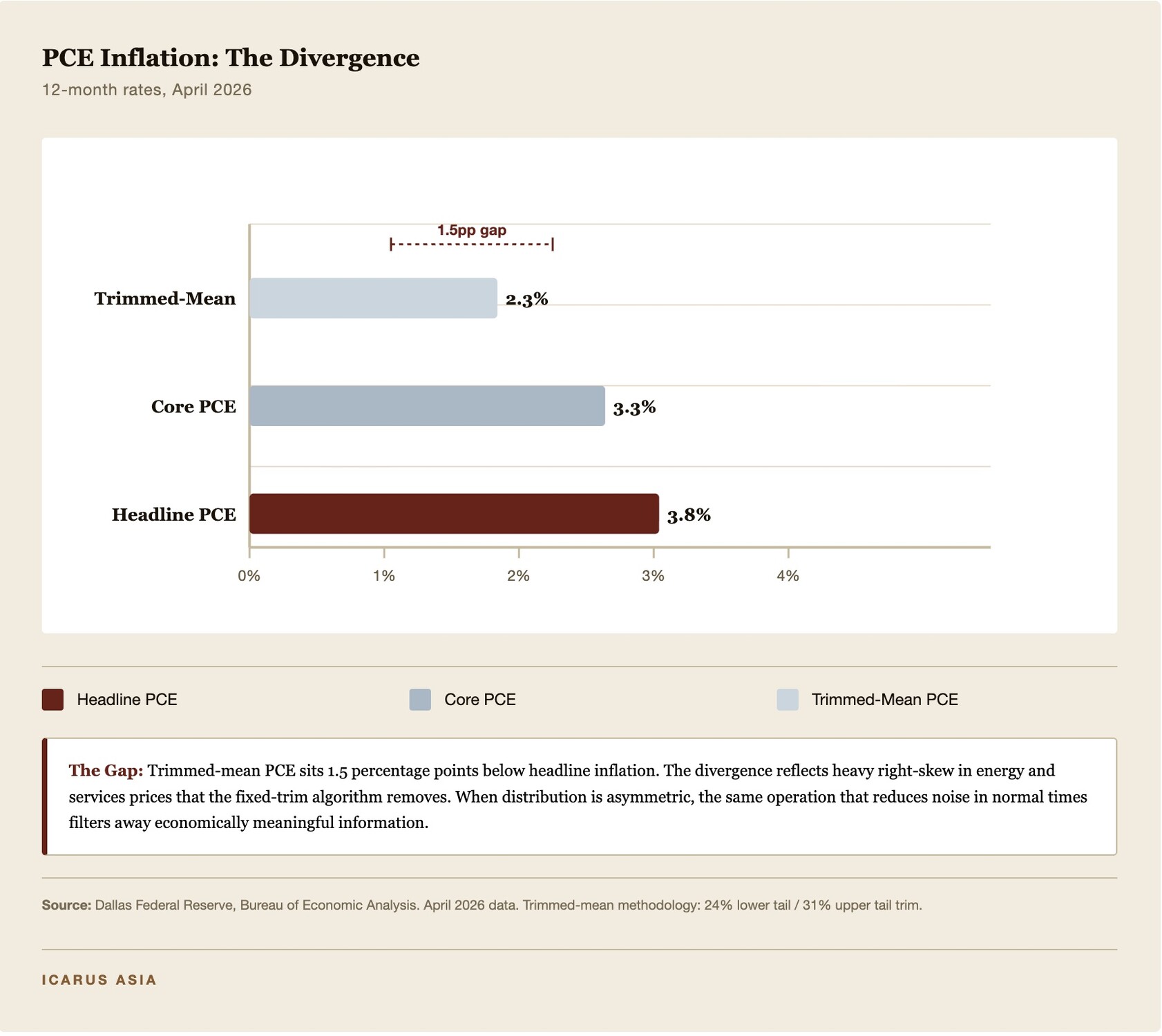
The trimmed-mean personal consumption expenditures index, which strips out the most extreme price swings, is running at 2.3% as of April 2026. But that figure masks a widening gap from the inflation households and markets actually see.
Warsh, who took office May 22, signaled early that he would prioritize the Dallas Federal Reserve's trimmed-mean PCE over the headline rate of 3.8% or even core inflation at 3.3%. The measure works by discarding roughly 24% of the lowest price changes and 31% of the highest ones across the 184 components of the PCE index, then averaging what remains.
Historically, this approach has reduced noise and improved inflation forecasts. The problem is timing.
Right now, the trimmed-mean metric appears to be hiding rather than illuminating the inflation picture.
"The distribution of price changes has become heavily right-skewed," according to Dallas Federal Reserve economists. Energy, airfares, and travel services are clustered in the upper tail. But the fixed-trim algorithm removes them anyway, the precise items that anchor household expectations and drive monetary policy skepticism.
The result? A 1.5 percentage-point gap between trimmed-mean and headline inflation, the widest in recent history.
Derivatives markets have already registered doubt.
Odds of interest rate cuts by the end of 2026 fell from 50% in February to zero by late March. CME FedWatch derivatives now assign 12% odds to a rate hike, a shift driven by concerns that trimmed-mean PCE is a measurement that suits a dovish narrative while households live in a hawkish reality.
The tension is not new, but it is acute.
Cleveland Federal Reserve research on inflation measures has documented that fixed-trim approaches can distort signals in fat-tailed environments. When price movements cluster asymmetrically, the same statistical operation that reduces noise in normal times ends up filtering away economically meaningful information.
Warsh faces an inherited framework.
His predecessor had leaned on trimmed-mean PCE in recent years, but without elevating it to primary status. Warsh's early signals suggest he intends to make it central to the Fed's inflation guidance, betting that it captures the "true" underlying trend better than either headline or core.
The stakes are high.
History suggests that when central banks become anchored to a gauge that understates inflation, the eventual correction tends to be violent.
When the Fed Misses a Step
The Volcker disinflation in the early 1980s offers the starkest example.
By 1980, headline CPI was near 15%. Volcker's response was not gradual. The Fed raised the federal funds rate to 20% and above, triggering a severe recession, dollar appreciation, and cascading defaults among Latin American sovereigns that had borrowed heavily in dollars. The pain was real, but credibility was restored.
Greenspan faced a subtler version in 1994.
The Fed doubled the funds rate from 3% to 6% in a single year, including a surprise 75-basis-point move. While the U.S. avoided recession, the combination of higher yields and a stronger dollar contributed to the December 1994 peso collapse and the broader Tequila crisis. Once again, the sharpness of the reversal reflected how quickly market participants reassess policy when they lose confidence in a narrative.
Most recently, Fed officials called inflation "transitory" through much of 2021, only to confront mounting evidence that the shock was persistent and broad-based. The ensuing tightening cycle, which lifted rates by 525 basis points over 16 months from March 2022 to July 2023, was the fastest since Volcker. That pace reflected not optimal monetary policy but the need to repair credibility after a visible forecast miss.
The common thread: once markets lose faith in the measurement or the narrative, the Fed's response must be sharper and more disruptive to restore it.
The Moment of Truth
Warsh's June meeting will be his first as chair with full control of the agenda and messaging.
Market positioning suggests three possible outcomes, each with distinct implications.
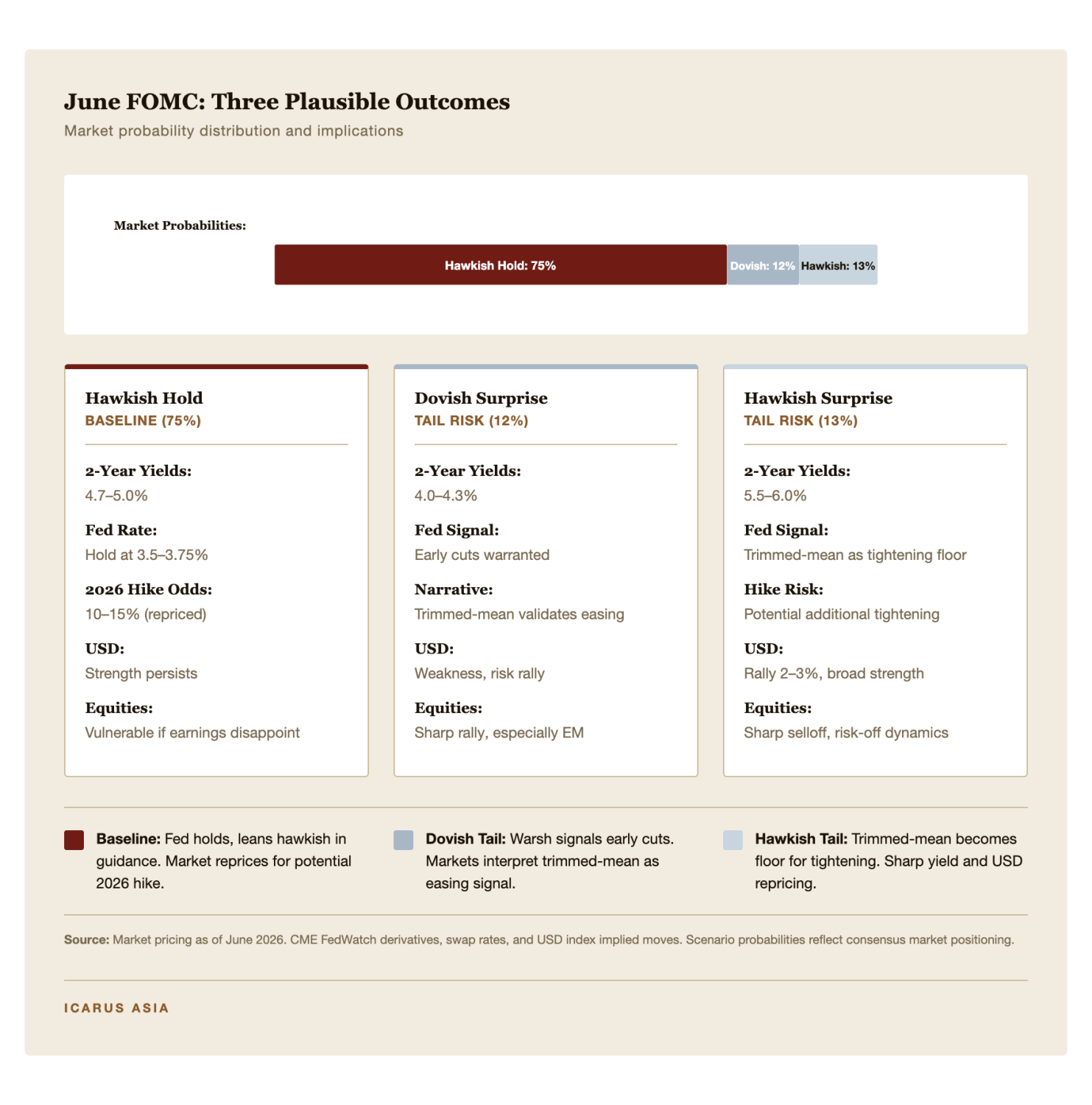
The baseline case, favored by around 75% of market participants, assumes the Fed holds the policy rate in the 3.5% to 3.75% range but leans hawkish in forward guidance. Warsh would acknowledge that trimmed-mean PCE signals inflation is moving toward the 2% target, but emphasize that skewness, supply shocks, and geopolitical risks argue for restraint.
The trimmed-mean becomes a floor on how low rates go, not a call for easing. Two-year yields would remain in the 4.7% to 5.0% range. Swaps would reprice odds of a 2026 hike to 10% to 15% from less than 5%.
A dovish surprise, with perhaps 12% odds, would see Warsh signal that early cuts are warranted because the trimmed-mean PCE print reflects a more accurate picture of underlying inflation than markets believe. This would validate the thesis that skewed data had misled the prior regime into excessive caution. Two-year yields could collapse to 4.0% to 4.3%, triggering a risk rally in equities and emerging markets.
The hawkish tail, around 13% odds, would represent the scenario markets most fear. Warsh would effectively elevate trimmed-mean PCE as a floor for tightening, not a signal to ease. If early inflation data suggests the skewness is persistent, he might even signal additional hikes ahead. Two-year yields would spike to 5.5% to 6.0%. The dollar would rally 2% to 3%. Equities would sell off sharply, particularly those segments dependent on favorable financing conditions.
The distribution of these probabilities reflects a market caught between two narratives: one that trusts the Fed's new measurement regime, and one that views it as a retrospective justification for earlier passivity.
The Emerging-Market Buffer
One structural difference between now and past tightening cycles is emerging market positioning.
The International Monetary Fund's recent analysis suggests that most emerging economies are better prepared for a U.S. rate shock than they were in 1982, 1994, or even 2022.
Net capital flows to emerging markets ex-China reached 0.6% of GDP in 2023, the highest since 2018, despite portfolio outflows in earlier periods. Stronger reserves, more credible inflation-targeting frameworks, and earlier domestic rate hikes that preempted the Fed's shift have insulated policymakers in Asia and parts of Latin America.
The differentiation matters.
Strong performers like South Korea, Taiwan, and Singapore have independent inflation-targeting regimes, FX reserves exceeding $400 billion, and flexible exchange rates that absorb dollar strength. Weak performers like Turkey and Argentina, burdened by structural fiscal pressures and quasi-pegged regimes, remain vulnerable to capital flight and currency pressure.
But there will be no generalized EM crisis on the scale of 1982 or even the more recent Taper Tantrum. The bar for systemic stress is higher now, and most emerging economies have built buffers.
The Blind Spot
Warsh inherits a framework, not invents one. And he moves with the data available in real time.
The trimmed-mean PCE approach has merit in normal regimes and has improved inflation forecasts historically. But measurement regimes are credible only as long as they track the inflation that matters to expectations-setting.
Right now, they are diverging.
Households see gas, airfares, and hotel prices. Markets see a 1.5 percentage-point gap between what the Fed's new favorite number says and what headline inflation actually is. The question for Warsh is whether June's meeting will narrow that gap or widen it.
If he signals continued confidence in the trimmed-mean framework without acknowledging the skewness problem, markets will read it as willful blindness. If he acknowledges it but holds the line anyway, he risks credibility erosion. If he reverses course and elevates headline or core inflation back to primary status, he concedes that the shift was premature.
The Fed's measurement regime matters more than central bankers typically admit. It shapes expectations, anchors market pricing, and determines how violent the eventual correction will be if the narrative breaks.
Warsh's June FOMC meeting will test whether the trimmed-mean PCE framework can hold, or whether it becomes the next chapter in the Fed's history of narrative collapse.
The author is the Head of Research and Analysis at Icarus Asia, a Hong Kong-based risk and advisory consultancy.
Disclaimer: This is not investment advice. Please do your own research and consult a registered financial advisor.
Sources
Primary Sources
Dallas Federal Reserve Trimmed-Mean PCE Data and MethodologyURL: https://www.dallasfed.org/research/pceReference: "Skewness Warrants Caution as Trimmed-Mean PCE Inflation Eases" (April 2026)
Federal Reserve Economic Data (FRED) PCE Inflation Index (Headline, Core, Trimmed-Mean)Federal Funds Effective RateURL: https://fred.stlouisfed.org/
Cleveland Federal Reserve Research on Median and Trimmed-Mean Inflation MeasuresFixed-trim bias analysis in fat-tailed distributionsURL: https://www.clevelandfed.org/research
Bureau of Economic Analysis (BEA) Personal Consumption Expenditures Price IndexApril 2026 PCE data releaseURL: https://www.bea.gov/
CME FedWatch Tool Market-implied Fed Funds rate probabilitiesTwo-year swap rate pricingURL: https://www.cmegroup.com/markets/notifications/cbot/fed-funds.html
Reference Material
International Monetary Fund (IMF) Analysis of emerging market resilience to Fed tightening cyclesCapital flows and currency dynamics researchURL: https://www.imf.org/en/Publications
Reuters / Bloomberg Market commentary on PCE divergence and derivatives positioning
Swaps market pricing (February–March 2026) Morningstar research on inflation measurement transparency
U.S. Federal Reserve Board Historical monetary policy decisions and tightening cycles 1979–1984 Volcker era documentation 1994–1995 Greenspan rate hikes 2022–2023 rate hike cycle (525 bps in 16 months)
Historical References
Federal Reserve Archives
Volcker Disinflation (1979–1984): Federal Funds Rate to 20–22%; Latin American debt crisis (1980s) analysis; Greenspan 1994 Surprise Rate Hike (75 basis points); Mexican Peso Crisis / Tequila Crisis (December 1994)
U.S. Treasury Historical Data 2-year Note yields (April 2026 baseline: 4.7–5.0%) 10-year constant maturity rates USD Index movements
Data Verification
All inflation figures haev been verified as of June 3, 2026:
Trimmed-Mean PCE: 2.3% (12-month, April 2026)
Headline PCE: 3.8% (12-month, April 2026)
Core PCE: 3.3% (12-month, April 2026)
Federal Funds Effective Rate: 3.63% (May 2026)
Charts
PCE Inflation Chart: Data sourced from Dallas Federal Reserve and BEA
FOMC Scenarios Chart: Market probabilities from CME FedWatch and derivative pricing as of June 2026
Attribution Notes
Methodology: Fixed-trim algorithm: 24% lower tail / 31% upper tail (Dallas Federal Reserve standard)
All claims are sourced to government databases, Federal Reserve publications, or verified market pricing. No forward-looking statements beyond scenario analysis are made without explicit attribution to CME FedWatch or market consensus pricing.