
News · Ideas · US
Kevin Warsh Says AI Will Fix Inflation. The Numbers Say Not Yet.
The new Fed Chair's case for lower interest rates rests on a productivity story that hasn't materialized yet -- and new evidence suggests the A.I. buildout is already pushing prices higher.
The new Fed Chair's case for lower interest rates rests on a productivity story that hasn't materialized yet -- and new evidence suggests the A.I. buildout is already pushing prices higher.
In March of 2026, 49,000 residents on California's side of Lake Tahoe learned their electricity supply was about to get considerably more expensive -- and considerably less certain.
Liberty Utilities Ltd, the company that serves the California shore of the lake, told state regulators it would need to find a new source for three-quarters of its power within 14 months. NV Energy, the Nevada-based company supplying most of that electricity, said it could not continue the arrangement beyond May 2027 because of its "own resource needs."
What NV Energy described as a "long-standing" transition plan looked rather different from inside the data center industry.
The previous September, Jeff Brigger, NV Energy's director of business development, had told a data center conference that tech companies were driving requests to triple the utility's peak demand -- which runs around 9,000 megawatts during heat waves. "These are unprecedented times," Brigger said, according to the Las Vegas Review-Journal.
Northern Nevada has become one of the fastest-growing data center corridors in the country. Google, Apple and Microsoft have built or are planning facilities around the Tahoe-Reno Industrial Center east of Reno, according to Fortune. A January report from the Desert Research Institute, part of the University of Nevada, Reno, counted more than 40 projects underway in the region. NV Energy's own 2024 resource plan lists 12 of them, projecting 5,900 megawatts of new demand -- nearly three times the Hoover Dam's capacity -- and load growth by 2033 that would exceed half of Nevada's entire 2024 net electricity generation.
NV Energy's own 2024 resource plan lists 12 of them, projecting 5,900 megawatts of new demand -- nearly three times the Hoover Dam's capacity -- and load growth by 2033 that would exceed half of Nevada's entire 2024 net electricity generation.
NV Energy denied any connection to the Lake Tahoe situation.
"Data centers did not influence this decision," the company said in a statement. "The decision for Liberty to move to its own power supply is based on long-standing agreements and planning assumptions that date back more than a decade — well before data center growth became a factor." But a California Public Utilities Commission spokesperson told CapRadio, Sacramento's public radio station, that according to Liberty, NV Energy's decision was "partially due to projected demand by data centers in the region."
Rates in the area were already rising before the supply disruption became public.
Danielle Hughes, a North Tahoe resident and consumer advocate who also works in California's Energy Commission efficiency division, said she is one of roughly 17,000 to 20,000 year-round residents bearing costs that state energy models don't capture. The rate structure hits permanent residents with demand charges that vacation homeowners don't face, she said. "Our rates are going to be the highest in the country most likely, and we are not being considered," Ms. Hughes told CapRadio. "Someone like Mark Zuckerberg who's a non-resident doesn't have a demand charge, but has a high peak demand."
Our rates are going to be the highest in the country most likely, and we are not being considered
Cody Bass, South Lake Tahoe's mayor, said he found out about the supply problem the same way his constituents did. "We really didn't get any notice prior to the public press release," Mr. Bass told CapRadio. He has since met with Liberty and state regulators, who assured him the lights won't simply go out. That's not what worries him. "I think we're pretty aware it's going to cause higher rates, and that of course becomes a major issue for our residents, businesses and for everybody else because our rates are already pretty high."
Lake Tahoe offers a ground-level preview of a tension now running through the broader American economy. The infrastructure costs of the artificial intelligence buildout -- power, grid upgrades, data center construction -- are landing in electricity bills now, while the technology's promised productivity gains remain years away.
That timing gap sits at the center of one of the more consequential debates in monetary policy -- one that Kevin Warsh, the newly confirmed Federal Reserve chairman, will have to confront as he navigates pressure to cut interest rates ahead of November's midterm elections.
The Inflation Debate
Warsh has argued publicly that artificial intelligence will reduce costs across the economy, lift productivity and create room for lower interest rates without reigniting inflation. The argument has gained traction in market commentary and among Fed-watchers. But an accumulating body of central bank research, investment analysis and sector-level data suggests the thesis is considerably more fragile than its proponents acknowledge.
The sharpest challenge comes not from theoretical models but from the price data itself.
A quarterly index tracking the A.I. footprint across the American economy found that artificial intelligence has already made a positive -- and rising -- contribution to United States inflation, with the most A.I.-exposed sectors tending to show the highest inflation rates. The finding comes from a paper by Professor Salem Abo-Zaid of the University of Maryland, published in April 2026. The infrastructure costs of the technology are arriving before the productivity gains that are supposed to offset them.
Those costs are most visible in energy.
American electricity inflation ran at 6.9% year-on-year through December 2025 -- more than double the headline personal consumption expenditure index, the Federal Reserve's preferred inflation measure -- according to Bloomberg data cited in a June 2026 commentary from Nuveen, a TIAA company-owned asset manager. Consumer electricity prices are likely to stay near 6% annual growth through 2027, while data center demand is on course to nearly double from its current share of roughly 4% of total American electricity consumption by 2030, according to Nuveen estimates.
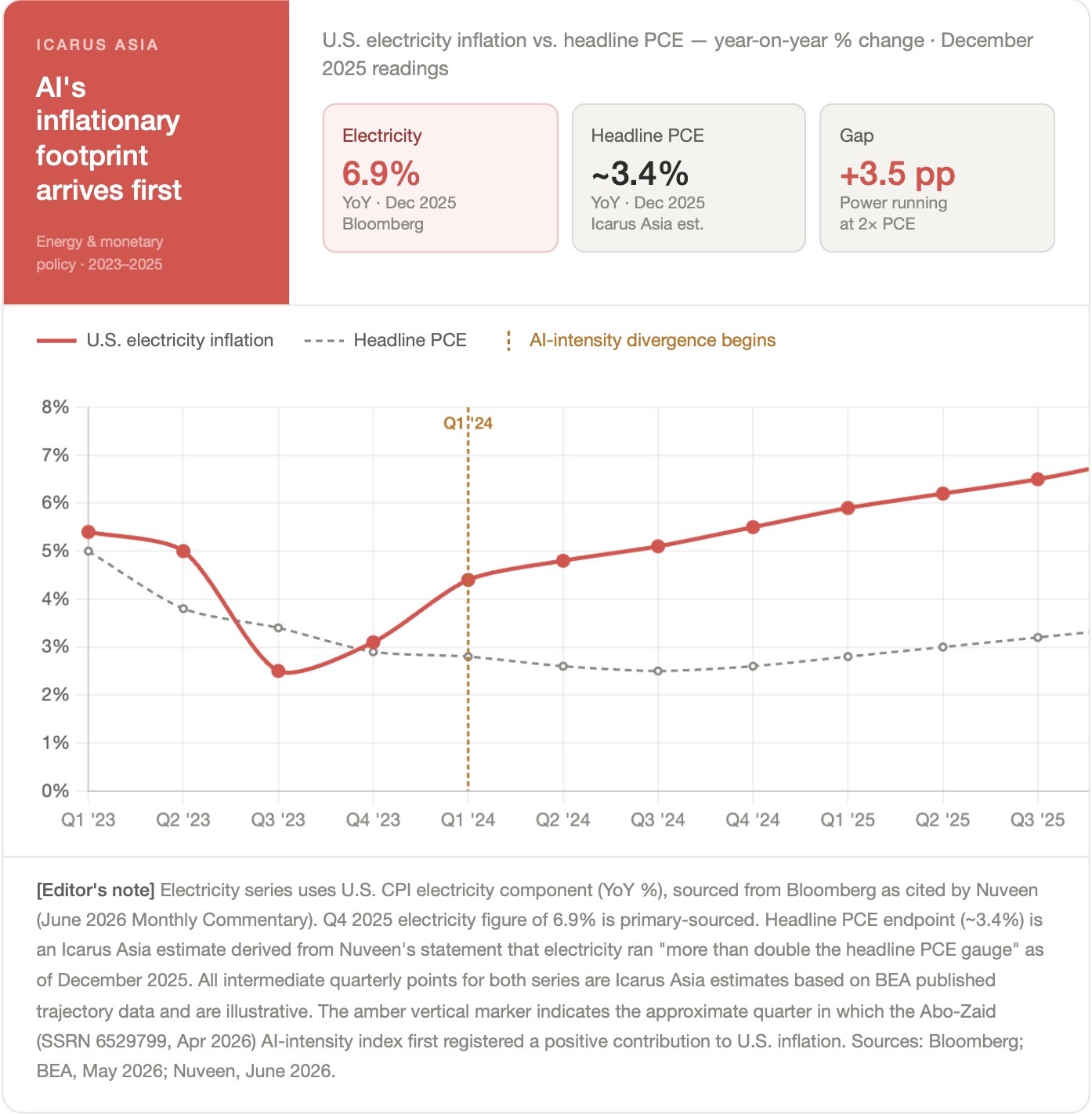
"The clearest empirical signal so far cuts against the consensus that A.I. is disinflationary," wrote Laura Cooper, Nuveen's head of macro credit, and Quinn Brody, a senior macro strategist, in the June commentary. "The steep costs of the A.I. buildout are arriving faster than the productivity gains that are supposed to offset them."
The steep costs of the A.I. buildout are arriving faster than the productivity gains that are supposed to offset them.
A Tenuous Claim?
The broader academic literature agrees that the inflation picture is fundamentally uncertain.
A Bank for International Settlements – BIS working paper -- one of the most rigorous central bank examinations of A.I.'s macroeconomic effects -- found that artificial intelligence raises output, consumption and investment, but that the inflation response depends critically on expectations. If businesses and households anticipate future productivity gains, they may spend and invest today against tomorrow's expected income, pulling inflation forward before the gains have arrived. That channel alone is enough to cloud the near-term picture, even if A.I. ultimately delivers the productivity dividend its advocates foresee.
Research from the International Monetary Fund (IMF) reaches a similar conclusion. Model simulations in a 2025 working paper found that A.I. can raise global productivity and economic output significantly over a decade, but that near-term inflation may edge higher because investment and demand outpace the initial supply response. In those simulations, central banks respond with modest interest rate increases in the short run -- not cuts.
The productivity payoff from A.I. remains elusive.
Since 2024, 64 cents of every dollar of American economic growth has come from technology spending, and hardware investment has risen from nearly 2% of gross domestic product to more than 3%, according to the Bureau of Economic Analysis. Yet more than three in four American businesses have yet to incorporate artificial intelligence into their operations, according to the U.S. Census Bureau. The productivity gains running above 2% in the current business cycle largely reflect post-pandemic labor market dynamics, not any A.I. contribution.
The clearest sector-level evidence for A.I. as a disinflationary force comes from European manufacturing.
A 2025 paper in Economics Letters by Borowski, Fidrmuc and Jaworski found that a 10-percentage-point increase in the share of European Union firms using A.I. is associated with roughly a 0.3 to 0.6 percentage-point decline in producer-price inflation, with effects concentrated in services and visible only after firms pass a threshold of adoption.
That is a real effect -- and the strongest empirical support Mr. Warsh's thesis can claim.
But lower producer prices in A.I.-adopting sectors don't automatically translate into broader consumer price disinflation. Aggregate inflation also depends on wages, industries that haven't adopted A.I., energy and housing costs, and whether A.I.-related capital investment raises demand elsewhere in the economy.
A 2026 policy note from SUERF - The European Money & Finance Forum, a European forum for monetary economists, captured the two-sided nature of A.I.'s economic transmission precisely: the technology can be disinflationary by lifting supply and cutting labor costs per unit of output, but inflationary through stronger investment demand, higher expected incomes and frictions as workers adapt. The note described A.I. as "conditionally disinflationary" rather than inherently deflationary -- a distinction that matters considerably for anyone trying to use it to justify lower interest rates.
The note described A.I. as "conditionally disinflationary" rather than inherently deflationary -- a distinction that matters considerably for anyone trying to use it to justify lower interest rates.
Economists surveyed by Financial Times largely rejected the idea that artificial intelligence would meaningfully reduce inflation or interest rates over the next two years, with many expecting the effect to be negligible. A June 2026 World Economic Forum survey found that economists now expect A.I.-driven productivity gains to take at least another two years to materialize across most industries -- longer than they anticipated at the start of 2026.
Are the Bond Vigilantes Buying This?
The bond market is sending a mixed signal.
When researchers at the National Bureau of Economic Research studied Treasury, inflation-protected securities and corporate bond yields around major A.I. model releases in 2023 and 2024, they found yields fell consistently by more than 10 basis points on average, remaining lower for over two weeks after each release. On the surface, bond markets appeared to price A.I. as a deflationary shock. But the researchers attributed that reaction partly to downward revisions in expected consumer spending -- a considerably less optimistic reading than the Warsh framing implies.
Meanwhile, the financing of the A.I. buildout -- data centers, semiconductor supply chains, power infrastructure -- is generating structural upward pressure on long-term interest rates through a wave of corporate bond issuance, a dynamic the Federal Reserve Bank of Dallas flagged earlier this year as structural rather than cyclical.
The financing of the A.I. buildout -- data centers, semiconductor supply chains, power infrastructure -- is generating structural upward pressure on long-term interest rates through a wave of corporate bond issuance.
Beneath all of this sits what economists call the neutral interest rate -- the rate at which monetary policy is neither stimulating nor restraining the economy.
A more productive A.I.-driven economy would imply a higher neutral rate, since stronger growth prospects raise the equilibrium cost of borrowing. But if the gains from A.I. flow disproportionately to corporations and investors while displacing workers, higher precautionary savings and greater economic uncertainty could push in the other direction. The Federal Reserve Bank of Cleveland currently estimates the nominal neutral rate falls somewhere between 2.9% and 4.5% — a band wide enough to make confident policy prescriptions difficult to defend.
If the gains from A.I. flow disproportionately to corporations and investors while displacing workers, higher precautionary savings and greater economic uncertainty could push in the other direction.
The employment picture adds its own uncertainty.
The International Monetary Fund estimates that close to 40% of global employment is exposed to A.I. Roughly four in five American workers have at least 10% of their job tasks within reach of large language model capabilities. Yet since generative A.I. arrived, economy-wide job losses and wage declines have not materialized. More than 142,000 American technology workers were laid off through mid-2026 -- about 33% more than during the same period in 2025 -- but analysts put only roughly a quarter of those cuts down to A.I. and automation, with the rest reflecting cost discipline and the unwinding of pandemic-era over-hiring, according to data from TrueUp and Challenger, Gray & Christmas, Inc.
More than 142,000 American technology workers were laid off through mid-2026 -- about 33% more than during the same period in 2025 -- but analysts put only roughly a quarter of those cuts down to A.I. and automation, with the rest reflecting cost discipline and the unwinding of pandemic-era over-hiring.
The Cato Institute has argued that while Warsh may be right about the need to overhaul the Fed's governance, his inflation argument is a trap: turning a forward-looking productivity thesis into a confident monetary policy framework requires both rapid adoption of A.I. and a clean pass-through from productivity gains to lower prices -- two assumptions the evidence does not currently support.
Artificial intelligence will probably prove disinflationary at the margin over time, particularly in industries that adopt it broadly. But the gap between A.I.'s immediate costs -- power, capital spending, infrastructure -- and its eventual supply-side benefits means the near-term inflation effect is more likely to work against rate cuts than in favor of them.
Nuveen's Cooper and Mr. Brody were direct about the investment implication: "A.I.'s supply-side benefits are long-dated, while its demand on capital markets is immediate."
For monetary policy, the logic runs the same way -- treat A.I. as a modest structural disinflationary force with wide margins of uncertainty, not a deflation engine that obviously creates room for materially lower rates now.
Warsh may prove right in the long run. The question is how long Americans can afford to wait.
The author is the Head of Research and Analysis at Icarus Asia, a Hong Kong-based risk and advisory business.
Disclaimer: This is not investment advice. Please do your own research and consult with a registered financial advisor.
Sources
Abo-Zaid, Salem. "AI-Intensity Index and U.S. Inflation." SSRN Working Paper 6529799. University of Maryland, April 2026.
Andrews, Isaiah, and Maryam Farboodi. "Do Markets Believe in Transformative AI?" NBER Working Paper 34243. National Bureau of Economic Research, 2025.
Bank for International Settlements. "Artificial Intelligence and Macroeconomic Effects." BIS Working Paper No. 1179, 2024.
Borowski, Jakub, Jarko Fidrmuc, and Pawel Jaworski. "Artificial Intelligence Adoption and Producer-Price Inflation: Evidence from European Manufacturing." Economics Letters, 2025.
Eloundou, Tyna, Sam Manning, Pamela Mishkin, and Daniel Rock. "GPTs Are GPTs: An Early Look at the Labor Market Impact Potential of Large Language Models." arXiv Working Paper 2303.10130, 2023.
International Monetary Fund. "Artificial Intelligence, Productivity, and Global Growth." IMF Working Paper WP/25/76, 2025.
SUERF – The European Money and Finance Forum. "Artificial Intelligence, Labour Markets, and Inflation." SUERF Policy Note, 2026.
Searls, "How AI Debt Financing Impacts Duration Supply and Interest Rates." Dallas Fed Economics. Federal Reserve Bank of Dallas, February 2026.
Zaman, Saeed. "Estimates of the Neutral Interest Rate." Federal Reserve Bank of Cleveland, September 2025.
World Economic Forum. "Global Economic Outlook Hangs in Balance Between Geopolitical Headwinds and AI Boost, Chief Economists Warn." WEF Chief Economists Outlook, May 2026.
Cooper, Laura, and Quinn Brody. "AI's Inflationary Footprint." Nuveen Monthly Macro Commentary. TIAA/Nuveen, June 2026.
Bloomberg Terminal data cited via Nuveen: U.S. electricity CPI year-on-year through December 2025.
Bureau of Economic Analysis. National Income and Product Accounts. U.S. Department of Commerce.
U.S. Census Bureau. "Business Trends and Outlook Survey — AI Adoption." 2026.
TrueUp. Tech Layoff Tracker. Mid-2026.
Challenger, Gray & Christmas. Job Cut Report. Mid-2026.
NV Energy. 2024 Integrated Resource Plan.
Cato Institute. "Kevin Warsh Is Right About Fed Reform. His Inflation Solution Is a Trap." 2026.
Capital Public Radio (CapRadio). Reporting on Liberty Utilities, NV Energy, and Lake Tahoe power rates. March 2026.
Financial Times. Economist survey on AI, inflation, and neutral rates. 2026.
Fortune. Reporting on Google, Apple, and Microsoft data center facilities at Tahoe-Reno Industrial Center. 2025–2026.
Las Vegas Review-Journal. Reporting on NV Energy Director Jeff Brigger and data center demand projections. September 2025.
Desert Research Institute, University of Nevada. Report on data center projects in Northern Nevada. January 2026.