
News · Rates & FX · Japan
Japan’s Quiet Defense of the Yen
The 2026 record-breaking intervention has laid bare the limits of Japan’s defensive economic strategy. Caught between a weak yen that fuels inflation and a precarious debt load that prevents aggressive rate hikes, Tokyo is increasingly relying on a series of tactical strikes--and an ever-growing list of non-rate tools--to maintain a fragile, managed equilibrium.
Late last spring, as the yen weakened past 160 to the dollar, Japanese authorities stepped in with their largest currency operation on record.
Over just a few weeks in April and May, the Ministry of Finance spent ¥11.7 trillion or about $73 billion buying yen and selling dollars. The pair snapped back hard, briefly touching the mid-155s before beginning its slow drift higher again. It was not the first time. Operations in 2022 and 2024 had already brought the confirmed total above ¥34 trillion, more than $200 billion.
For a nation long accustomed to using a weak yen as an economic crutch, the currency’s prolonged slide has turned into something more intractable.
Japan’s policymakers face a bind: raising interest rates fast enough to bolster the yen risks inflaming the country’s enormous government debt burden. So they have turned instead to a subtler arsenal -- foreign exchange intervention, calibrated quantitative tightening, pointed verbal warnings, and technical fixes to keep the bond market from seizing up.
The approach amounts to a managed decline: a yen weak enough to support exporters and contain borrowing costs, but not so weak that it sparks domestic fury or international tension.
The events of early 2026 have laid bare how entrenched this dynamic has become.
With the Bank of Japan sitting on roughly ¥589 trillion in Japanese government bonds and the nation’s debt among the heaviest in the developed world, aggressive rate hikes remain a perilous option. The Ministry of Finance has instead become the front-line responder, repeatedly using reserves to cushion the fall.
A Self-Reinforcing Cycle
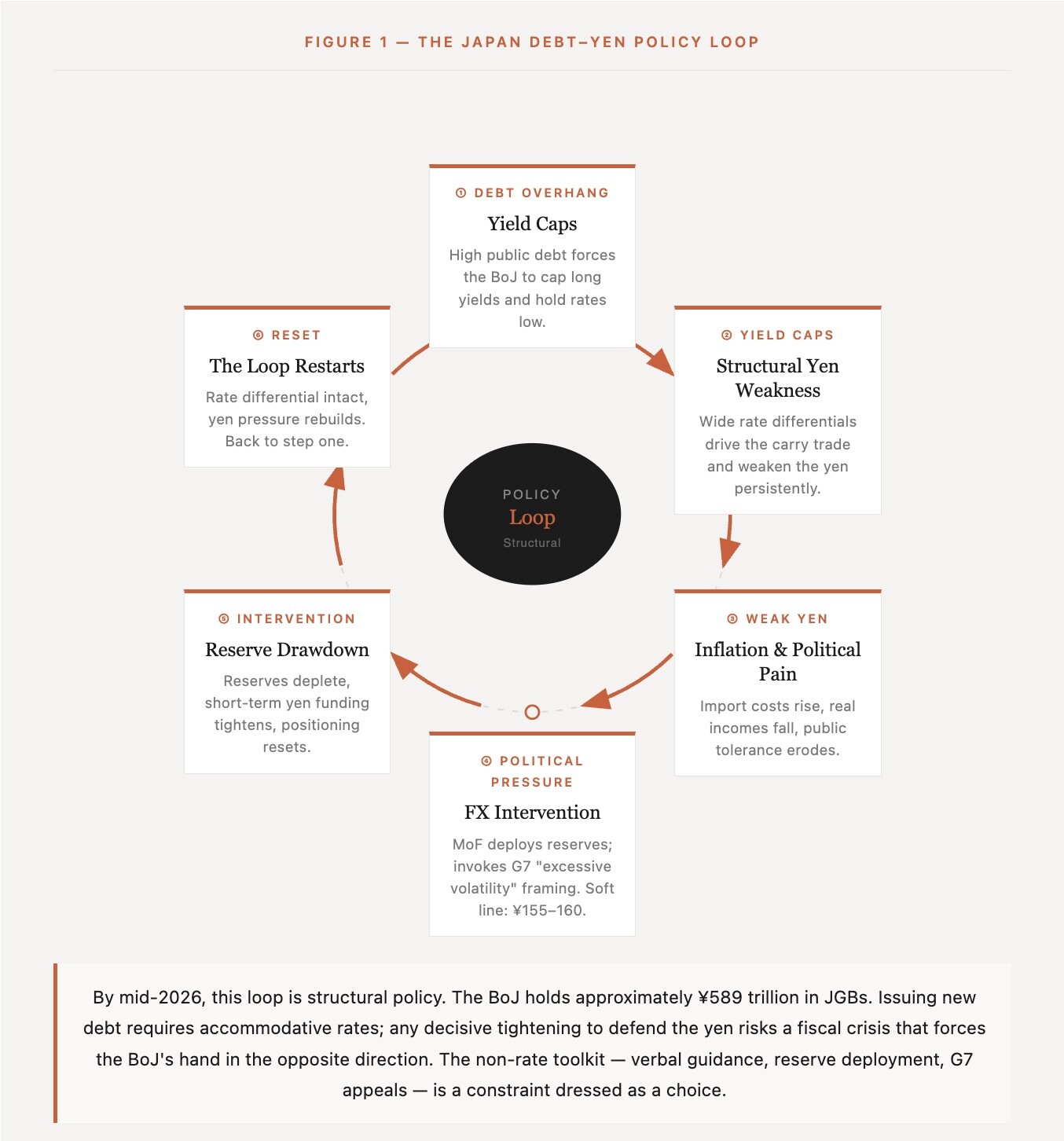
High public debt has long pushed the central bank to suppress long-term yields through heavy bond purchases. That policy helps keep borrowing costs manageable but also sustains low rates relative to the United States, encouraging yen-funded carry trades that steadily weigh on the currency. When the yen’s decline accelerates, import prices climb, inflation squeezes households, and political pressure mounts. The reflex is intervention: selling dollars from the nation’s reserves to buy yen. It delivers a jolt, but rarely alters the deeper forces at work.
Analysts at the The Brookings Institution have highlighted the awkward contradiction.
The Bank of Japan’s efforts to cap yields widen the rate gap that weakens the yen, while the Ministry of Finance then spends reserves trying to undo some of that damage. The two arms of policy often pull in opposite directions.
The split in responsibilities is by design.
The Ministry decides when to act; the Bank executes through the Foreign Exchange Fund Special Account. This setup lets officials address currency moves without immediately disrupting monetary policy or the fragile equilibrium in the government bond market.
Record Interventions and Tactical Strikes
Japan’s modern era of yen-buying resumed in September and October 2022, with ¥9.18 trillion deployed as the dollar-yen rate neared 152. In 2024, spring and summer operations topped ¥13 trillion. The 2026 round stood apart for sheer size: ¥11.7 trillion concentrated in a single window, the largest confirmed intervention Japan has ever undertaken.
The timing is deliberate. Officials often strike during thin trading — Tokyo holidays or quieter overnight hours — to stretch their impact. The results can be striking.
In the latest episode, the yen strengthened several big figures almost overnight, handing losses to leveraged carry positions and forcing traders to reassess. Studies of past interventions show that big, concentrated moves can shift the exchange rate by several yen in a day, with heightened volatility sometimes lingering for days or weeks.
Still, the respite tends to be short-lived. Once the immediate surprise wears off, the familiar pressures — interest rate gaps, global risk appetite, commodity costs — reassert themselves. The interventions buy breathing room and reset positioning. They rarely rewrite the longer-term script.
The mechanics of funding add another edge.
When the Ministry sells dollars for yen, it initially drains liquidity from the banking system. The Bank of Japan often sterilizes the impact over time to keep policy on track, though the initial squeeze can push short-term yen funding costs higher — an extra headache for carry traders. Older episodes, like the massive interventions of 2003 and 2004, suggest that less fully sterilized operations sometimes left a more lasting imprint on the currency.
The Limits of Quantitative Tightening
The Bank of Japan’s gradual retreat from years of heavy bond buying adds another layer of constraint. Fitch Ratings has projected net negative JGB purchases — the essence of quantitative tightening — of ¥33.6 trillion in 2025 and ¥45.6 trillion in 2026, mostly through passive runoff of maturing holdings rather than outright sales. Monthly redemptions hover around ¥6 trillion, pointing to a natural annual runoff of roughly 8 percent of the central bank’s JGB stock under steady conditions.
Even this cautious pace has come under internal review.
Before the June 2026 policy meeting, officials were reportedly weighing whether to slow the reduction in purchases for fiscal 2027 to avoid unsettling the bond market. Aggressive sales have largely been ruled out. A sharp spike in long-term yields would quickly inflate fiscal interest payments and test confidence in Japan’s debt outlook. Instead, the combination of gradual runoff and the Securities Lending Facility — which lends specific JGB issues to ease repo shortages and collateral crunches — helps preserve enough stability for the Ministry to conduct its FX operations without triggering a domestic bond-market scare.
The maturity profile of the Bank’s holdings also matters.
Modest adjustments can allow some steepening further out the curve, modestly lifting term yields that influence carry trades. But the same debt concerns that require yield management limit how much room the Bank has to let yields rise without courting trouble. Quantitative tightening, in this setting, plays a supporting role at best.
Reading the Signals
Market participants have grown adept at spotting the signs.
While no formal “line in the sand” has ever been declared, repeated interventions and official language have made the 155–160 zone feel like dangerous territory for yen shorts. As the dollar-yen rate climbs toward those levels, Ministry and Bank officials tend to intensify their public warnings — “monitoring with a strong sense of urgency,” “ready to act against excessive volatility.” Traders take note.
The shift shows up clearly in options markets.
The 25-delta risk reversal — measuring the volatility gap between out-of-the-money dollar calls and puts — often flattens or even inverts as demand for downside protection on the pair intensifies. Carry positions get trimmed, stops tightened, structures adjusted. When the actual intervention arrives, the reaction can be abrupt. The April-May 2026 operation served as the latest case study.
These soft boundaries and rhetorical cues influence how risk is distributed. They make crowded positions more vulnerable. Yet they do not erase the structural headwinds.
The Political Balancing Act
Inside Japan, there remains a measured acceptance of a moderately weak yen.
Manufacturers and the tourism industry gain from it. A softer currency supports nominal growth and eases the weight of debt servicing. But tolerance has clear limits.
When depreciation accelerates to the point of driving up supermarket prices for energy and food faster than wages can catch up, the narrative shifts to “excessive volatility.” At that stage, officials reach for G7 language that allows intervention in cases of disorderly moves detached from fundamentals.
The framing offers diplomatic flexibility.
Japan can act without formally targeting levels or provoking accusations of currency manipulation. Even so, the country’s foreign reserves, standing at roughly $1.2 trillion, are substantial but not infinite. Repeated large-scale drawdowns inevitably raise questions about how long the buffer can hold.
Implications for Global Investors
For hedge funds, asset managers, and macro traders, the 2026 setup presents a recurring tactical landscape. The non-rate toolkit — intervention around soft thresholds, passive QT supported by lending facilities, and carefully timed signals — functions as a pressure-release valve. It lets authorities blunt the yen’s sharpest drops without upending the JGB market or fiscal stability.
Outcomes will hinge heavily on external conditions.
If American yields ease gradually and commodity prices stabilize, periodic interventions alongside modest policy adjustments may keep the dollar-yen pair within a politically acceptable range. Persistent high U.S. rates or renewed energy shocks, however, could force faster reserve use and tougher decisions. A quicker narrowing of the rate gap would ease the burden naturally, giving the Bank of Japan more room to maneuver.
In the meantime, the focus remains on familiar indicators: the shape of the options surface, the pace of Bank of Japan purchases, reserve updates, and the temperature of official statements. The debt-yen loop continues. The toolkit keeps the system functioning, one intervention at a time.
How much longer that proves sufficient is the larger question hanging over Japan’s economy — and over anyone positioned in the world’s most watched currency pair.
The author is the Head of Research and Analysis at Icarus Asia, a Hong Kong-based risk and advisory business.
Disclaimer
Not investment advice. Please do your own research.
Sources
Ministry of Finance (Japan) – Foreign Exchange Intervention Operations (monthly and quarterly data, historical CSVs)
Bank of Japan – “What is foreign exchange intervention? Who decides and conducts it?”
Bank of Japan – “Outline of the Bank of Japan’s Foreign Exchange Operations”
Bank of Japan – Securities Lending Facility (JGB securities lending framework)
Brookings – “Japan’s falling yen and fiscal space”
Fitch Ratings – “BoJ’s Accelerating QT to Test Private Sector Demand for JGBs”
Alicia García-Herrero – “BoJ to start quantitative tightening which could support Yen more than intervention”
Daiwa Institute – “Issues with BoJ’s JGB Purchases and Market Liquidity”
East Asia Forum – “Strong reactions to a weak yen shake Japan’s economy”
Nippon.com – “Japan Spends Record Amount on Yen-Buying Intervention in October” (Oct 2022)
Reuters – “History of Japan’s intervention in currency markets” (latest 2026 update)
Reuters – “Japan spent $73 billion in yen-buying intervention, ministry data shows” (Apr–May 2026)
Nikkei Asia – “Japan confirms record $73bn yen-buying intervention in April–May”
Wall Street Journal – “Japan Spent Record $73 Billion to Support Yen”
CNBC – “Japan confirms first currency intervention since 2022” (Apr–May 2024)
Reuters – “Japan spent record $42.8 bln in October interventions to prop up yen” (Oct 2022)
Japan Times – “Japan intervention data eyed as yen hovers near 160 per dollar”
CNBC – “Japan may have fired its yen bazooka twice, but markets …”
ING – “USD/JPY: Largest quarterly intervention since 2004”
FRBSF Economic Letter – “Japanese Foreign Exchange Intervention” (framework and sterilization) https://www.frbsf.org/wp-content/uploads/el2003-36.pdf
VoxEU – “Currency intervention as global monetary easing: The case of Japan in 2003–04”
“Effectiveness of official daily foreign exchange market intervention operations in Japan”
GlobalCapital – “Risk Reversals & Their Relationship With Spot”
Menthorq – “Risk Reversal and SKEW Guide”
Richard Katz, Japan Economy Watch