
News · Macro · India
India's Big Bet to Lure Expatriate Dollars Runs Into a Funding Squeeze
A Reserve Bank of India program built to draw dollars from wealthy Indians abroad is losing momentum, undercut by the same overseas funding costs it was designed around
Five weeks after the Reserve Bank of India rolled out a special program to pull dollars from wealthy Indians abroad, the flow of money has already begun to taper, bankers involved in the effort say. It is an early stumble for a policy meant to shore up the country's foreign exchange reserves.
The program lets Indian banks offer foreign-currency deposits, known as FCNR(B) accounts, with a subsidy attached. India's central bank absorbs the cost of hedging currency risk on deposits with terms of three to five years, a facility it introduced on June 8. The subsidy was supposed to let banks pass on richer rates to nonresident Indians and pull in dollar inflows that have lagged for years. Instead, bankers say demand has cooled just as the economics behind the sales pitch have moved against them.
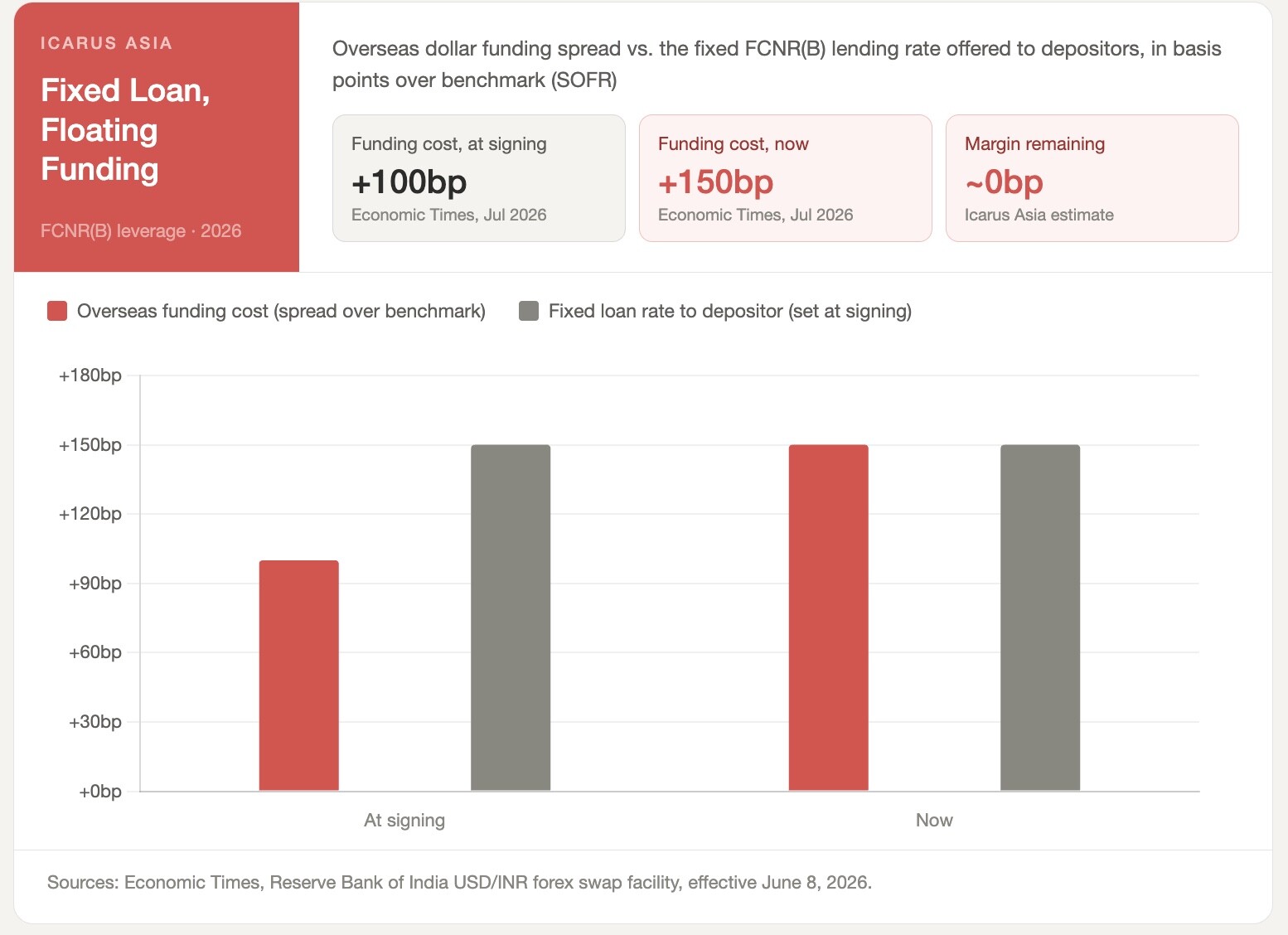
"The issue is the pricing of dollar funds, which is key to ensuring that high net worth individuals (HNIs) get enough leverage on their funds that will ultimately lead to double-digit returns," a banker involved in the program told India's The Economic Times this month. "But dollar funds — both on bonds and loans — have been more expensive as foreign banks are seeking a higher price," the banker told the Indian financial broadsheet. "So, what was available at 100 basis points above the benchmark rate is now costing 150 basis points over the benchmark rates, which has skewed the calculations."
The math behind that squeeze starts with the leverage banks have been marketing on top of the plain deposits.
A nonresident Indian puts up $1 million. An overseas branch of an Indian bank borrows roughly nine times that amount abroad, around $9 million, and lends it to the client, who places the full $10 million into an FCNR(B) deposit paying about 6 percent. She earns the full 6 percent on her own money and roughly half a percentage point on the borrowed nine. Banks have advertised the blended result as returns near 14 percent.
A former banker who described the mechanics in a social media post this month argued that the branch extending that loan is running a fixed-rate, five-year asset against a funding cost that floats, and has already moved against it.
"A fixed loan rate is not just a protection for the depositor but also an obligation on the bank," the banker said. "No institution absorbs negative carry for five years by choice." The risk, in the post's words, "migrates out of the rate column and into the documentation... into recall provisions, covenant thresholds, material adverse change language."
The funding strain shows up elsewhere in Indian banks' dollar borrowing. State Bank of India and Bank of Baroda both pulled back planned dollar bond issues last month after investors demanded wider spreads than the banks were willing to pay. HDFC Bank went ahead with a $750 million offering of five-year bonds, pricing them at 90 basis points over the five-year U.S. Treasury yield, described as the tightest spread achieved by any private Indian bank on record.
None of this helps with the risks associated with the program.
Interest on a plain FCNR(B) deposit is exempt from Indian income tax under Section 10(15)(iv)(fa) of the Income Tax Act, as long as the depositor holds nonresident or "resident but not ordinarily resident" status, and no tax is withheld at source. Both principal and interest can be freely repatriated. The former banker's post made the same point to would-be depositors directly: "Your own $1 million earns 6%, tax-free in India. That is real, and it needs no leverage."
The swap facility itself was built to fix a narrower problem.
Nonresident Indian deposit inflows had been sluggish for years, at a time when the central bank has been working to bolster foreign exchange reserves. Under the facility, the Reserve Bank bears the currency-hedging cost that banks would otherwise absorb themselves on fresh FCNR(B) deposits with three-to-five-year terms, provided the deposits are mobilized before September 30.
It removed currency risk from the banks' side of the ledger. It left funding risk in place.
For anyone weighing the leveraged version, the former banker asks a pertinent question.
Under what conditions can the facility be recalled, repriced or unwound before maturity, and what happens to the deposit if that happens. It answered its own question about the 14 percent being sold. "The 14% isn't a return," it said. "It's a residual. And residuals are the first thing to go."
The author is the Head of Risk and Analysis at Icarus Asia, an Asia-focused risk and advisory consultancy.