
News · Banks · India, Hong Kong
By sparing the rod on PwC, regulators risk spoiling the profession
Regulators across five continents have sanctioned the firm for professional negligence, lapses in detecting fraud, and compromised independence over some two decades. But far from an apology, PwC's leaders haven't even…
Regulators across five continents have sanctioned the firm for professional negligence, lapses in detecting fraud, and compromised independence over some two decades. But far from an apology, PwC's leaders haven't even expressed contrition.
PricewaterhouseCoopers, one of the world's four dominant audit firms, has accumulated financial penalties, settlements, and lawsuit judgments exceeding $1 billion after regulators in the United States, United Kingdom, India, Hong Kong, and Australia found the firm repeatedly failed to perform its basic duty as a public watchdog.
The breadth of the record is striking.
In every major jurisdiction where PwC operates, regulators have cited the same core failures: auditors who accepted management's word without independent verification, partners whose consulting ambitions compromised their independence, and quality control systems that either missed or tolerated the problems. The cumulative weight of the findings has prompted regulators to move beyond fines toward structural remedies--practice bans, mandatory client limits, and, in Australia, a criminal investigation--signaling that the profession's longstanding defense that auditors are not fraud investigators is losing traction.
Evergrande: 'Egregious' Failures in China's Biggest Collapse
The most consequential recent case involves China Evergrande Group, the property developer whose $300 billion debt implosion sent shockwaves through global credit markets. PwC served as Evergrande's auditor from the company's 2009 listing through 2023. Hong Kong's Accounting and Financial Reporting Council (AFRC) found that PwC had "actively acquiesced to manipulation" by Evergrande's management, ignoring site inspection results that showed properties described as ready for handover were still under construction and permitting unjustified accounting entries that inflated the developer's reported profits year after year. [1]
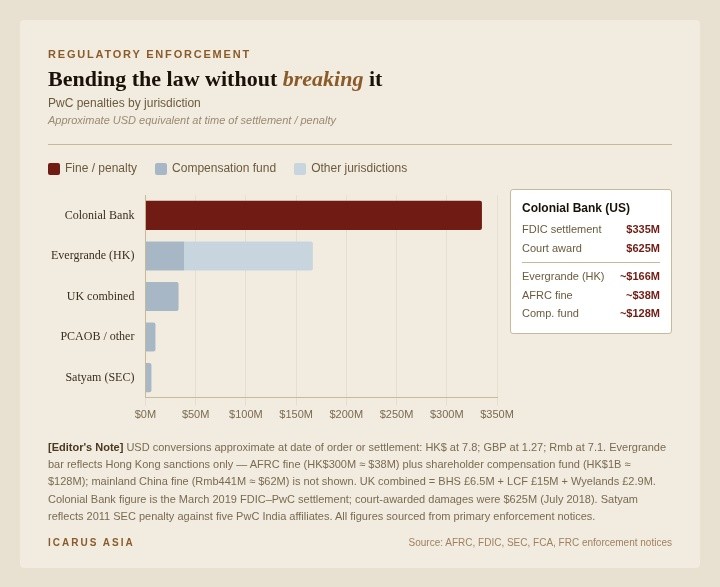
Regulators in both mainland China and Hong Kong imposed historic sanctions in 2024 and 2025. Beijing levied a RMB441 million ($62 million) fine and imposed a six-month ban on auditing state-owned companies. Hong Kong added a HK$300 million fine, a six-month prohibition on taking new public-interest entity clients, and required PwC to set aside HK$1 billion to compensate minority shareholders who lost money on the falsified statements. [1] [2] [3]
The collapse of the China franchise also triggered a leadership rupture.
Raymund Chao, who headed PwC's Asia-Pacific and China operations throughout the firm's decade-long relationship with Evergrande, departed in July 2024. An anonymous internal letter circulated in April of that year alleged that Chao had prioritized maximizing partner earnings, reportedly taking home HK$50 million annually, over effective risk management. The letter's claims have not been independently verified and PwC China said the letter it contained “inaccurate statements and false allegations.” After Chao's exit, Daniel Li, a partner from the Chinese mainland, briefly took over before U.K. senior partner Hemione Hudson was brought in to manage the crisis. According to people familiar with the matter, Chao has since withdrawn his partnership capital and relocated abroad. [4] [5] [6]
Colonial Bank: A Court Finds Negligence, a Settlement Avoids Admission
In the United States, PwC's audit of Colonial Bank produced one of the largest professional negligence judgments ever entered against an accounting firm. Colonial collapsed in August 2009, one of the biggest U.S. bank failures since the 1980s, after its largest mortgage client, Taylor Bean & Whitaker, sold it hundreds of millions of dollars of non-existent or worthless mortgage assets.
The Federal Deposit Insurance Corporation, acting as receiver, sued PwC for repeatedly issuing clean opinions while the fraud was ongoing. In December 2017, a federal judge in Alabama concluded that PwC had not designed its audits to detect fraud and had failed to perform adequate checks on whether the underlying mortgages actually existed. A jury later awarded the FDIC $625 million in damages. [7]
PwC settled in March 2019 for $335 million, without admitting liability.
FDIC board member Martin Gruenberg voted against authorizing the settlement, saying PwC's negligence "contributed directly to the failure of Colonial Bank and large losses to the Deposit Insurance Fund." The total estimated loss to the FDIC insurance fund from Colonial's failure was $2.96 billion. [7] [8] [9]
India's Satyam: A Decade of Forged Bank Statements
The failure that established the template for PwC's subsequent troubles came in January 2009, when Satyam Computer Services founder B. Ramalinga Raju confessed to inflating the company's accounts by more than $1 billion. PwC's Indian affiliate, Lovelock & Lewes, had audited Satyam for nearly a decade without detecting that the company was falsifying 6,603 invoices and maintaining $1.2 billion in fictitious cash balances that did not exist.
The Securities and Exchange Board of India found that PwC had relinquished control of cash confirmation letters to Satyam's own management, allowing company insiders to provide forged bank statements. SEBI called the work an "eyewash of an audit exercise."
The U.S. SEC sanctioned five Indian PwC affiliates in 2011 and extracted a $6 million fine--at the time the largest ever imposed on a foreign accounting firm--along with a six-month ban on accepting new U.S.-listed clients. The Public Company Accounting Oversight Board (PCAOB) separately fined Lovelock & Lewes and PwC Bangalore a combined $1.5 million for violations of its auditing standards. The PCAOB is a nonprofit corporation created by in the wake of the Sarbanes-Oxley Act of 2002 to oversee the audits of US-listed public companies. India's market regulator separately imposed a two-year ban on PwC from auditing listed companies. [10] [11]
A Pattern of Failures Across the United Kingdom
British regulators have compiled their own catalog of PwC lapses.
The Financial Reporting Council fined the firm £6.5 million in 2018 after finding that lead audit partner Stephen Denison devoted just two hours of work to the BHS audit before signing off on the retailer as a "going concern." BHS was sold for £1 shortly afterward and entered administration two years later with £1.3 billion in debts and a £571 million pension deficit. Denison was banned from audit work for 15 years. [12]
In August 2024, the Financial Conduct Authority imposed the first fine it had ever levied against an audit firm, charging PwC £15 million for failing to report suspicions of fraud at London Capital & Finance. The mini-bond firm collapsed in 2019, wiping out thousands of retail investors. The FCA found PwC had encountered clear red flags during its 2016 audit--including aggressive behavior from LCF executives--but never reported its concerns. [13]
Australia: Confidences Sold, Government Contracts Lost
The most reputationally damaging episode unfolded in Australia in 2023, when it emerged that a senior PwC partner, Peter Collins, had shared confidential government tax policy information with colleagues across the firm's global network. PwC had been retained by Australia's Treasury to advise on new multinational tax avoidance rules; Collins' colleagues used the advance intelligence to win consulting contracts helping multinationals structure around those same rules. A Senate inquiry described the conduct as "a sickening example of a lack of integrity." [15] [16]
The scandal forced PwC Australia to sell its government consulting business for $1 to private equity firm Allegro Funds, creating a new entity called Scyne Advisory, and triggered the resignation of the CEO and eight partners. In October 2024, the Australian Federal Police raided PwC's Sydney headquarters after investigators concluded the firm's international arm was withholding information about the full scope of the leak. [14] [17]
Cheating Exams, Cutting Corners
Underlying each local failure is a broader institutional pattern that regulators at the PCAOB have documented in serial enforcement actions. Between 2021 and 2025, the PCAOB fined PwC member firms in the Netherlands ($3 million) and Israel ($2.75 million) for widespread sharing of answers on mandatory internal training exams covering ethics, independence, and auditing standards, with Singapore and Australia facing separate quality control sanctions. [18] [19]
The PCAOB's 2024 inspection of U.S. PwC audits found deficiencies in 15.6% of reviewed engagements--a rate that has fluctuated between 2% and 30% over the previous six inspection cycles. The persistent recurrence of the same categories of failure, particularly in revenue recognition and estimates, suggests that the firm's repeated remedial commitments to regulators have not produced lasting change.
"If the individuals responsible for auditing the financial statements of public interest entities are willing to subvert their own professional certification processes," regulators noted in the PCAOB enforcement filings, the reliability of their audit opinions is itself called into question.
The cumulative bill is rising.
Between Colonial Bank's $335 million settlement, Evergrande's HK$1.3 billion in fines and compensation, the Satyam, BHS, and LCF penalties, and the PCAOB enforcement actions, direct financial costs now approach $2 billion. On the face of it, this might seem like a sizable amount. Until you realize that PwC reported a record global gross revenue of $56.9 billion for the fiscal year ending June 30, 2025, representing a 2.7% growth in local currency.
Regulators in the UK are still pressing forward with the proposed Audit, Reporting and Governance Authority, which would give statutory overseers broader powers to break up firms that fail repeatedly.
Until then, firms like PwC will have no incentive to change.
A rap on the knuckles is no rod.
-- The author is the Head of Research and Analysis at Icarus Asia, a Hong Kong-based risk and advisory firm.
References
[1] Accounting and Financial Reporting Council. AFRC Imposes HK$300 Million Fine and Six-Month Practice Limitation on PricewaterhouseCoopers over the Evergrande Audits. AFRC Press Release.
[2] Bloomberg Law. HK to Limit PwC Practice for 6 Months Over Evergrande Audit.
[3] South China Morning Post. PwC to Pay HK$1 Billion to Evergrande Minority Shareholders over Audit Failures.
[4] Business Standard. PwC Names In-House Executive as its New China Head amid Regulatory Scrutiny. July 3, 2024.
[5] The Irish Times. PwC China Crisis Looms after Audit of Evergrande. May 22, 2024.
[6] Caixin Global. In Depth: PwC's Evergrande Crisis Deepens With Record Hong Kong Settlement and Criminal Probes. April 28, 2026.
[7] Federal Deposit Insurance Corporation. FDIC Settles with PricewaterhouseCoopers LLP on Audits of a Failed Bank. Press Release, March 15, 2019.
[8] Federal Deposit Insurance Corporation. Dissent from Settlement with PricewaterhouseCoopers LLP for Accounting Malpractice at Colonial Bank. Martin J. Gruenberg, March 15, 2019.
[9] Federal Deposit Insurance Corporation. FDIC Settles with PricewaterhouseCoopers LLP on Audits of a Failed Bank. Press Release, March 15, 2019.
[10] U.S. Securities and Exchange Commission. SEC Charges India-Based Affiliates of PwC for Role in Satyam Accounting Fraud. Press Release 2011-82, April 5, 2011.
[11] Public Company Accounting Oversight Board. PCAOB Announces Settled Disciplinary Order Against PricewaterhouseCoopers International Firms in India for Audit Violations Related to Satyam.
[12] Financial Reporting Council. Sanctions against PwC and Former Audit Partner in Relation to BHS. June 2018.
[13] Financial Conduct Authority. PwC Fined £15 Million for Failing to Alert the FCA to Suspected Fraudulent Activity at London Capital & Finance plc. August 16, 2024.
[14] Accounting Times (Australia). PwC Scandal Persists with AFP Office Raid. October 2024.
[15] Parliament of Australia, Senate Finance and Public Administration Committee. PwC: The Cover-up Worsens the Crime.
[16] Tax Practitioners Board (Australia). Former PwC Partner Banned for Integrity Breach.
[17] Al Jazeera. PwC Australia Sells Advisory Business amid Tax Leak Scandal. July 4, 2023.
[18] Public Company Accounting Oversight Board. PCAOB Sanctions PwC Israel for Quality Control Violations Related to Widespread Improper Answer Sharing. February 2025.
[19] CPA Practice Advisor. PCAOB Doles Out $8.5M in Total Fines to Most of the Big Four's Dutch Affiliates for Exam Cheating. June 25, 2025.